Organizing a Family With Twins or Multiples
How to organize a family with twins or multiples: merge what you can, split what you must, and keep one shared calendar and chore list everyone sees.
By Famiyo Editorial Team6 min read
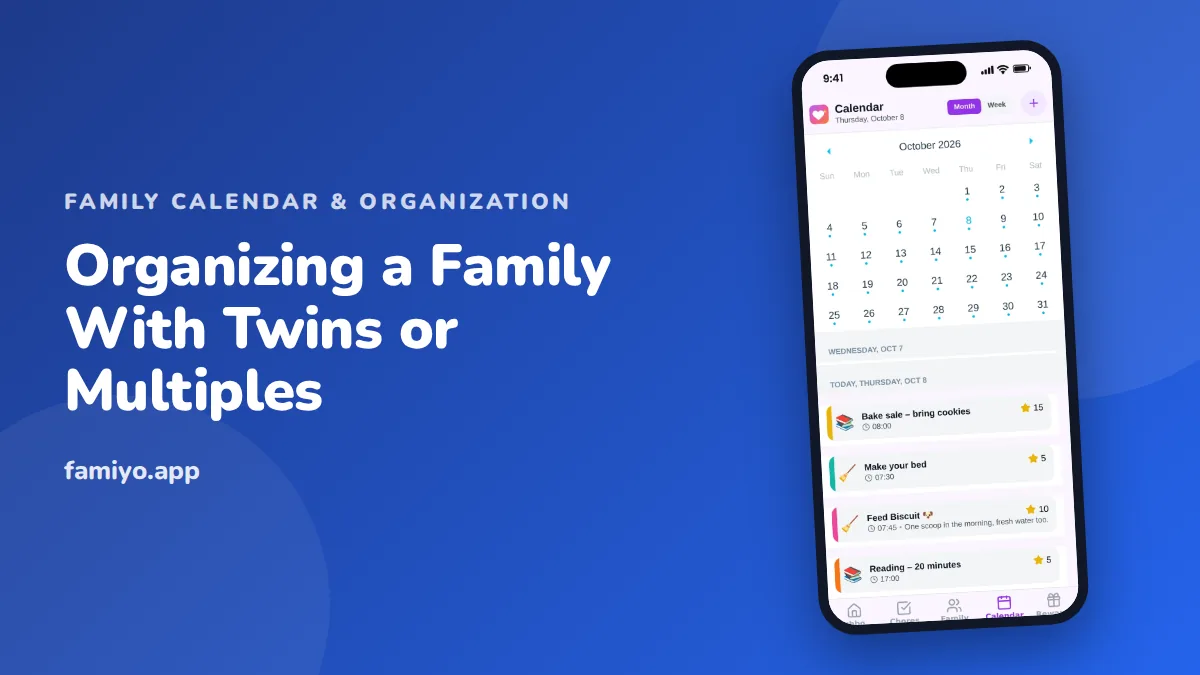
With one child, a missed nap is a small problem. With two the same age, it happens twice and at the same moment, and the same goes for the doctor visit, the permission slip and the birthday party. Families with twins or higher multiples are not less organized than other families. They just feel every gap double. This guide shows what to merge, what to keep separate, and how to set up the planning so it stays manageable as the children grow.
What changes when you have twins or multiples
Everything that other families do once a day, you do two or three times in the same ten minutes. Bath time, a school form, a lost shoe. At the same time, everything that is hard for other families to coordinate, like same-age friends or a shared class schedule, comes for free.
So the organizing principle is simple. Look for the things that can be done once, and do them once. Then protect, on purpose, the things that need to be separate. Twins also say, loudly and sooner than most siblings, "that's not fair". A visible system settles most of those arguments before they start.
What to merge and what to keep separate
Start by sorting your week into two lists. This table is a starting point, and your own sort will look a little different.
| Do once for everyone | Keep individual |
|---|---|
| Meals, snacks, packed lunches | One-on-one time with each parent |
| Wake-up, nap and bedtime rhythm (in the baby and toddler years) | Activities each child actually chooses |
| Doctor, dentist and school appointments, booked back to back | Friends, playdates and birthday parties |
| School runs, pickups, drop-offs | A few belongings each child owns outright |
| Family rules and the chore list | Points, rewards and praise |
| Weekly planning, one shared calendar | Clothes and gear that are clearly labeled |
The right-hand column is the one most parents skip. Twins who are always treated as a unit can lose out on their own interests and their own wins. A short stretch alone with a parent each week costs little and often settles more than any rule does.
Setting up one calendar for two or more children
Two separate calendars hide clashes. One calendar with a color for each child shows them in seconds, because you see two colors stacked on the same Tuesday at 4:00.
- Give each child a color and keep it forever. Add a color for the whole family and one for each parent.
- Put every appointment, practice, party and school date on it, including the ones that only concern one twin.
- Add the travel time as a separate entry or in the title. "Soccer 4:00 (leave 3:30)" saves a rushed afternoon.
- Mark the weekly one-on-one slots so they do not get filled by something else.
- Give every adult who helps (the other parent, a grandparent, a sitter) access, so nobody has to ask what is on.
If you are choosing a tool, our overview of the best family organizer apps compares the options side by side. For the habits behind it, mom hacks to make life easier has small routines that work with any setup.
The weekly 15-minute plan
Pick one fixed time each week, say Sunday after the kids are in bed, and sit down with the calendar for 15 minutes. Both parents, if there are two.
Check the days ahead for three things: double bookings (two events, one driver), the days that are too full, and the gaps where one-on-one time can go. Then look at the week's meals and the forms due. Write down what has to be bought, signed or booked. That is all.
With school-age twins, add the children to this meeting once they can read a calendar. Our family meeting agenda topics give you a short running order, and a child who has helped decide the week argues less about it.
When the twins start school
School brings the first real split. Some families ask for the same class so the children share a rhythm, and others prefer separate classes so each child builds their own friends. Either is fine, and the calendar only needs one extra habit: when the two classes send different notes, put both on the calendar with the child's color.
Two backpacks, two folders and two sets of homework need two homes by the door. Use one labeled bin or hook per child, and do the 5-minute bag check together the night before. Birthday parties are the other trap. If both are invited, it is usually one of you in two places, so decide ahead who takes which, and book it in advance.
Chores and fairness between same-age siblings
Twins compare. If one takes out the trash and the other waters the plants, expect a debate about which is harder. Answer it before it starts.
- Use the same size of job for each child. A 10-minute job for one is a 10-minute job for the other.
- Rotate the jobs every two to four weeks, so nobody is stuck with the bathroom forever.
- Give each child their own points or check marks. A shared reward for a shared job is fine, but each child should see their own progress.
- Match the chore to the child, not to the twin. If one is ready for a harder job, that is allowed, and it should be worth more.
The age ranges in our guide to age-appropriate chores for kids apply to each child separately. Same birthday does not always mean the same skills.
Doing the daily routine with two (or three) at once
With babies and toddlers, the most useful habit is a shared rhythm. If one wakes up, wake the other and feed them together. It feels wrong the first time and then it saves hours. Keep a simple log of feeds, naps and medicine for each baby in one place that both adults can see, so a hand-off does not depend on memory.
With older children, think in stations rather than rooms. A hook, a shoe spot and a bin for each child at the door means getting out of the house takes minutes. Label cups, water bottles and bags, since identical things lead to arguments. Lay out the next day's clothes at night, for both.
Outside help counts as a system too. A regular sitter, a grandparent on a fixed afternoon or a neighbor swap is easier to keep going than a favor asked at the last minute.
One calendar and one chores list in Famiyo
Famiyo is a free family app for iPhone and Android that combines a shared family calendar, chores with points and a rewards shop; kids join with a code, no email needed. For a family with multiples, the useful part is that everyone sees the same screen: every child has their own color, so two events at the same hour stand out, and both parents see changes live on their own phones. Chores can be worth points, and each child can earn their own number for the same task.
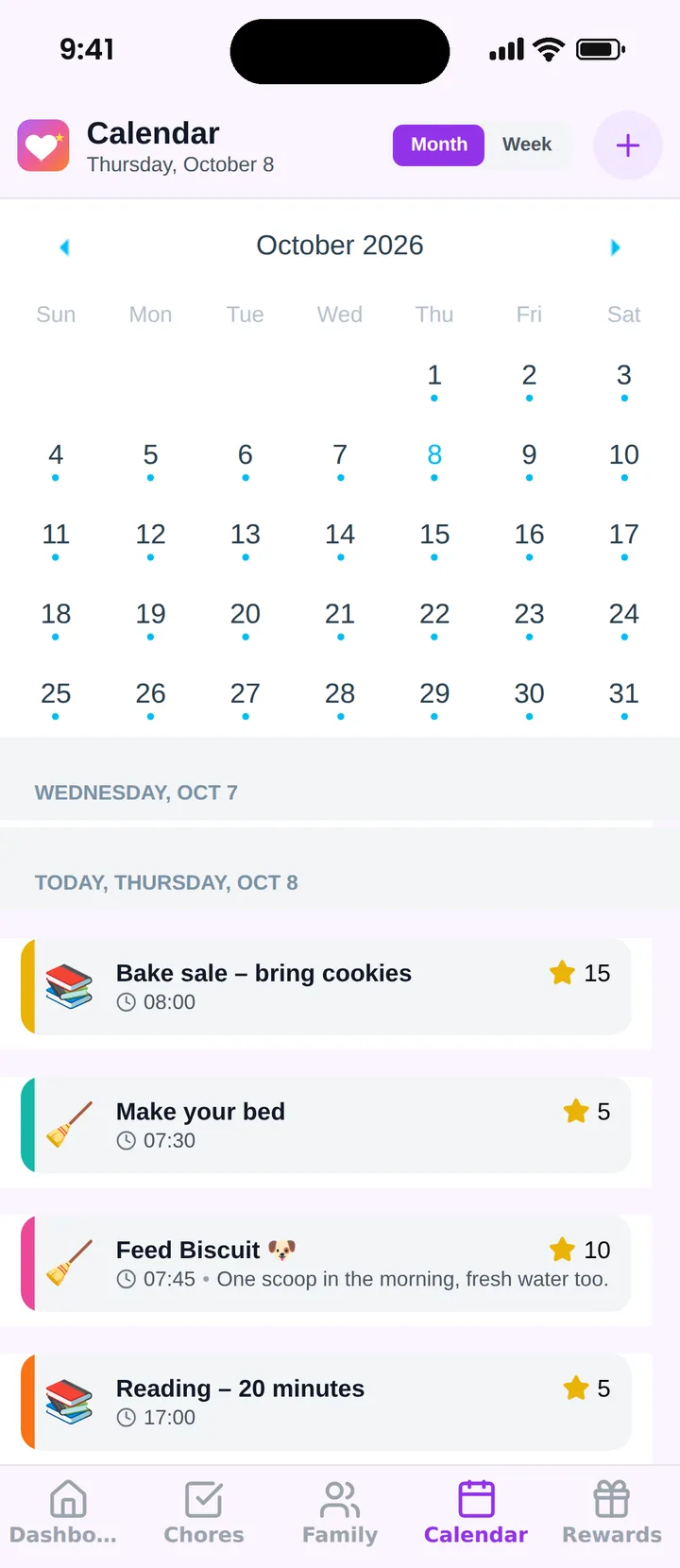
The free plan covers up to 3 family members, so a family of five will want to look at the Premium option first.
Start with one change
Pick the single place where the week feels doubled, probably the calendar or the morning, and fix that first. Try the 15-minute plan for three Sundays in a row. If the planning always lands on one parent, read mental load in relationships and split it before it wears anyone down.
Frequently asked questions
How do you organize a house with twin babies?
Run both babies on the same rhythm for sleep and feeding as far as you can, keep supplies in two or three stations instead of one nursery, and write down each baby's feeds and naps in one shared place so either adult can step in without asking.
Should twins have separate calendars?
One calendar with a different color for each twin works better than two. You see clashes at a glance, such as two events at the same hour, and each child still has their own identity. Add a third color for shared family plans.
How do you give twins one-on-one time?
Schedule it like any other appointment. Fifteen to thirty minutes a week with each child alone, for a walk, an errand or a bedtime story, is realistic for most families. Put it on the calendar so it survives a busy week.
Do twins need the same chores?
They can share a chore list, but each child should own specific jobs and earn their own points. Same-age siblings compare everything, so make the rule visible: same size of job, same value, rotated every few weeks.
How do you handle two sets of activities and appointments?
Book twins into the same slot wherever the doctor, dentist or school allows it. For activities, try the same day or the same venue first. Where interests differ, accept that the calendar will be busier and plan the drive time in.
Try Famiyo With Your Family
Chores with points, a rewards shop for kids and one shared family calendar. Set it up in a couple of minutes.



Free to download • No credit card required • Available on iOS & Android