Responsibility Chart for a 9-Year-Old: What to Include
A responsibility chart for a 9-year-old with seven age-fit tasks, a points scale and rewards, plus a free printable weekly chart to start using today.
By Famiyo Editorial Team4 min read
Free printable
My Responsibility Chart
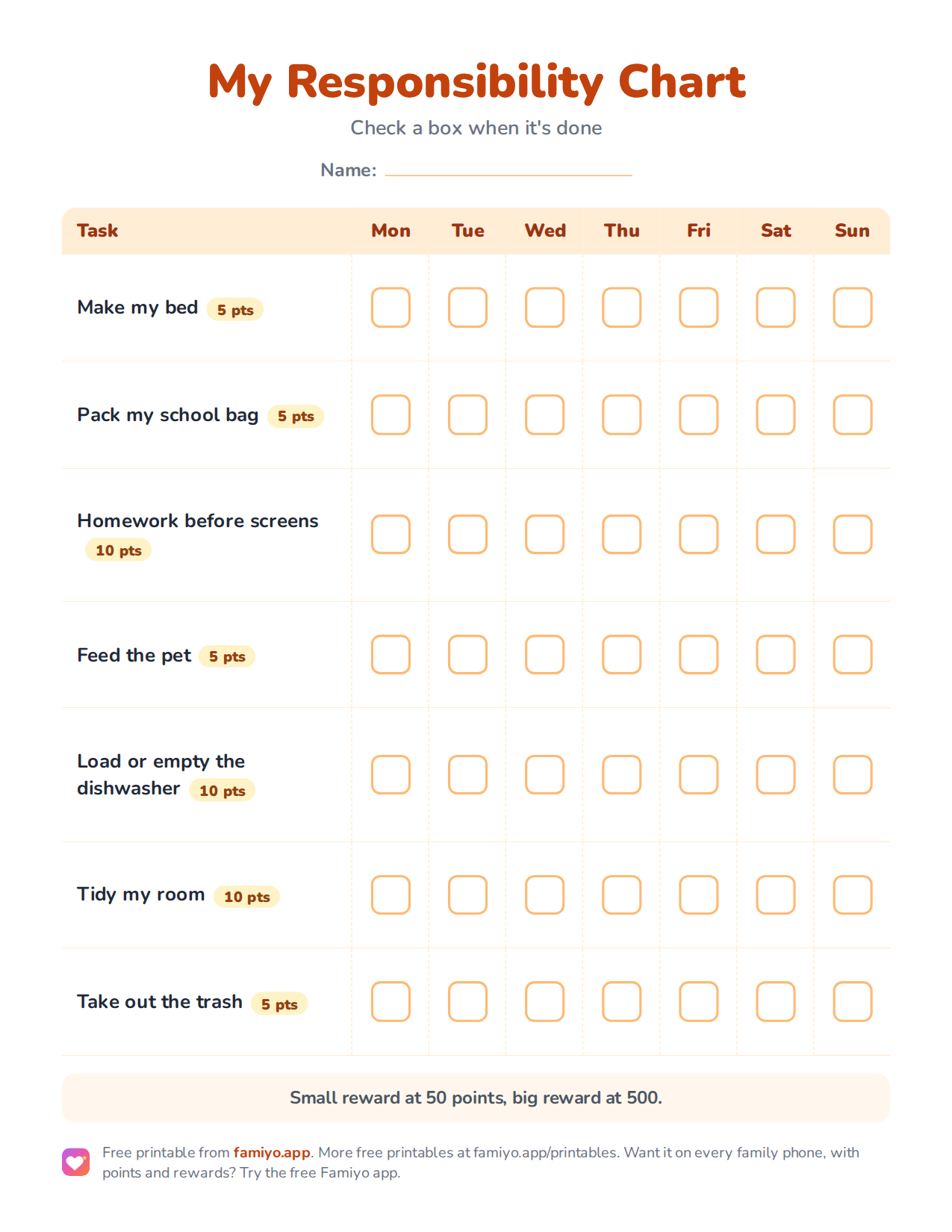
A weekly chart on one US Letter page. Download the PDF to print it, or save the image to use it on a tablet or in a document.
Free for home, classroom and nonprofit use, see the license. More free printables.
Nine is a turning point. Your child can follow a plan without you standing next to them, cares about being fair, and mostly wants to be treated as a bit more grown up. A responsibility chart fits this age because it puts a lot of the keeping-track in their hands. Here's what a 9-year-old can reasonably handle, how to share the tasks out, what the points should look like, and a printable weekly chart.
What a 9-year-old can take on
At 8 to 9, children can usually load the dishwasher, fold and put away laundry, vacuum a room, make a simple snack and take out the trash. That's roughly 20 to 30 minutes a day, which is a good ceiling. A nine-year-old also has a longer attention span than a few years ago, can hold a short list in their head and is starting to plan ahead by a day or two.
What they still need is a visible list, a regular time for each task and an adult who notices. Many 9-year-olds will promise to remember and then forget by dinner. That isn't laziness. The part of the brain that plans and starts tasks is still developing, and a chart carries that load while it builds.
If this chart feels a step too easy or too hard, see the chore chart ideas for 8-year-olds for a gentler version.
Responsibilities worth putting on the chart
Think in three groups: looking after yourself, helping the household and looking after something else. Each group teaches something different, and a good chart has a mix.
| Area | Tasks for a 9-year-old | What it builds |
|---|---|---|
| Own stuff | Make the bed, pack the school bag, tidy the room, put laundry in the hamper | Ownership of their own space and things |
| Schoolwork | Start homework before screens, put finished work in the bag | Planning and follow-through |
| Household | Load or empty the dishwasher, take out the trash, set the table | Contribution to the family |
| Caring for others | Feed a pet, water plants, help a younger sibling find shoes | Noticing what someone else needs |
| Weekly bigger job | Vacuum one room, fold a load of laundry, change their sheets | Longer tasks with a start and a finish |
Start with three or four daily tasks, drawn from at least two groups. Add a weekly bigger job once the daily ones are mostly running on their own.
How many points, and what for
Keep it simple. Small tasks of 2 to 5 minutes, such as making the bed or feeding the pet, are worth 5 points. Medium ones of 10 to 15 minutes, such as loading the dishwasher or tidying the room, are worth 10. A bigger job of 30 minutes or more, such as vacuuming the whole floor, is worth 20. An extra 2 points when they do it without a reminder rewards exactly the habit you're after.
Then price the rewards so a small one is within reach every 2 to 3 days: 30 to 50 points for 15 extra minutes of screen time or choosing dessert, 100 points for picking the family movie, and 300 to 500 points for a bigger treat such as a day out. Let your 9-year-old help write the reward list. At this age, a say in the prizes does a lot of the motivating.
The printable chart
The printable below has seven tasks down the side and a box for each day of the week. It suits a 9-year-old who's ready to manage their own list. You don't need every task every day. Cross out the boxes that don't apply (the trash on days it isn't collected, the dishwasher on the day someone else does it), and write the points in your own handwriting if you change them.
Three tasks are daily by design: making the bed, packing the school bag and starting homework before screens. That's 20 points a day. The others are set days of your choosing. A good week lands around 200 points, so a small reward arrives every few days and the 500-point reward takes a few weeks.
Let your child color or check the boxes themselves. If they get to mark it, the chart belongs to them.
How to introduce it
- Sit down together and read the list aloud. Ask, "Is there anything on here you think is unfair? Anything missing?"
- Agree on a time for each task. "Bed before breakfast. Bag before bed."
- Hang the chart where your child will see it every day, at eye level.
- Check it together in the evening for the first two weeks, two minutes, no lectures.
- When they forget, ask a question: "What's next on your chart?" It puts the thinking back on them.
If you'd like more ways to get cooperation without nagging, how to get kids to do chores without asking goes through them. Family rules also help, and household chores rules is a good place to start.
A digital version in Famiyo
Famiyo is a free family app for iPhone and Android that combines a shared family calendar, chores with points and a rewards shop; kids join with a code, no email needed. The printable's seven tasks become repeating chores with the same points, and your 9-year-old sees only their own list on their own phone, along with the points they've earned.
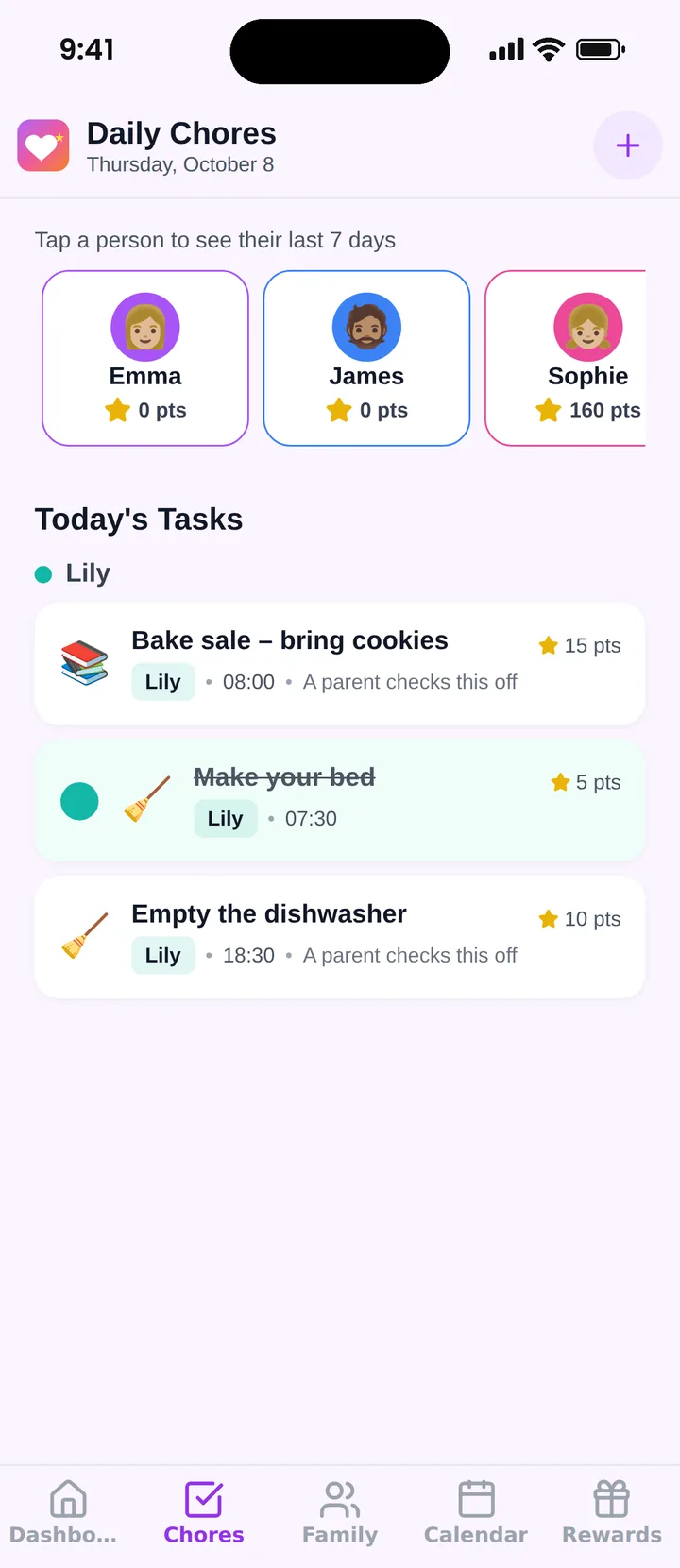
You choose whether a parent approves each task or your child checks it off, and you can set up a rewards shop with prices in points. Compare tools in our list of the best chore chart apps.
Frequently asked questions
What responsibilities can a 9-year-old have?
Most 9-year-olds can make their bed, pack their school bag, do homework, load the dishwasher, fold and put away laundry, take out the trash, feed a pet and vacuum one room. Plan about 20 to 30 minutes a day, and add one bigger weekly job.
How many tasks should be on the chart?
Three or four daily tasks, plus one weekly bigger job from age 8. The printable lists seven so you can pick which ones run daily and which only on set days. More than four on any one day usually feels like too much.
Should a 9-year-old be paid for a responsibility chart?
Not for the basics. Keep daily responsibilities as part of belonging to the family, and use points toward small rewards. If you want to pay, reserve it for extra jobs such as washing the car. Points can convert at 100 points to $1.
What if my 9-year-old forgets everything on the chart?
Put the chart where the tasks happen, link each task to an existing habit such as breakfast, and keep the list short. Remind by asking, 'What's next on your chart?' rather than giving the instruction. Give it 2 to 3 weeks before judging it.
Try Famiyo With Your Family
Chores with points, a rewards shop for kids and one shared family calendar. Set it up in a couple of minutes.



Free to download • No credit card required • Available on iOS & Android