Behavior Chart for a 3-Year-Old: How to Make It Work
How to build a behavior chart a 3-year-old understands: two or three positive behaviors, a sticker right away, a fresh start daily, plus a free printable.
By Famiyo Editorial Team5 min read
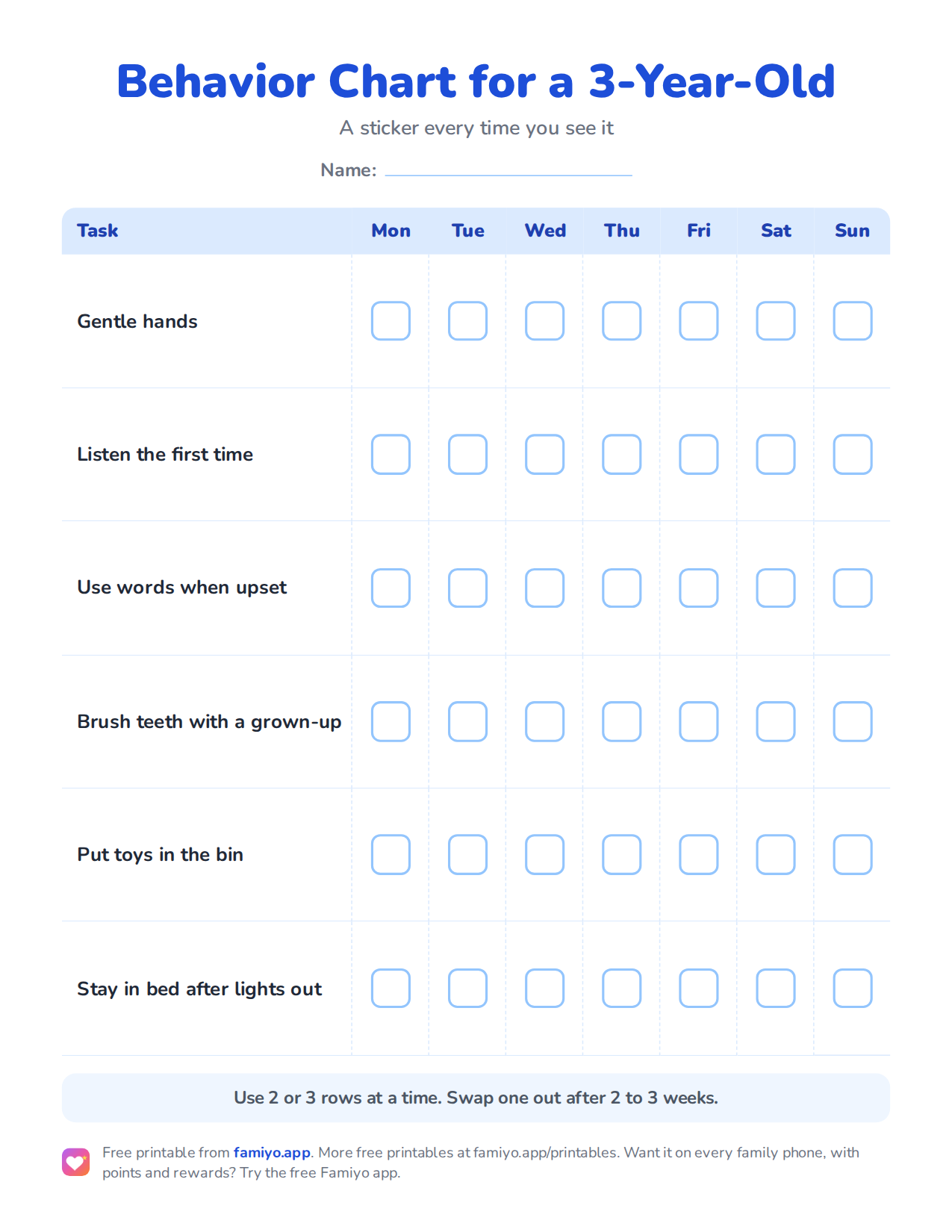
Free printable
Behavior Chart for a 3-Year-Old
A weekly chart on one US Letter page. Download the PDF to print it, or save the image to use it on a tablet or in a document.
Free for home, classroom and nonprofit use, see the license. More free printables.
Three-year-olds hit their siblings, melt down in the cereal aisle, climb out of bed at 9 p.m. and then hand you a squashed dandelion with total sincerity. A behavior chart can help with the first three, but only when it's built for how a 3-year-old thinks. Below you'll find what to track, how to run the chart each day, the exact words to use and a printable you can fill in tonight.
What a 3-year-old can understand about a chart
At three, a child lives almost completely in the present. "If you're good all week, you get a prize" means very little, because a week isn't something they can hold in their head. What they do understand is a quick cause and effect: I did the thing, I got the sticker. Most can also follow a simple "first this, then that," and they love seeing proof of their own success stuck to the fridge.
What they can't do yet is judge whether they had a "good day" overall, remember a morning rule at the playground that afternoon without a cue, or cope calmly with losing something they already earned. A chart that asks for any of those will fall apart within days.
So a chart for this age needs to be small (two or three behaviors), visible (at your child's eye level), immediate (the sticker goes on within seconds) and concrete (a picture for each row). The American Academy of Pediatrics' guidance on discipline puts a lot of weight on noticing and praising the behavior you want to see. A sticker chart is a structured, visual way of doing exactly that.
Picking the behaviors to track
Write each behavior as what your child should do, not what they should stop doing. "No hitting" names the hitting. "Gentle hands" names the goal, and that's the picture your child carries around.
| What you're seeing | What goes on the chart | When it earns a sticker |
|---|---|---|
| Hitting or pushing a sibling | Gentle hands | A play stretch before snack, lunch or dinner with no hitting |
| Ignoring requests | Listen the first time | Does a simple request after one ask, like "shoes on" |
| Screaming when frustrated | Use words when upset | Says "I'm mad" or "help me" instead of screaming, even loudly |
| Toothbrushing fights | Brush teeth with a grown-up | Opens up and lets you finish brushing |
| Toys everywhere | Put toys in the bin | Toys are in the bin before bath |
| Bedtime escapes | Stay in bed after lights out | Still in bed in the morning (sticker at breakfast) |
Choose one behavior your child already does fairly often, like putting toys in the bin, and one or two that are harder. The easy row guarantees stickers on day one, which is what makes a 3-year-old want to keep going. For more ideas on what children this age can help with at home, our list of age-appropriate chores for kids starts at age 2.
Setting it up in one evening
- Pick two or three behaviors and draw a simple picture next to each: two hands, a toothbrush, a bed.
- Put the chart on the fridge or a door at your child's eye level, with the stickers nearby but out of reach.
- Introduce it at a calm moment, not right after a meltdown. Try: "This is your chart. Every time you use gentle hands, you get to put a sticker here."
- Practice once. Let your child show gentle hands on a teddy bear and give the very first sticker for the practice.
- During the day, give the sticker right away and name what you saw: "You were mad at your brother and your hands stayed gentle. That's a sticker."
- At bedtime, count the stickers together and hand over the small reward if they reached it.
- Start a fresh row the next morning, no matter how the day went.
What to say when things go wrong
The words matter more than the stickers. A 3-year-old who gets a lecture every time they miss a sticker will start to hate the chart.
When they don't earn one, keep it short and point forward: "Not this time. You'll get another chance after snack." Then move on. When they ask for a sticker for something that isn't on the chart, like sharing a toy, you can say: "That was kind. That one gets a high five." This keeps the chart focused without ignoring the good moment.
Never peel a sticker off as a punishment. Once it's earned, it stays. If a consequence is needed, handle it separately and calmly, and let the chart stay the place where only good things happen.
Rewards a 3-year-old actually cares about
At this age, the best rewards are small, daily and involve you. An extra bedtime story, choosing the bath toy, picking the cup for breakfast, a few extra minutes of chase in the yard. Save toys and treats for rare occasions, or the chart quickly becomes a shopping list.
For the first week or two, link the reward to the same day: two or three stickers means an extra story tonight. Once your child is winning most days, you can add a bigger reward that takes two days of stickers, like a trip to the park with a parent. Waiting longer than that usually comes later, around age 5 or 6.
When the chart stops working
Interest fading after a week is normal. Change the sticker type or redraw a picture, but keep the behavior. If your child melts down every time a sticker is missed, the target is too big: shrink it to "gentle hands until snack" instead of all morning.
If an older sibling wants a chart too, give them real jobs with points instead, the way a kids chore tracker works, so both charts feel fair without being the same.
Give any new chart 2 to 3 weeks of daily use before judging it. When a behavior happens almost every day without help, retire it out loud ("You don't need a sticker for gentle hands anymore, you've got it") and add the next one. If hitting, biting or tantrums are very frequent or intense, mention it at your child's next pediatrician visit.
Using the printable chart
The printable below has six behavior rows with a box for each day from Monday to Sunday. Use two or three rows at a time and cross out the others, or cut them off. It suits 3-year-olds and young 4-year-olds who are just starting with charts. Print a fresh copy every Monday so the whole week starts clean.
Running the same chart in Famiyo
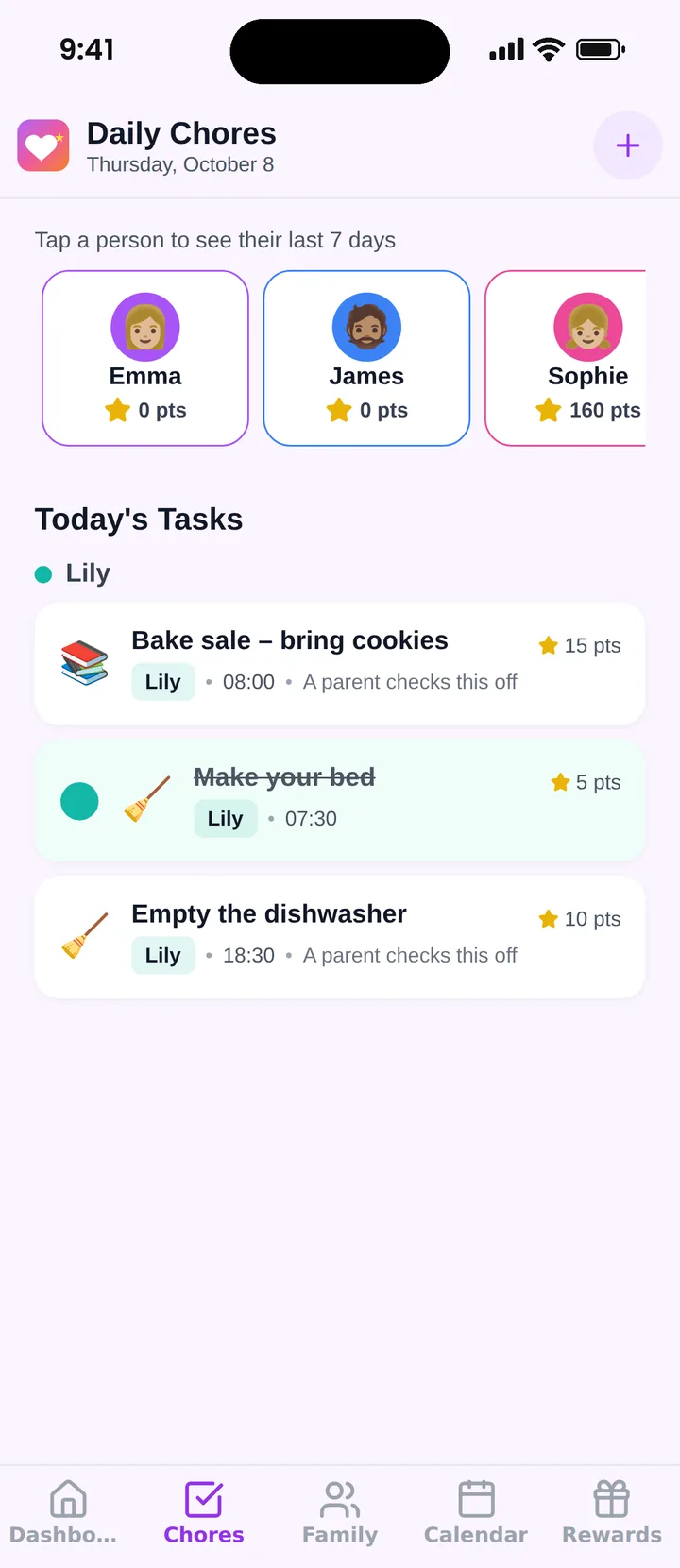
Famiyo is a free family app for iPhone and Android that combines a shared family calendar, chores with points and a rewards shop; kids join with a code, no email needed. For a 3-year-old, a parent runs it: add each behavior as a daily repeating task worth 5 points and set it so a parent approves it. Your child can watch their list and points on a family iPad, and the rewards shop can hold an "extra bedtime story" reward. The free plan includes one repeating task, so tracking two or three behaviors needs Premium. If you're comparing options, see our list of the best chore chart apps.
Tonight, pick the one easy behavior and the one that's driving you up the wall. That's enough for a first chart.
Frequently asked questions
Is a 3-year-old too young for a behavior chart?
No, as long as the chart is simple. Most 3-year-olds understand 'do this, get a sticker' when the sticker comes right away and the chart has pictures. What they can't handle yet is waiting a week for a prize or tracking five rules at once, so keep it to two or three behaviors and a daily payoff.
Should I take away a sticker when my 3-year-old misbehaves?
No. Once a sticker is earned, it stays. Taking stickers back turns the chart into something scary, and a 3-year-old usually reacts by refusing the chart entirely. Handle misbehavior separately with a calm, short consequence, and let the chart stay a place where only good things happen.
How many stickers should a 3-year-old need for a reward?
Start low enough that your child wins on the first day, often two or three stickers for a small bedtime reward like an extra story. After a week or two of steady success, you can add a bigger reward that takes two days of stickers. Long waits come later, around age 5 or 6.
How long should we use a behavior chart with a toddler?
Give the chart 2 to 3 weeks of daily use before you decide whether it works. Once a behavior happens almost every day without a reminder, retire it from the chart with some fanfare and swap in the next one. Most families rotate behaviors rather than stop the chart completely.
Try Famiyo With Your Family
Chores with points, a rewards shop for kids and one shared family calendar. Set it up in a couple of minutes.



Free to download • No credit card required • Available on iOS & Android