Household Chores Rules Every Family Should Agree On
Ten household chores rules for families, the exact words to use with kids, what to do when a rule gets broken and how to agree on them in one short meeting.
By Famiyo Editorial Team6 min read
Most chore fights aren't really about the dishes. They're about the rules nobody ever said out loud: what counts as done, when it's due, and whether "in a minute" means anything at all. Below are ten household chores rules you can adopt as they are, the words to use with kids, what to do when one gets broken (it will, probably by Wednesday) and how to get the whole family to sign on.
Why a chore list isn't enough
A chore list tells kids what to do. It says nothing about when, how well, or what happens if they don't. That gap is where every argument lives. Your 9-year-old "loaded the dishwasher" by putting four cups in it. Your teen will take the trash out "later," which in teen time can mean Thursday. Neither of them is lying. You just never agreed on the rules.
Rules fix that by settling the questions once instead of every evening. Kids are excellent negotiators, and a household without rules gives them something to negotiate every single day. A household with rules gives them a referee that isn't you.
10 household chores rules worth agreeing on
You don't need all ten. Pick the four to six that cover your family's most common fights, and add more later.
- Done means done the way we agreed. Write the standard down for each job. "Dishwasher loaded" means plates facing in, cups on the top rack, door closed and the counter wiped. A child can't hit a target nobody described.
- Chores come before screens. Not as a threat, just as the order of the day. Jobs first, tablet second, every day, so nobody has to argue about it.
- Everyone who lives here helps. That includes adults, and it includes every child regardless of gender. Our piece on why boys and girls should get the same chore list explains why this matters more than it looks.
- Family jobs are unpaid, extra jobs can earn. Making your bed and clearing your plate are what people who live together do. Washing the car or cleaning out the garage can earn money or points.
- One reminder, then the list talks. A parent reminds once. After that, the answer to "what do I have to do?" is "check your list."
- You make it, you clean it. Spilled cereal, Lego on the stairs, a sticky table after a snack: that's yours, right away, no chart required.
- Swaps are fine, skipping isn't. Kids can trade jobs with a sibling as long as both agree and a parent hears about it before the deadline.
- Every chore has a clock time. "Before dinner" or "by 7:00," never "later" or "sometime today."
- Sick days and big days move chores, they don't erase them. Fever, test week or a tournament weekend pushes the job to another day.
- Nobody secretly redoes your job. If a parent redoes a chore behind a child's back, the child learns that a half-done job gets finished by someone else. If it isn't up to standard, the child fixes it, with help if needed.
Notice what's missing: rules about attitude. "Do it cheerfully" is a lovely idea and impossible to enforce. Rule the job, not the face your kid makes while doing it.
What each rule sounds like out loud
Rules live or die on the exact words you use when one comes up. A rule said in a tired, angry voice turns into a lecture. Said plainly, it's just information.
| Rule | Say this | Instead of this |
|---|---|---|
| Done means done | "Show me the counter when you think you're finished." | "That's not clean. Do it again." |
| Chores before screens | "The tablet's ready once your two jobs are checked off." | "No screens until this house is clean!" |
| One reminder | "Check your list." | "How many times do I have to tell you?" |
| Swaps are fine | "Fine by me if Maya agrees. Tell me what you traded." | "Work it out yourselves." |
| Clock time | "Trash goes out before 7." | "Do it later, okay?" |
| You make it, you clean it | "Grab the cloth, it's your spill." | "Who did this?" |
| Big days move chores | "Big game Saturday, so the bathroom moves to Sunday." | "Forget it, I'll do it." |
Short sentences, no history lesson about every other time they forgot. If you hear yourself starting with "You always," stop and go back to the left column.
How to agree on the rules in one 20-minute meeting
Rules that are announced get resisted. Rules that are agreed get followed, mostly. A short family meeting does the job.
- Pick a calm time. Sunday after dinner works. The middle of a fight about the laundry does not.
- Bring a draft of four to six rules, written as one sentence each.
- Read them out and ask what's unfair. Kids will spot real problems, like a 7:00 deadline on a night with soccer practice.
- Let each child add or change one rule. They often pick something like "parents give a day's warning before adding a new chore," which is a perfectly fair rule.
- Write the final version on one sheet, have everyone sign it, and stick it on the fridge.
- Set a review date three weeks out. New routines need 2 to 3 weeks of consistent use before you can judge them.
Adjust the meeting to the kids. A 5-year-old needs three or four rules with a small drawing next to each. An 8-year-old can handle the full sheet; if you're building their list at the same time, our chore chart ideas for 8-year-olds cover which jobs fit that age. Teens should get a real vote on deadlines, because a rule they helped set is one they can't call unfair.
What to do when a rule gets broken
It will happen. The first week usually goes great, and then midweek everybody is tired and the trash is still sitting by the back door. That's normal. What matters is what happens next.
Keep consequences natural and boring. If chores come before screens, the screen simply waits. If a job misses its clock time, it still gets done, the no-reminder bonus is gone for the day, and that's it. No speech.
A few things make broken rules worse:
- Extra chores as punishment. They teach kids that housework is a penalty, which is the exact opposite of what you want.
- Taking back points or rewards already earned. Our guide to gentle parenting and chores explains why a points tally works better as a record than as something you can confiscate.
- Changing the rule in the moment. "Fine, just this once" turns every rule into an opening offer.
If the same rule breaks every day for two weeks, the rule probably isn't the problem. The chore may be too big, too vague or badly timed. Check whether it really needs to happen daily; our list of chores kids should do every day separates the daily jobs from the ones that can wait for a weekly slot.
Rules that sound sensible but backfire
Some rules feel right and quietly cause trouble.
"Everything has to be perfect." Kids stop trying when they can't win. Aim for the written standard, not your standard on a good day.
"All chores are paid." It sounds motivating until your kid asks how much you'll pay them to carry their own plate to the sink. Pay for extras, not for basics.
"Your room, your rules." Reasonable for a teenager with the door closed, but even then there's a floor: no old food, dirty clothes reach the hamper, and clean laundry gets put away eventually.
"We'll do chores when we have time." You won't. Nobody has time. Chores need a slot in the day, like dinner.
"Good kids help." Tying chores to being a good person makes every missed job feel like a verdict on the child. Keep it about the job.
Letting the phone do the reminding
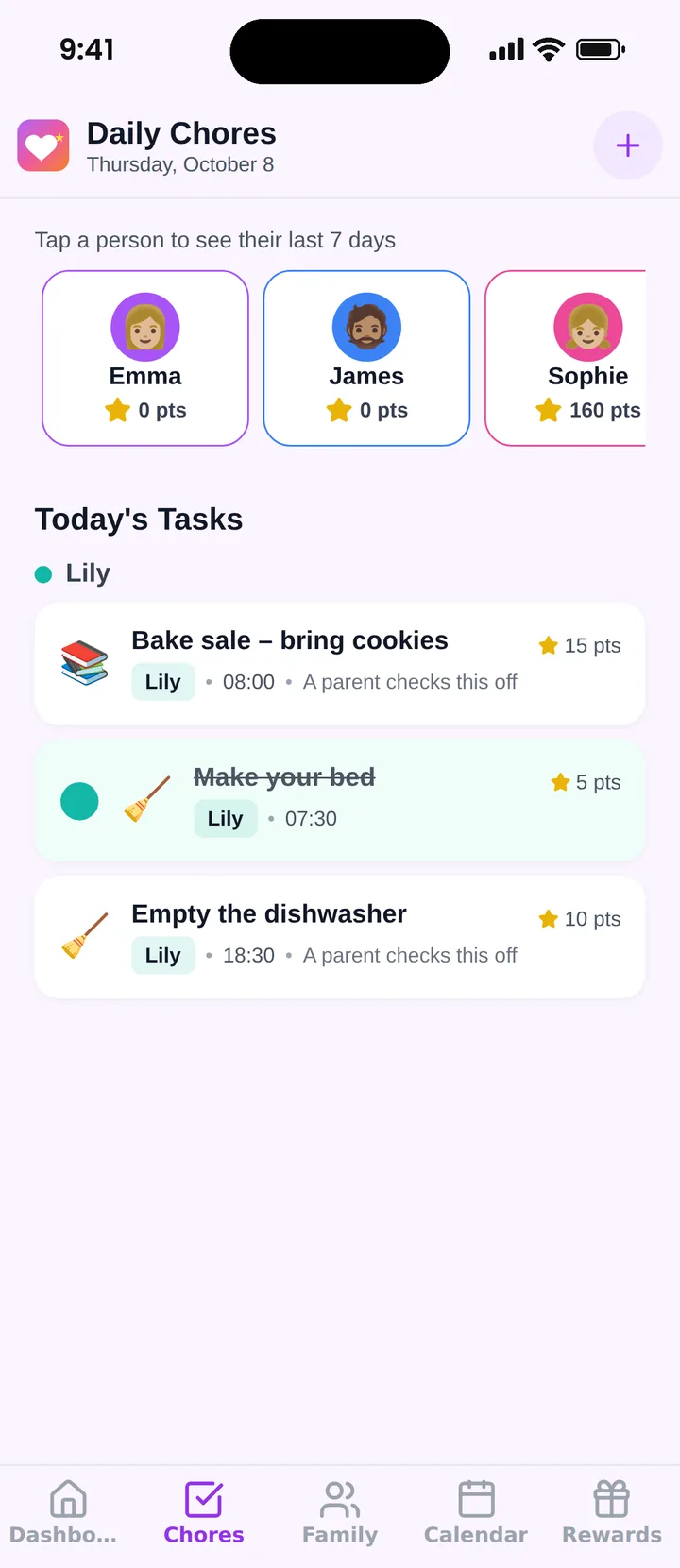
Famiyo is a free family app for iPhone and Android that combines a shared family calendar, chores with points and a rewards shop; kids join with a code, no email needed. It takes over the most tiring rule on the list, the one reminder. Each chore repeats on its own schedule, and kids get a push notification when a new task lands on their phone, so you're not the alarm clock anymore. They check jobs off themselves, or you switch on parent approval so "done means done" gets a quick look before points count. You get notified when a chore is finished. A +2 bonus for jobs done without a reminder rewards the exact habit the rules are after. For other options, see our list of the best chore apps for kids.
Tonight, pick the three rules that would end your most common argument, write them on one sheet of paper and bring it to dinner.
Frequently asked questions
How many household rules about chores should a family have?
Start with four to six. Fewer than that leaves gaps kids will find, and more than that nobody remembers. Young children do best with three or four rules and a picture next to each. You can add a rule later when the same argument keeps coming back.
What is a fair consequence when a child skips a chore?
Keep it natural and dull. The chore still has to be done, the next privilege waits until it is, and the no-reminder bonus is lost for that day. Avoid piling on extra chores as punishment, which teaches kids that housework is a penalty rather than part of living somewhere.
Should parents follow the same chore rules as kids?
Mostly, yes. If the rule is that dishes go in the dishwasher, not the sink, it applies to adults too. Kids notice double standards fast. Parents will have different and bigger jobs, but the rules about deadlines, standards and cleaning your own mess should cover everyone.
At what age can kids help make the chore rules?
From about 5, kids can suggest a rule and vote on it. By 8 or 9 they can negotiate deadlines and swaps sensibly, and teens should help write the rules that affect them. Children follow rules they helped make far more willingly than rules handed down.
Try Famiyo With Your Family
Chores with points, a rewards shop for kids and one shared family calendar. Set it up in a couple of minutes.



Free to download • No credit card required • Available on iOS & Android