Behavior Chart for a 5-Year-Old: How to Make It Work
A behavior chart for a 5-year-old that works: 3 to 5 positive goals, a star each time, a reward within a few days, and a free printable weekly chart.
By Famiyo Editorial Team5 min read
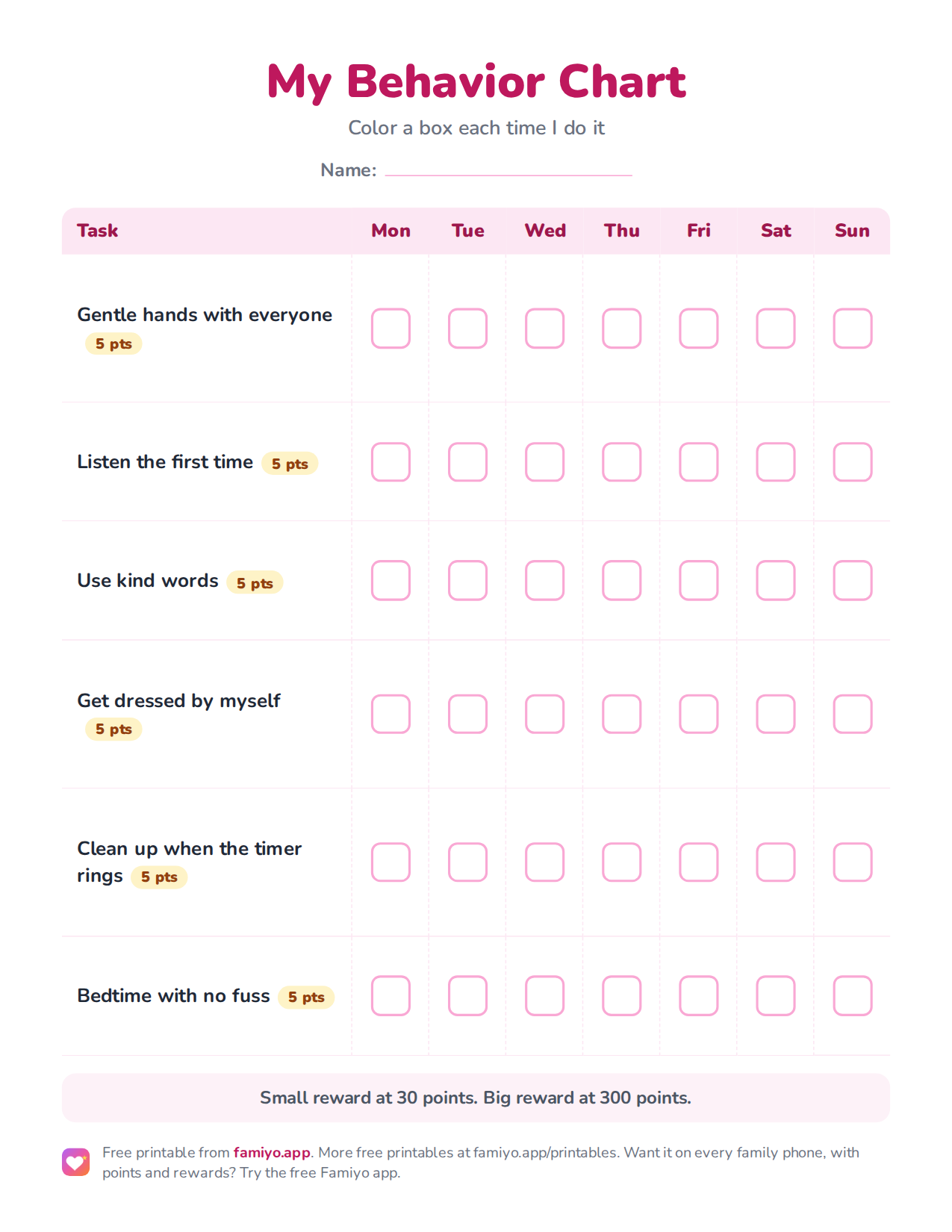
Free printable
My Behavior Chart
A weekly chart on one US Letter page. Download the PDF to print it, or save the image to use it on a tablet or in a document.
Free for home, classroom and nonprofit use, see the license. More free printables.
Five is the kindergarten year. Your child is learning a whole new set of rules at school, and the effort of following them all day often spills out at home around 4 pm. A behavior chart for a 5-year-old can help, as long as it fits what children this age can actually do. Here's what to put on it, how to run it, what to say, and a printable weekly chart to start with.
What a 5-year-old can handle on a behavior chart
Compared with a younger preschooler, a 5-year-old has a few new strengths. They can usually follow two- or three-step instructions, they understand that rules apply even when nobody is watching (at least in theory), and they can count their own stars. Many are proud of being "big" and respond well to being trusted with more.
Their limits matter just as much. A week is still a long time to wait, impulse control is a work in progress, and big feelings arrive faster than words. So a chart at this age needs quick wins, a reward within a few days, and goals that describe one clear action. If your child is younger or the chart feels like too much, the behavior chart for a 4-year-old uses simpler goals and even faster rewards.
Choosing the behaviors
Write every goal as the thing you want to see, never the thing you want to stop. "No hitting" tells a child what not to do. "Gentle hands" gives them something to aim for. Pick 3 to 5 goals, and make sure at least one is something your child already manages most days.
| On the chart | What it looks like | What to say when you see it |
|---|---|---|
| Gentle hands | Asks for a toy back instead of grabbing; walks away when angry | "You were so mad, and you kept your hands to yourself. That's a star." |
| Listen the first time | Stops and responds when called, without three reminders | "I asked once and you came. Thank you." |
| Use kind words | Says "can I have a turn?" instead of yelling | "You asked your brother so kindly." |
| Get dressed by myself | Clothes on before breakfast, help only with tricky buttons | "You got dressed all by yourself, start to finish." |
| Clean up when the timer rings | Toys back in the bins when the 5-minute timer goes off | "Timer rang and you started right away." |
| Bedtime with no fuss | Pajamas, teeth, into bed, without bargaining | "Straight into bed. Your body's going to love that sleep." |
Notice the praise names the exact behavior. "Good job" is pleasant but vague. "You kept your hands to yourself" tells your child precisely what earned the star.
How to run the chart day to day
- Introduce it at a calm moment, not right after a meltdown. Try: "We're going to make a chart for the things you're learning. Every time you do one, you color a box."
- Mark it right away. A 5-year-old connects the star to the action only if it happens within minutes.
- Count together at bedtime. Two minutes, no lectures, just "Look how many you did today."
- Make the first reward reachable within 2 to 3 days. Early success is what gets a child invested.
- Never take stars away. After a hard day, say: "Today was tricky. Tomorrow you get new boxes to fill."
- Review after 2 to 3 weeks. Drop goals your child has mastered and add one new one.
A word on hard days. Some 5-year-olds have far more trouble with impulse control or transitions than others, and that's not a failure of the chart or of your parenting. If big behaviors are happening both at home and at school most days, it's worth talking to your child's pediatrician. The American Academy of Pediatrics' guidance on discipline favors this kind of positive, specific attention over punishment, and a chart fits well alongside whatever support you're given.
The printable chart
The printable below has six positive goals down the side and a box for every day of the week. Each goal is worth 5 points, so a perfect day is 30, which is also the price of a small reward like choosing dessert or an extra bedtime story. A big reward, such as a day out, sits at 300 points and takes a few weeks to reach.
It suits a child who's just started kindergarten, or any 5-year-old who's ready for a little more structure than stickers on the fridge. Cross out any goal that doesn't fit your family and write your own in its place. Let your child color the boxes themselves. Putting the mark on the page is half the fun.
When the chart stops working
Every chart loses its shine at some point, usually around week three. A few common patterns and what to do:
Your child starts bargaining ("I was gentle, give me a star!"). That's actually a good sign that they understand the goal. Agree when it's true, and keep stars for moments you saw.
The chart gets ignored. Swap the reward, change the colors, or let your child pick one new goal. Novelty matters at this age.
A sibling wants one too. Give them their own chart with their own goals. Comparing two kids' charts on the same fridge rarely ends well.
Most kids move from behavior goals to small jobs around the house by 6 or 7. When that time comes, our chore chart ideas for 7-year-olds take over where this chart leaves off. If you'd like to lean less on stars over time, gentle parenting and chores covers getting cooperation without threats or bribes.
A digital behavior chart in Famiyo
Famiyo is a free family app for iPhone and Android that combines a shared family calendar, chores with points and a rewards shop; kids join with a code, no email needed. Each goal from your chart becomes a daily repeating task worth 5 points. For a 5-year-old, set it so a parent approves the task rather than the child checking it off, and tap approve the moment you see gentle hands in action.
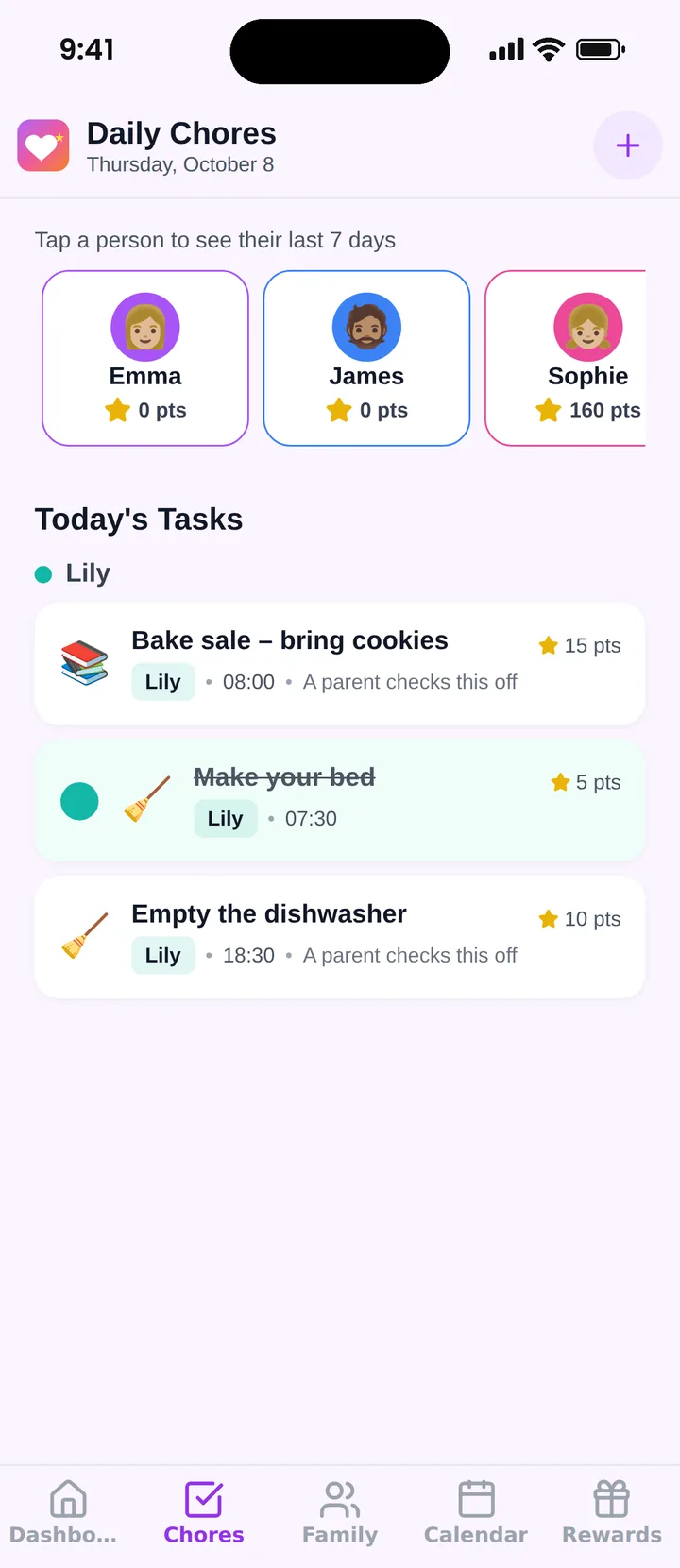
Your child can see their own goals and growing points on a tablet or an old phone. In the rewards shop, "choose dessert" costs 30 points, and they can redeem it themselves. More options are in our list of the best chore chart apps.
Frequently asked questions
How many behaviors should be on a 5-year-old's chart?
Three to five. Fewer than three and the chart feels empty; more than five and a 5-year-old can't keep the goals in their head. Start with the one or two behaviors causing the most friction, plus one the child already does well so they earn stars from the first day.
Should I take away stars for bad behavior?
No. Taking away a star a child already earned teaches them the chart can't be trusted, and many kids stop trying. Handle the misbehavior separately and calmly, and let the chart only ever count what went right.
How long should a behavior chart last for a 5-year-old?
Run it for 2 to 3 weeks before judging it. Once a behavior happens most days without prompting, retire it from the chart with some fuss about how grown-up that is, and add a new goal or let the chart fade.
What rewards work for a 5-year-old?
Small, quick and often shared with you: choosing dessert, an extra bedtime story, picking the family movie, a trip to the playground. At this age, time with a parent usually motivates more than toys, and a reward every 2 to 3 days keeps the chart alive.
Try Famiyo With Your Family
Chores with points, a rewards shop for kids and one shared family calendar. Set it up in a couple of minutes.



Free to download • No credit card required • Available on iOS & Android