Chores for 13-Year-Olds: What a Young Teen Should Handle
25 chores a 13-year-old can own, from laundry start to finish to cooking a family meal, plus how much time to expect each day and how to hand jobs over.
By Famiyo Editorial Team5 min read
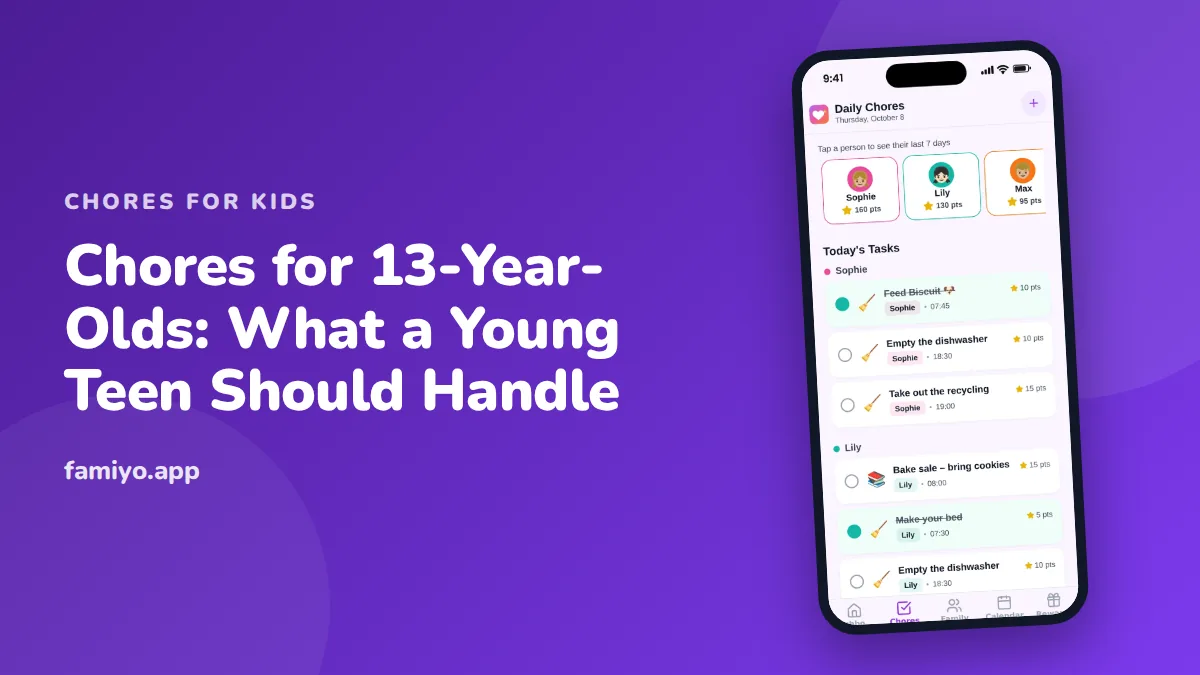
A 13-year-old can do nearly every job in the house. What needs to change at this age is less the list and more the arrangement: fewer "can you help me with this" moments and more "this job is yours." Here are 25 chores that fit a young teen, how much time to expect, a sample week and a way to hand jobs over so they stay handed over.
What changes at 13
Physically, most 13-year-olds can do adult chores. The skills still developing are the planning ones: remembering a task without a cue, estimating how long something takes and fitting it around homework and practice. Those skills grow through practice, which is exactly what owning a chore gives them.
Young teens also want independence and privacy, and they bristle at step-by-step instructions they've heard before. They tend to respond better to being trusted with an outcome ("the kitchen is clean by 8") than to being told each move. That's the shift to make: set the standard and the deadline, check the result, and leave the method to them.
25 chores a 13-year-old can own
The list builds on what they learned at 10 to 12, when they started cleaning a bathroom sink, changing sheets and cooking with an adult nearby. At 13 those turn into whole jobs.
Their own things
- Do their own laundry from sorting to putting it away.
- Change their bed sheets once a week.
- Reset their room weekly: floor clear, trash out, dishes back in the kitchen.
- Pack their own school lunch.
- Add their own practices, games and due dates to the family calendar.
Kitchen
- Cook one simple family dinner a week, like tacos, pasta with a side salad or a sheet-pan chicken and vegetables.
- Load, run and unload the dishwasher.
- Wipe the counters, stovetop and table after dinner.
- Clean out the fridge before grocery day.
- Write the grocery list from the week's meal plan.
- Shop from that list, with you in the store at first and then alone at a nearby store.
Around the house
- Vacuum and mop a floor.
- Clean a whole bathroom: toilet, sink, mirror, tub and floor.
- Take out the trash and recycling and bring the bins back.
- Dust and tidy the living room.
- Change a light bulb, replace a vacuum bag and handle other small fixes.
- Clean mirrors and the inside of windows.
Outside and the car
- Mow the lawn, after training, in closed shoes and with hearing protection.
- Rake leaves, pull weeds and water the garden.
- Shovel the walk and steps in winter.
- Wash and vacuum the car.
Family and people
- Watch younger siblings for short stretches while you're home or close by.
- Help a younger sibling with part of their routine, like reading the bedtime story or checking their school bag.
- Take full care of a pet: food, water, walks, litter and reminding you about vet visits.
- Plan and run one family activity a month, like a game night.
Nobody needs all 25 at once. A typical 13-year-old might own items 1, 3, 7 and 14 every week, plus one bigger job like cooking or mowing.
How much is reasonable each day
A common guideline for teens is 30 to 45 minutes of chores a day. That includes their own laundry and room, so the family-facing part is often smaller than it sounds. Here's what that can look like across a school week:
| Day | Daily basics (10 to 15 min) | Bigger job |
|---|---|---|
| Mon | Dishwasher, wipe counters | Own laundry, start to finish |
| Tue | Dishwasher, wipe counters | Trash and recycling night |
| Wed | Basics only: practice night | None |
| Thu | Dishwasher, wipe counters | Cook family dinner |
| Fri | Clear own things from shared rooms | None |
| Sat | Room reset | Mow the lawn or clean the bathroom |
| Sun | Change sheets | Plan the week on the calendar with you |
Protect sleep while you're adding responsibility. The American Academy of Pediatrics recommends 8 to 10 hours for teenagers, so a chore that pushes bedtime late should move to the weekend, not get squeezed in at 10 p.m.
How to hand a chore over to a 13-year-old
Handing over a job is a process, not a single announcement. These steps work for laundry, cooking or anything else on the list.
- Pick one job at a time. Laundry is a good first one, because the natural consequence (no clean jersey for Saturday) teaches better than any lecture.
- Do it together once while you explain the standard, not every move. "Darks and lights go separately. Anything with a tag that says hand wash goes in this basket."
- Let them do it the next time with you nearby but hands off.
- Agree on what done means and when. "Laundry is done when it's folded and in your drawers by Sunday night."
- Check the result, not the method. If they fold differently than you do, let it go.
- Step back after 2 to 3 weeks of steady results. Keep a light check, like a quick look on Sunday, rather than daily reminders.
When something slips, name it plainly and without sarcasm: "The laundry didn't get done this week. What got in the way, and what's your plan for this week?" That keeps the job theirs instead of quietly taking it back.
Helping out versus owning a job
The difference matters more than the specific chores. "Help me with dinner" means you're in charge and they're assisting. "You're cooking Thursday" means they choose the recipe, check the ingredients and serve the meal, with you available for questions. The second version is harder at first and builds far more.
Younger siblings benefit too. They see their older brother or sister running real jobs, and that makes their own chores feel like a step on the same ladder. For a full picture of what each child in the house can do, our list of age-appropriate chores for kids covers ages 2 to 13 and up, and the chore chart ideas for 7-year-olds work well for a much younger sibling.
Assigning teen chores in Famiyo
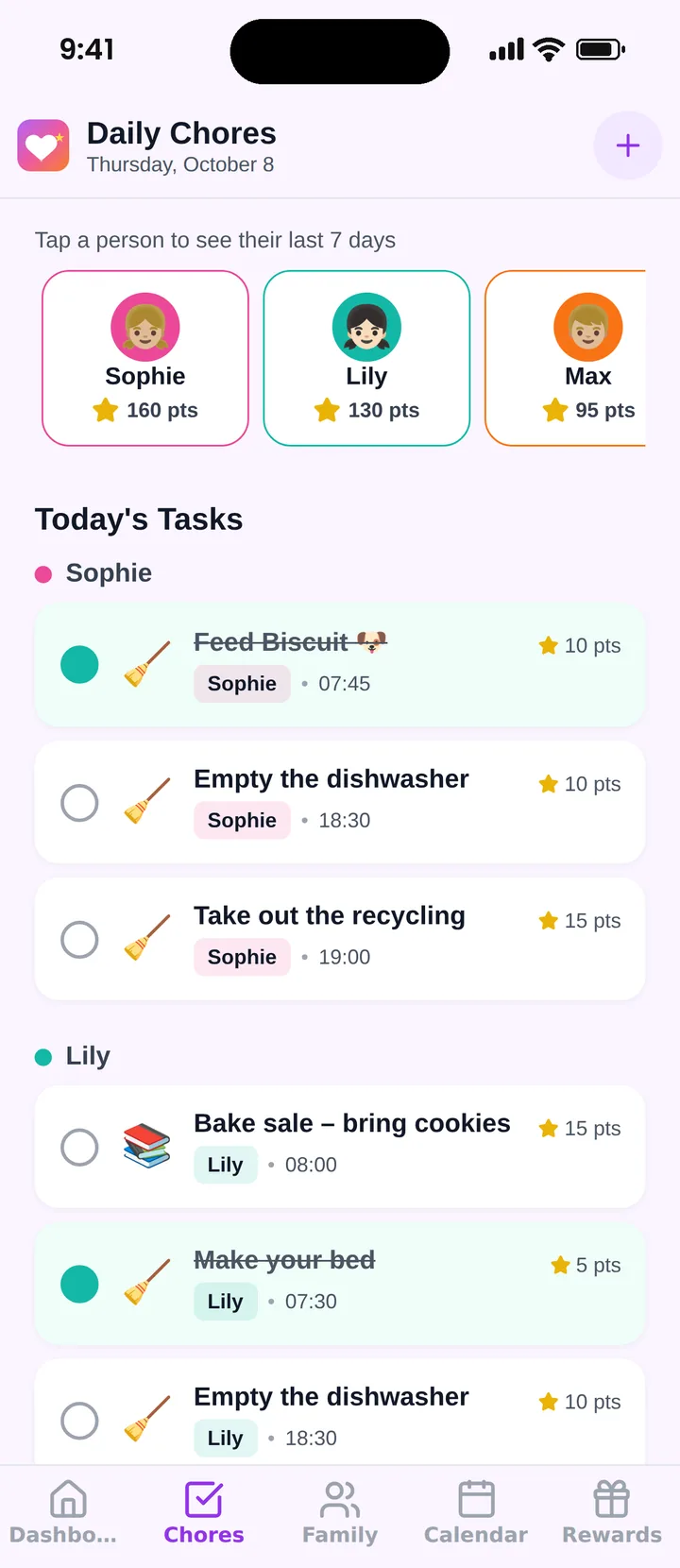
Famiyo is a free family app for iPhone and Android that combines a shared family calendar, chores with points and a rewards shop; kids join with a code, no email needed. Your 13-year-old joins on their own phone with a 6-character code and sees their chores next to their practices on the calendar. Set laundry as a weekly chore on Monday, the dishwasher as a daily one, and give bigger jobs like cooking or mowing 20 points and medium ones 10. Because the goal at 13 is ownership, let them check off their own tasks; you still get a notification when a job is done. Younger siblings appear on the same screen. For other options, see our list of the best chore apps for kids, or read why a kids chore tracker helps.
This week, pick one whole job from the list and hand it over using the steps above. Add the next one only when the first is running on its own.
Frequently asked questions
How long should a 13-year-old spend on chores?
About 30 to 45 minutes on a typical day is a reasonable target, including their own laundry and room. On heavy school or sports days it can drop to a few minutes of basics, with a bigger job moved to the weekend so the weekly total stays about the same.
Should a 13-year-old do their own laundry?
Yes. Most 13-year-olds can do laundry start to finish: sorting, choosing the cycle, moving it to the dryer, folding and putting it away. Teach it over two or three loads together, then hand it over with a fixed laundry day so it doesn't pile up.
Are chores for a 13-year-old boy different from chores for a girl?
No. The same list fits any 13-year-old. Cooking, cleaning a bathroom, mowing and caring for younger kids are things every adult needs to know, and splitting them by gender leaves a teen missing half the skills they'll need when they live on their own.
What if my 13-year-old refuses to do chores?
Some pushback is typical at this age. Give them more control over when and how, keep the list short and clear, and link chores to privileges they care about. If refusal comes with a broader change in mood, sleep or behavior, talk with their pediatrician.
Try Famiyo With Your Family
Chores with points, a rewards shop for kids and one shared family calendar. Set it up in a couple of minutes.



Free to download • No credit card required • Available on iOS & Android