Behavior Chart for Toddlers: Printable and How to Use It
A simple printable behavior chart for toddlers with 5 easy goals, plus how to pick behaviors, give rewards that work at ages 2 and 3, and keep it going for weeks.
By Famiyo Editorial Team4 min read
Free printable
Toddler Behavior Chart
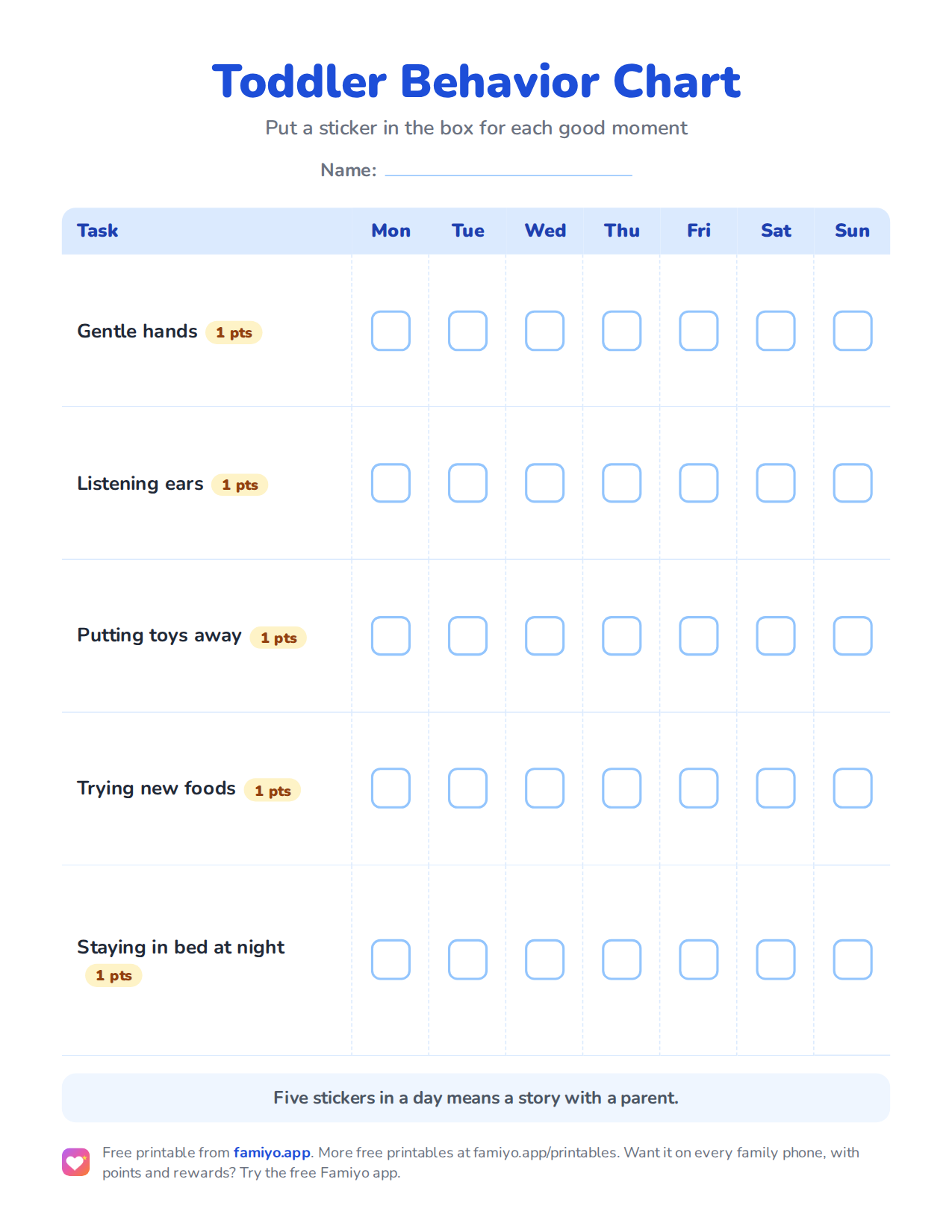
A weekly chart on one US Letter page. Download the PDF to print it, or save the image to use it on a tablet or in a document.
Free for home, classroom and nonprofit use, see the license. More free printables.
Two-year-olds don't misbehave to annoy you. They are tired, hungry, curious and still learning to stop when someone says stop. A behavior chart can help, but only if it fits how toddlers think: short goals, pictures, quick rewards. This page shows how to set one up, which behaviors to start with and what the printable below is for.
The printable has five goals for a typical day with a toddler, a box for each day of the week, and a note about what five stickers means. It suits children from about age 2 to 4. Change the items to match what is hard at your house right now.
What a toddler behavior chart is for
It is a tool for noticing what is going well. For a child this age, the chart matters less than the moment you hand over the sticker: you stop, smile and say what you saw. "You used gentle hands with the baby. Here's a sticker." That is the whole mechanism.
Because of that, a chart is not a punishment tool, and it will not fix a hard stage on its own. Tantrums, biting and hitting at this age are mostly about big feelings and little words. The chart gives you a regular excuse to catch the good moments you would otherwise skip over.
Pick the right behaviors
Start with one or two. Choose things your child can do now, written as what you want to see.
| Instead of | Write | Picture to use |
|---|---|---|
| No hitting | Gentle hands | Open hand |
| Stop screaming | Quiet voice | Finger on lips |
| Don't make a mess | Toys in the bin | Toy bin |
| Don't fight bedtime | Stay in bed | Bed with a moon |
| Don't refuse dinner | Try one bite | Fork |
Toddlers read pictures far better than words. Draw them or cut them from magazines, and put the chart at their eye level, on the fridge or the wall by the bedroom.
How to use the chart, step by step
- Pick one goal and talk about it at a calm time: "Today we're practicing gentle hands."
- Show the chart and the stickers. Let your child hold them.
- Catch the behavior and reward it within seconds: sticker, cheer, hug.
- Say what they did, in a short sentence.
- Count the stickers together before bath time.
- When the child reaches the target, give the agreed reward right away.
If you are weighing other formats, there are more in our reward chart ideas, and a comparison with older ages in behavior chart for kids.
Keep it short and happy
A chart session should last under a minute. Sit at your child's level, point to the picture, hand over the sticker and move on. If your toddler is already upset, skip it. A chart introduced in the middle of a meltdown becomes part of the meltdown. Do the sticker moment when things are calm, and let your child stick it on themselves whenever possible. Fine motor practice is a bonus, and ownership of the chart keeps it theirs.
Rewards that work at this age
Toddlers have a short memory for promises. A prize at the end of the week means little. Better options:
- A sticker straight away, every time.
- A small treat after a full row: bubbles, a favorite song, five extra minutes at the park.
- A big hug and a high-five. Your attention is the actual currency.
- One bigger reward after a full week, like choosing the story or the bath toy.
Avoid food as the main reward, and don't use screen time. Toddlers are still learning what sets them off, and candy plus a tablet becomes a new thing to fight over. For more detail on getting little ones to help with tasks, see how to get a 3-year-old to clean up toys.
When it isn't working
Most toddler charts stall for one of four reasons:
- Too many goals. Cut to one.
- Rewards come too late. Hand them over now.
- It has turned into a threat ("no sticker if you..."). Go back to noticing good moments only.
- You stopped using it. A chart that lives in a drawer does nothing.
Give it two to three weeks of steady use before deciding. If the same behavior is getting worse, such as frequent biting or long, intense meltdowns, mention it to your pediatrician. They have seen it before.
Replacing paper with the app
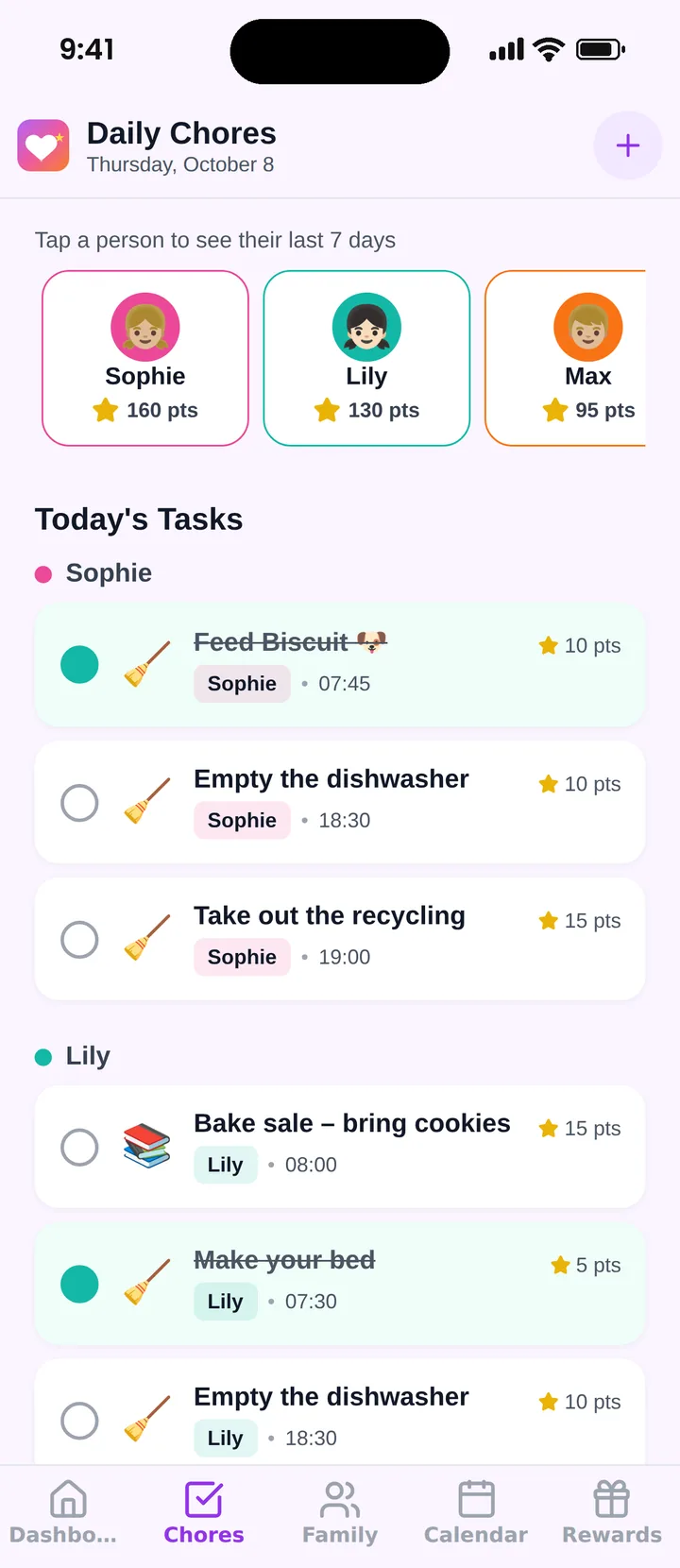
Famiyo is a free family app for iPhone and Android that combines a shared family calendar, chores with points and a rewards shop; kids join with a code, no email needed.
For a toddler, the paper chart is still the better tool, because stickers need small hands. Where Famiyo helps is with the older child and with the grown-ups: repeating chores that show up every day, points for each one, and push notifications so everyone remembers. Live sync means both parents see what has been done. See the best chore chart apps if you want to compare. The screen below shows the day's chores for every child.
Print the chart, pick one goal, and tape it to the fridge tonight.
Frequently asked questions
At what age can a toddler use a behavior chart?
Most children can understand a simple sticker chart from around age 2 to 3. Younger toddlers don't connect a sticker with something they did an hour ago, so give it right away and keep the goals very basic.
How many behaviors should a toddler chart track?
Two to four is plenty. A toddler cannot hold a long list in mind, and a chart with ten rows turns into a chart nobody fills in. Start with one or two, and add another only when the first is easy.
What rewards work for toddlers?
Stickers, a stamp, a bubble session, an extra story or a short game together. Reward right away and keep it small. Toddlers care more about your attention and a cheerful tone than about a prize.
What should I do when my toddler has a bad day?
Leave the chart as it is, skip the sticker without a lecture, and try again at the next chance. Never take stickers away. Tomorrow starts blank, and toddlers need that fresh start.
Try Famiyo With Your Family
Chores with points, a rewards shop for kids and one shared family calendar. Set it up in a couple of minutes.



Free to download • No credit card required • Available on iOS & Android