Chores for 14-Year-Olds: Responsibilities That Prepare Them for High School
What chores a 14-year-old should do, matched to the skills high school asks for: planning, early mornings, self-care and running a job without reminders.
By Famiyo Editorial Team6 min read

Fourteen is the year many kids start high school, and the jump is bigger than it looks from the outside: more teachers, more deadlines, earlier mornings and less hand-holding. Chores are one of the few places at home where a 14-year-old can practice the planning and self-management that high school suddenly expects. Below is a chore list built around those skills, a sample week that fits a freshman schedule and a plan for handing over the jobs that teach the most.
What a 14-year-old is ready for
Physically, a 14-year-old can do almost any household task an adult does. If they spent age 13 learning laundry, cooking and cleaning a bathroom (our list of chores for 13-year-olds covers that stage), the work at 14 is less about new tasks and more about running them without a prompt.
The skills still growing are executive ones: estimating how long something takes, remembering a commitment three days out, starting a boring job before it becomes urgent. Those develop with practice, and a chore with a deadline is practice. A freshman who has run their own laundry day for a year has already learned to plan around a fixed weekly obligation, which is exactly what a weekly lab report asks of them.
Chores that build high school skills
Pick chores for the skill they train, not only for the help they give you. Here's how common jobs map to what high school asks for.
| Chore | High school skill it builds | Time |
|---|---|---|
| Set and get up with their own alarm | Getting to first period on time without you | 1 minute |
| Pack lunch the night before | Preparing tonight for tomorrow | 10 minutes |
| Do their own laundry on a fixed day | Planning around a weekly deadline | 30 minutes active |
| Cook one family dinner a week | Following multi-step instructions, timing | 45 to 60 minutes |
| Write the grocery list and shop from it | Budgeting and checking their own work | 30 to 45 minutes |
| Clean a whole bathroom | Finishing a long job to a clear standard | 30 minutes |
| Add practices, tests and due dates to the family calendar | Tracking several schedules at once | 5 minutes |
| Book or call about their own appointments | Talking to adults on the phone | 5 to 10 minutes |
| Watch a younger sibling for an hour | Responsibility for someone else | 1 hour |
| Mow the lawn or shovel the walk | Working safely with equipment | 30 to 45 minutes |
The full list: 22 chores for a 14-year-old
These build on everything they did at 12 and 13. If you're still filling gaps, the chores for 12-year-olds list shows the earlier steps.
Running their own life
- Wake up with their own alarm on school days.
- Pack their own lunch and refill their water bottle.
- Do all of their own laundry, start to finish.
- Change their sheets weekly.
- Keep their room at an agreed standard, with a weekly reset.
- Track their own homework, practices and tests on the family calendar.
- Ask about or schedule their own haircut, dentist or orthodontist visits, with you confirming.
- Pack their own sports bag and keep the uniform clean.
Around the house
- Load, run and unload the dishwasher.
- Clean the kitchen after dinner: counters, stovetop, sink.
- Clean a whole bathroom.
- Vacuum and mop the main rooms.
- Take the trash and recycling out on collection day without a reminder.
- Clean out the fridge before shopping day.
- Handle small fixes: change a bulb, unclog a drain with a plunger, reset a tripped breaker with you there.
Food and errands
- Plan and cook one family dinner a week.
- Write the grocery list from what's missing.
- Shop from the list at a nearby store.
- Put groceries away and rotate older food to the front.
Family and outside
- Babysit younger siblings for short stretches.
- Mow, rake or shovel, depending on the season.
- Take full care of a pet, including remembering vet dates.
A 14-year-old doesn't need all 22. A balanced load is items 1, 2, 3 and 9 every week, plus one rotating big job from the house or outside list.
A sample week for a high school freshman
High school days are long, and many freshmen have practice or rehearsal after class. Spread the work so no single evening collapses. This sample assumes practice on Monday, Wednesday and Thursday.
| Day | Daily basics (10 to 15 min) | Bigger job |
|---|---|---|
| Mon | Own alarm, pack lunch, dishwasher | None (practice) |
| Tue | Own alarm, pack lunch, dishwasher | Laundry, start to finish |
| Wed | Own alarm, pack lunch | None (practice) |
| Thu | Own alarm, pack lunch, dishwasher | Trash and recycling out |
| Fri | Own alarm, kitchen after dinner | Cook family dinner |
| Sat | Room reset, change sheets | Bathroom or yard |
| Sun | Plan next week on the calendar | Grocery list and shopping with you |
The American Academy of Pediatrics recommends 8 to 10 hours of sleep for teenagers. If chores plus homework push bedtime past that, move the bigger job to the weekend rather than trimming sleep.
How to hand over the self-management chores
Laundry and dishes are easy to hand over because the result is visible. The self-management jobs (alarm, lunch, calendar, appointments) are harder, because the old system was you. These steps make the switch without a rough first month.
- Name the job and the outcome. "Starting Monday, getting up is yours. The bus leaves at 7:10."
- Do one week with a safety net. You knock once at the agreed time if they're not up, and say nothing else.
- Remove the safety net. From week two, if they miss the bus, they deal with the consequence you agreed on, such as a late pass or walking.
- Hand over the next job only when the first is steady for 2 to 3 weeks. Lunch, then the calendar, then appointments.
- Check in once a week, not daily. Sunday is a good time to look at the coming week together.
The words matter. "Did you remember your lunch?" every morning keeps you as the reminder system. "Your lunch, your call" makes it theirs, even if the first week includes one lunch from the vending machine.
Fairness when siblings are younger
A 14-year-old often notices that their list is longer than a 9-year-old sibling's. That's fair, and it helps to say why: jobs grow with age, and the younger child will get the same list at 14. Rotating the shared jobs, with each child doing an age-sized version, keeps resentment low. Our guide to chore rotation shows how to balance zones across ages.
Running a 14-year-old's chores in Famiyo
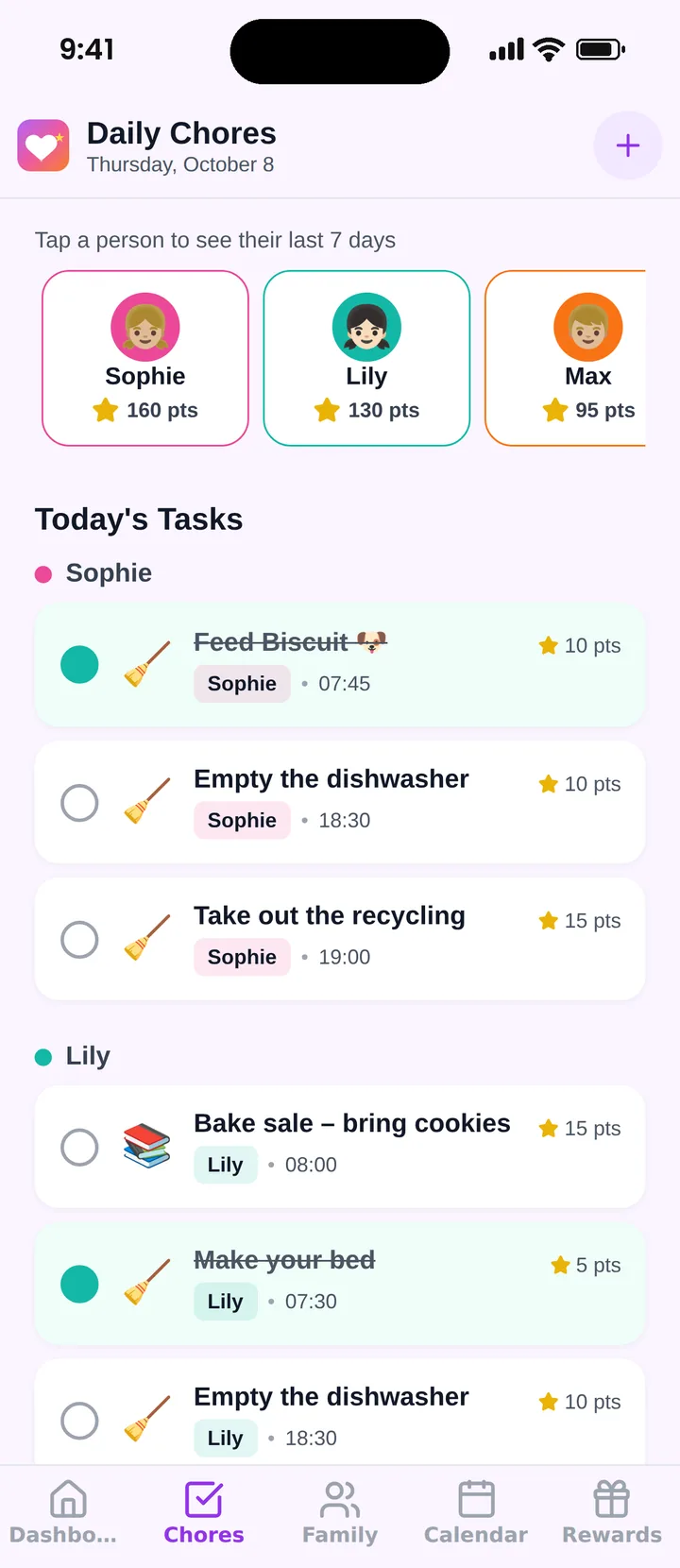
Famiyo is a free family app for iPhone and Android that combines a shared family calendar, chores with points and a rewards shop; kids join with a code, no email needed. Your 14-year-old joins on their own phone with a 6-character code and gets a push notification when a new chore is assigned. Set laundry as a weekly chore on Tuesday and the dishwasher as daily, then put bigger jobs like cooking or the bathroom at 20 points and medium ones at 10. Let them check off their own tasks, since ownership is the point at 14, and you'll hear when a job is done. Their practices and test dates can sit on the same shared calendar. To compare options, see our list of the best chore apps for kids.
This week, hand over one self-management job, the alarm or the lunch, and leave the rest of the list alone until it's running on its own.
Frequently asked questions
How many chores should a 14-year-old have?
Three or four short daily jobs plus one or two bigger weekly ones is a workable load, about 30 to 45 minutes a day in total. That count includes looking after their own things, such as laundry and lunch, which matter more at 14 than extra family jobs.
Should a 14-year-old get up with their own alarm?
Yes, most 14-year-olds can own their wake-up time. Agree on the time together, let them set the alarm, and stop doing the backup knock after a couple of weeks. Protect 8 to 10 hours of sleep, which the AAP recommends for teens, so the alarm is realistic.
Should a 14-year-old be paid for chores?
Keep the everyday jobs that come with living in the house unpaid, such as their own laundry and the dishwasher. Extra jobs you would otherwise hire out, like washing the car or a garage clean-out, can be paid, often $2 to $5 for a big one.
What if my 14-year-old has no time for chores during sports season?
Cut the list to a few daily basics that take 10 minutes, like their own dishes and laundry, and move bigger jobs to the off day or the weekend. Keeping a smaller habit going is better than pausing chores and restarting them in spring.
Try Famiyo With Your Family
Chores with points, a rewards shop for kids and one shared family calendar. Set it up in a couple of minutes.



Free to download • No credit card required • Available on iOS & Android