How to Get a 3-Year-Old to Clean Up Toys (Without a Fight)
Get a 3-year-old to clean up toys with a short script, one-step jobs, a 5-minute timer and fewer toys out. Includes what to say when they melt down.
By Famiyo Editorial Team6 min read
Your 3-year-old dumped the entire toy box between breakfast and snack, and now you are standing in a field of plastic bricks saying "clean up" for the fourth time. Nothing is happening. Sound familiar?
This page covers why it happens, a setup that makes cleanup possible for a small child, the exact words to use, and what to do when it all falls apart anyway. Because it will, sometimes. Usually on a Wednesday.
Why a 3-year-old freezes when you say "clean up"
To you, "clean up" means pick up the toys. To a 3-year-old, it means a huge, shapeless mess and no idea where to begin. They can follow one or two steps at a time, not a whole project. So they wander off, start playing with something, or lie down on the carpet. That is not defiance. It is a short attention span meeting a big job.
There is also the plain fact that they did not choose to stop playing. Being pulled out of a game feels bad at any age. A 3-year-old just has fewer ways to say so.
So the fix is not a firmer voice. The fix is a smaller job, a clearer signal and a parent who stays in the room.
Set up the room so cleanup is possible
Most of the work happens before you say a word.
- Fewer toys out. Keep a limited number in the play area and store the rest. A shorter pile means a shorter cleanup.
- Open bins, not lids. Lids, drawers and tall shelves are hard for small hands. A low, wide bin they can drop things into works best.
- One category per bin. Cars, blocks, animals, books. Tape a photo or a drawing on the front so they can match without reading.
- A home for everything. If a toy has no bin, it ends up on the floor.
You will probably rotate toys by hand every week or two. It is a small chore for you that saves a lot of arguing.
What to say: a script for a 3-year-old
Vague instructions fail. Specific ones, with a clear start and finish, work much better. Try this order.
- Give a warning. "Five more minutes of playing, then we tidy up." Stay near them while you say it, and get down to their eye level.
- Make the signal the same every day. A particular song, a chime or a timer on the counter. The signal becomes the cue, so you do not have to argue about when.
- Start together. "Let's do it. I'll take the blocks." Pick up a few pieces yourself so they see how it goes.
- Name one job at a time. "Can you put all the cars in the red bin?" Not "put your toys away."
- Say what's done. "Cars are finished. Now the animals." Each finished category gives them a small win.
- Notice effort. "You found the missing truck." Skip the long speech. A short, specific comment is enough.
- Finish with something nice. A story, a snack, a turn at the sink to wash hands. Cleanup leads somewhere pleasant.
If you want a few more ways to phrase this, our guide on how to get kids to pick up their toys covers the same ground for older children, and how to get toddlers to clean up their toys is useful if you also have a younger one at home.
Keep it short and keep it the same
At age 3, a cleanup that lasts 5 minutes is plenty. The typical daily chore time at ages 2 to 3 is 5 to 10 minutes in total, so toy cleanup can be most of it. A timer or a two-minute song helps, because "until the song ends" makes sense to a child in a way that "until it's tidy" does not.
Do it at the same points every day. Before lunch. Before bath. Before the evening story. A routine that happens at the same moment becomes a habit faster than one that depends on your mood. Give it 2 to 3 weeks before you decide whether it works. Habits at this age are slow.
You do most of the work at first, and that is fine. Over a few weeks, shift the balance a little: you pick up four toys, they pick up six. Eventually they do the bin they like best by themselves. If you want to see what comes next, our chores for 5-year-olds list shows where this skill goes.
When it goes wrong anyway
Some days the meltdown wins. A few ways to handle it.
| What happens | What to try |
|---|---|
| They collapse on the floor and cry | Stay calm, lower your voice, say "I'll help you start." Do the first three toys together. |
| They say "No!" and run | Don't chase. Say "I'll be here. Cars first when you're ready," and start tidying yourself. Often they come over. |
| They put toys away, then take others out | Say "Those toys are done for today," and move the bin up. Don't re-fight the same battle. |
| They are clearly tired or hungry | Skip it. Cleanup after a nap or a snack will be a lot easier. Put the mess in one corner and deal with it later. |
| They refuse every day for a week | Look at the setup. Too many toys? Bins too hard to reach? Job too long? Fix the setup before blaming the child. |
One more tool: a toy that stays on the floor goes up on a high shelf until tomorrow. Say this calmly beforehand ("If toys stay on the floor, they take a rest on the shelf") and follow through without anger. Do it rarely. It stops working if it is used all the time.
Do not turn this into a power contest. A 3-year-old will not lose a contest of wills with an adult who needs to cook dinner, and the lesson they take away is that cleaning up is a fight.
Do praise and points help at this age?
A little. Three-year-olds respond to attention and to simple, immediate rewards: a sticker, a high five, choosing the bedtime story. A long chart does not make sense at this age, because they cannot connect a point today with a prize on Saturday.
If you want to start counting, keep it to one task and make the reward the same day. The goal is the habit of helping, so the reward should be small and the praise should be about the effort ("You carried all the blocks"). For how rewards fit in as kids get older, see our guide to age-appropriate chores for kids.
Where an app can help
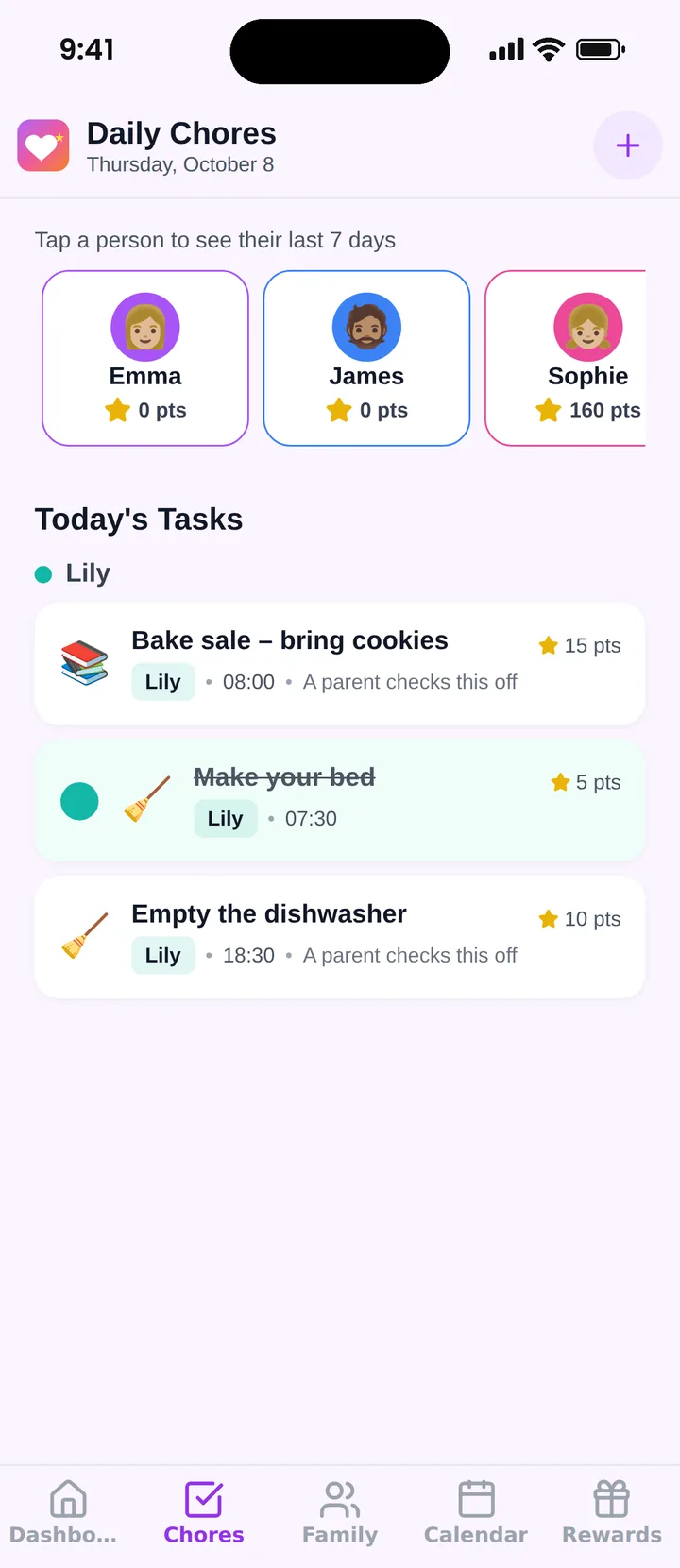
Famiyo is a free family app for iPhone and Android that combines a shared family calendar, chores with points and a rewards shop; kids join with a code, no email needed. For a 3-year-old, the app is really for you. You add "toys in the bins" once, set it to repeat every day, and the push notification reminds the person who was going to say it for the fifth time. The task appears in the child's own list, and you can approve it yourself so the check-off happens with you, in the room. Points add up for the child over time, which becomes useful at 5 or 6. You can see how it looks in our list of the best chore apps for kids.
A realistic first week
Day one, make one change: put out fewer toys and label the bins. Day two, pick the signal (a song) and the time (before lunch). Days three to seven, use the script, help every time, and stop the moment the song ends. Do not judge the result by how clean the room is. Judge it by whether your child took part without a fight, even for two minutes. That is the habit you are building.
Frequently asked questions
Why won't my 3-year-old clean up toys?
Usually because the job is too big and too vague. A floor covered in toys looks impossible to a 3-year-old. Break it into one category at a time, help them start, and they will join in far more often.
How long should a 3-year-old spend cleaning up?
About 5 minutes, which fits the 5 to 10 minutes of daily chores suited to ages 2 to 3. Use a song or a timer so the end is clear. A short, finished cleanup teaches more than a long one that ends in tears.
Should a 3-year-old clean up alone?
No. At this age cleanup works as a joint job. You put away some toys, they put away others. Gradually you do less. Expecting a solo cleanup at 3 is the most common reason it turns into a daily fight.
Should I take toys away if my 3-year-old won't tidy up?
A calm, pre-announced version works: toys left on the floor go on a high shelf for a day. Say it once, follow through without anger, and give them back tomorrow. Do it without lectures, and not as a surprise punishment.
How many toys should a 3-year-old have out at once?
Fewer than feels natural. Many families keep a handful of bins or one shelf in play and rotate the rest. Less on the floor means a shorter cleanup and fewer things to fight about.
Try Famiyo With Your Family
Chores with points, a rewards shop for kids and one shared family calendar. Set it up in a couple of minutes.



Free to download • No credit card required • Available on iOS & Android