Behavior Chart for Kids: Free Printable and How to Use It
A free printable behavior chart for kids, with 8 behaviors to track, how many to start with, what to reward and when to retire the chart.
By Famiyo Editorial Team5 min read
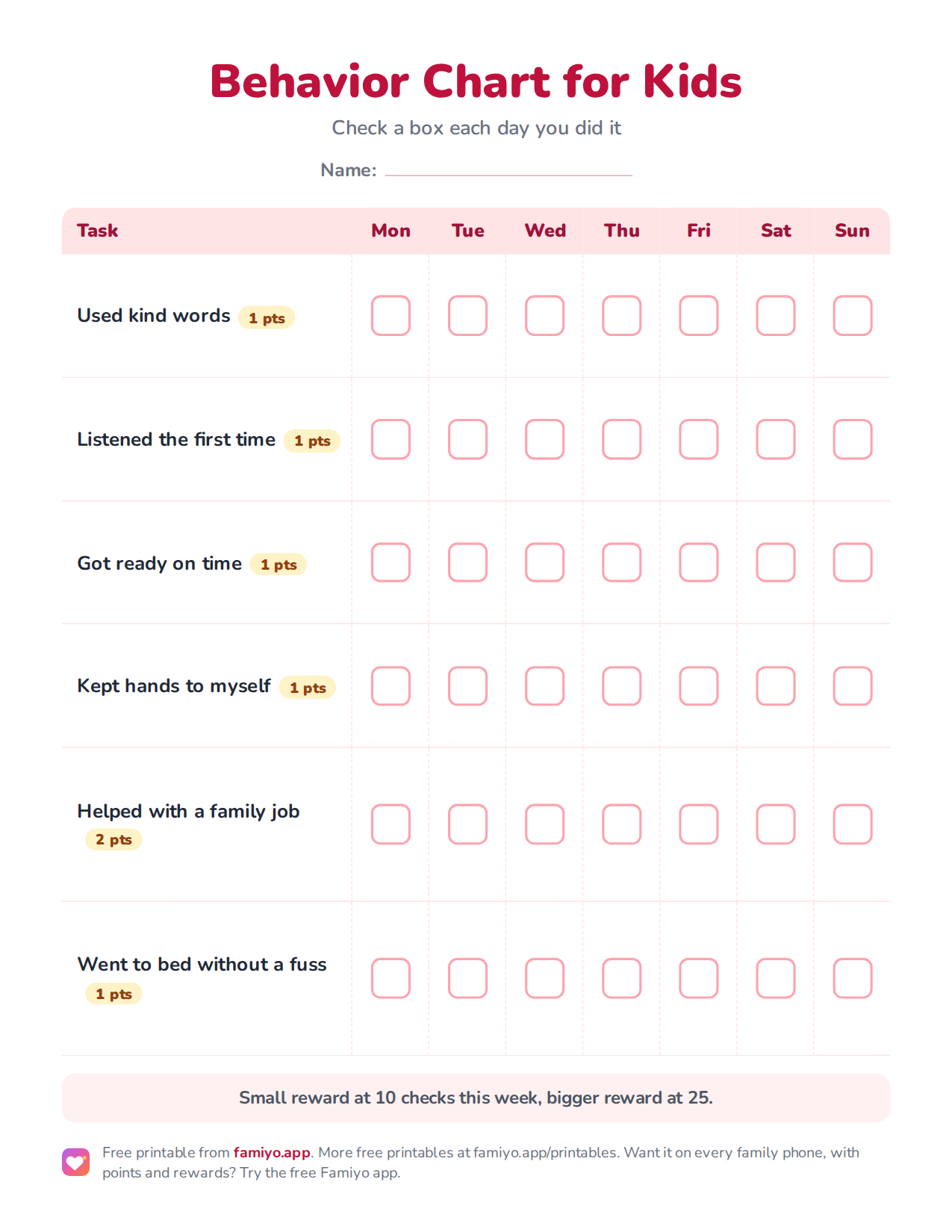
Free printable
Behavior Chart for Kids
A weekly chart on one US Letter page. Download the PDF to print it, or save the image to use it on a tablet or in a document.
Free for home, classroom and nonprofit use, see the license. More free printables.
A good behavior chart is boring on purpose. It is a short list of things you want to see more of, a row of boxes, and a few minutes each evening to check them off together. The ones that fall apart usually have too many lines, vague goals or a reward that is too far away.
This page gives you a free printable, eight behaviors you can pick from, a simple way to run it, and the point at which you should stop using it.
The free printable behavior chart
The printable below has a weekly grid with six behaviors down the side and Monday to Sunday across the top. It suits children from about 4 to 9. Print it, pick two to four lines to focus on and cross out the rest, or swap in your own. Each behavior has a point value in the margin so you can add up a weekly total and pick a reward from the line at the bottom.
It is meant to be a starting point. If your child has a different problem, such as hitting or bedtime, replace the lines with the exact behaviors you are working on.
8 behaviors worth putting on a chart
Good behaviors are specific, visible and positive. They describe what the child does, not what they stop doing. Here are eight, with wording that works and the age they tend to fit.
| Behavior | How to word it | Ages |
|---|---|---|
| Kind words | "Said please, thank you or a kind thing to someone" | 3 to 10 |
| Listening | "Did what I asked the first time" | 3 to 8 |
| Getting ready | "Dressed, shoes on, bag by the door before leaving time" | 5 to 10 |
| Gentle hands | "No hitting, pushing or grabbing for the whole afternoon" | 3 to 7 |
| Helping | "Did one family job without being reminded" | 4 to 12 |
| Calm bedtime | "In bed and quiet by lights-out time" | 3 to 8 |
| Trying again | "Kept going or asked for help when something was hard" | 5 to 10 |
| Screen stop | "Turned off the screen at the first warning" | 6 to 12 |
For jobs and routines, our chore list for kids has a bigger master list, and the kids responsibility list covers the everyday habits worth teaching.
How to run the chart, step by step
- Pick two to four behaviors. Not eight. You can rotate them in later.
- Explain it once, on a calm day. "We're going to track a few things. When you do them, you get a check. At the end of the week, checks turn into a reward."
- Choose the reward together. A small reward at the end of each week works better than one big prize a month away. Let the child pick from a short list you approve.
- Check boxes at the same time every day. After dinner or before the bedtime story works for many families. Sit down together and go through each line.
- Mark what went right first. Start with the boxes they earned and say exactly what they did: "You got your shoes on the first time."
- Leave misses empty and say nothing. No lecture, no removing earlier checks.
- Count on Sunday and give the reward. Then start a fresh sheet.
If you want a sense of how many points a small reward should cost, the Famiyo suggestion is 30 to 50 points for small treats like 15 extra minutes of screen time, and 100 for a medium one like picking the family movie. You can scale that down for a paper chart, such as 10 checks for a small reward and 25 for a bigger one, as in the printable.
What to reward and what to leave alone
Reward effort and progress, not perfection. A child who got ready on time four days out of seven has done something worth noticing. Reward the habit you are building, and skip the ones they already do easily, because those do not need an incentive.
Praise does most of the work. The check is a quick way to deliver it. Say what you saw, keep it short and mean it.
Do not take away checks as punishment for a different problem. If your child hits their sister on Tuesday, the consequence is about hitting, not about the boxes they earned for kind words on Monday. Earned marks stay.
Ideas for different situations
A chart for a 3-year-old looks different from one for a 9-year-old. For the youngest, use pictures instead of words, three lines at most, and a reward the same day. We cover this in our behavior chart for a 3-year-old article. For a 6-year-old who is starting to read, a short list in words and a weekly reward works, and our reward chart ideas page has formats from sticker sheets to jars.
If you want to compare formats, chore chart ideas for kids lists 25 of them.
When charts stop working
Three signs a chart has run its course. The child ignores it. The behaviors happen without checks. Or you forget to do it and nobody notices.
When that happens, do not just stop on a Tuesday. Step down: go from daily to a few times a week, then to occasional spot checks, while keeping the praise. If a behavior slips, bring the chart back for a couple of weeks. That is normal.
If it stops working within the first week, the fix is almost always the setup: too many lines, a reward that is too far off, or a goal that is too large. Shrink it before you give up.
Replacing the paper chart with Famiyo
Famiyo is a free family app for iPhone and Android that combines a shared family calendar, chores with points and a rewards shop; kids join with a code, no email needed. If the paper chart keeps getting lost or forgotten, the app does the same job on phones. You add the behaviors as repeating tasks with points, each child sees their own list, and checks things off themselves or waits for a parent to approve. Push notifications tell kids about new tasks and tell you when something is done, and every phone stays in sync. The rewards shop covers the end-of-week prize. See how it compares in our list of the best chore chart apps.
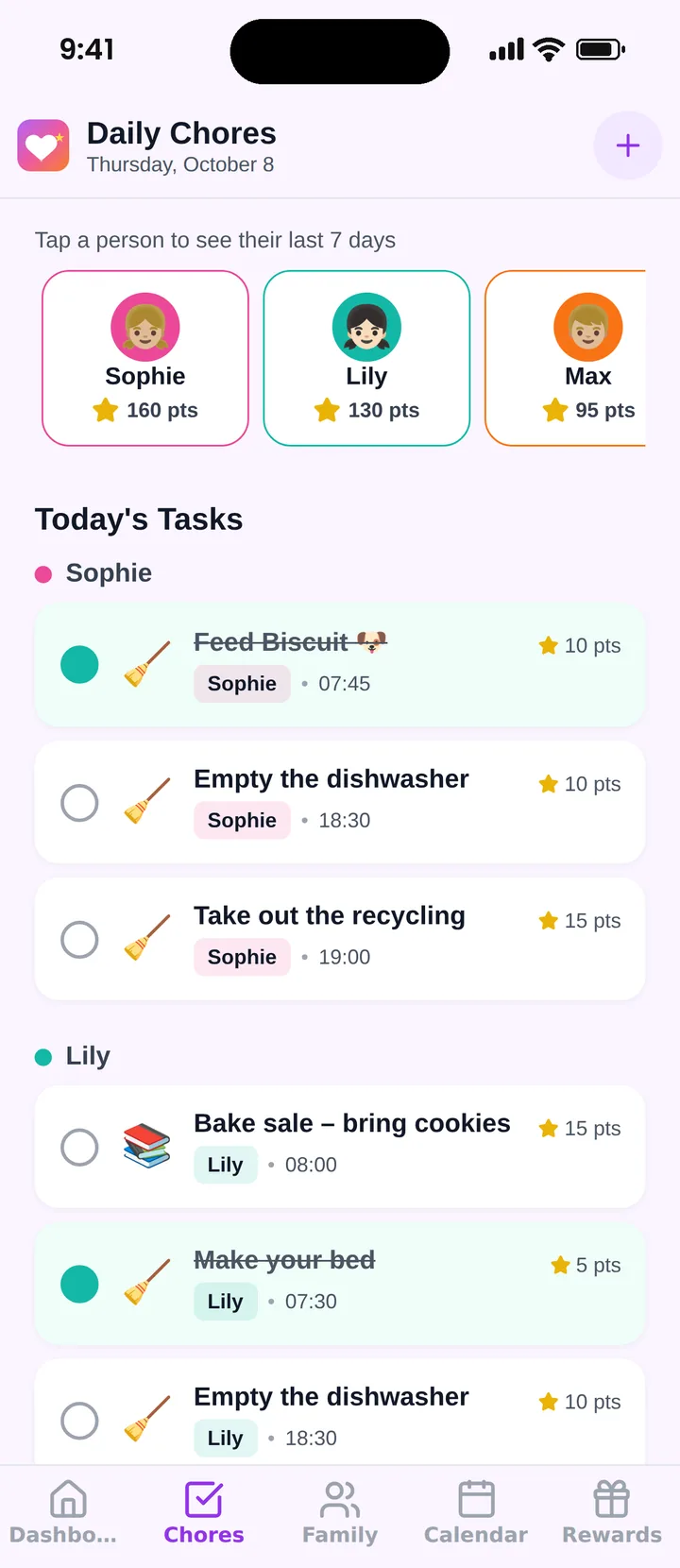
The free plan includes up to 3 family members and one repeating task, so a paper chart can still carry the rest.
Start with a single line
Print the chart tonight, circle the two behaviors that cause the most trouble, and tell your child what the first reward will be. Check boxes tomorrow evening, together, and keep it to five minutes.
Frequently asked questions
How many behaviors should be on a behavior chart?
Two to four. A short list is easier for a child to remember and for you to notice. Add a new line only when the first ones are happening most days with little effort.
What age is a behavior chart for?
It works best from about 3 to 10. Younger children need pictures and a quick check-off. Older children can use a written list. Teenagers usually prefer a talk and an agreement over a chart.
Should a behavior chart use stickers or checkmarks?
Either works. Stickers feel more fun for ages 3 to 6. Checkmarks are fine from 7 up. What matters is that the mark goes on straight after the behavior or at the same time every evening.
What should you do when a child misses a box?
Leave the box empty and move on without a lecture. Say 'Tomorrow's a new day' and start fresh. Avoid taking away earlier marks, which can make a child stop caring about the chart.
How long should you use a behavior chart?
Give it 2 to 3 weeks before judging it. Once the behaviors happen without much effort, move to checking a few times a week, then drop the chart while keeping the praise.
Try Famiyo With Your Family
Chores with points, a rewards shop for kids and one shared family calendar. Set it up in a couple of minutes.



Free to download • No credit card required • Available on iOS & Android