Chore Jar Ideas for Kids: 12 Ways to Use a Jar
Twelve chore jar ideas for kids: pick-a-chore, reward and marble jars, with slips to write for each age and tips so the jar keeps working past week two.
By Famiyo Editorial Team4 min read
A jar on the kitchen counter is a low-tech way to take the "you never help" argument out of the room. Kids reach in, pull out a slip and the jar decides. The idea has many forms: jars for choosing chores, jars for earning rewards, jars for saving up toward something. Here are twelve, with what to write on the slips and where each jar tends to go wrong.
Why a jar works (and when it doesn't)
Two things help. Chance feels fair, so the grumbling about "why do I always get the trash" drops. And a physical jar is visible, which a list on a phone is not, especially for younger children. Both work best for children aged about 4 to 10.
The limits are just as clear. A jar does not teach a child why chores matter, and random assignment can hand a 5-year-old a job that is too big. Rewards in a jar are also only as good as their size and price. If you want more on that balance, read how to reward your child without spoiling them.
Twelve chore jar ideas
- The pick-a-chore jar. Write one chore per stick. Each child draws one or two after school. Best for 6 and up.
- The color-coded jar. Use one color of stick for each age band so little kids only draw easy jobs, for example green for ages 4 to 6 and blue for 7 to 10.
- The five-minute jar. Every slip is a job that takes five minutes or less: "wipe the front of the fridge", "match all the socks in the basket". Good for the short window before dinner.
- The weekly big-job jar. One slip a week for a bigger job: "wash the car", "clean the bathroom sink". Worth a bonus in points.
- The reward jar. Slips list rewards instead of chores. After finishing the day's chores, the child draws one reward. Keep the rewards small.
- The mystery reward jar. Rewards are hidden. Chance adds excitement, but it also needs rules: no re-draws, no trading.
- The marble jar. Each finished chore adds a marble to a shared jar. When the jar is full, the family does something together, such as a movie night or pizza.
- The two jar system. One jar for chores, one for rewards. A completed chore stick moves from one to the other, which makes progress visible.
- The bonus jar. Optional extra jobs that earn extra points or a small payment. Kids choose to draw, so nobody is forced.
- The skip card jar. A few "skip a chore" cards are mixed in with the chores. Drawing one is a small win, and the rarity keeps it exciting.
- The family team jar. Slips are two-person jobs, such as "fold the towels together", which pair a younger and an older child.
- The coin jar. Kids put in a few coins for each job and watch it fill. For this one, see our guide to the chore allowance chart before you decide on amounts.
What to write on the slips
Be specific, short and visible. "Clean your room" is a fight. "Put dirty clothes in the hamper and books on the shelf" is a job. Here are sample slips by age.
| Age | Sample chore slips | Time |
|---|---|---|
| 4 to 5 | Water the plants, put toys in the bin, set the napkins | 5 to 10 minutes |
| 6 to 7 | Sweep the entry, feed the pet, sort laundry by color | 10 to 15 minutes |
| 8 to 9 | Empty the dishwasher, vacuum one room, fold a basket of towels | 15 to 20 minutes |
| 10 and up | Clean the bathroom sink, make a simple snack, change the bed sheets | 15 to 30 minutes |
For the reward slips, mix sizes. A few small ones (15 extra minutes of screen time, choose dessert), a few medium ones (pick the family movie, stay up 30 minutes later) and a rare big one (a day out). Our list of free rewards for kids is a good place to find slips that cost nothing.
Rules that keep a jar working
- One draw per turn, with no re-draws, unless you add a skip card.
- Return the stick to the jar once the chore is done, so every job stays in play.
- Review the jar once a month and remove slips that are too easy or too hard.
- Pair the jar with a clear time, such as "after snack, before screens".
- Do not use a chore as a punishment or put "go to your room" in the jar.
If points are part of your system, see delayed gratification activities for kids for ways to help children wait for bigger rewards.
When the jar stops working
The usual cause is that the novelty has worn off. By week three, kids know what is in the jar. Refresh it: add new slips, swap rewards and let the children write some of the slips. If a child keeps skipping the draw, check whether the chores are too big or the rewards too far away. If they are, a smaller jar with faster rewards usually brings it back.
A digital version of the reward jar
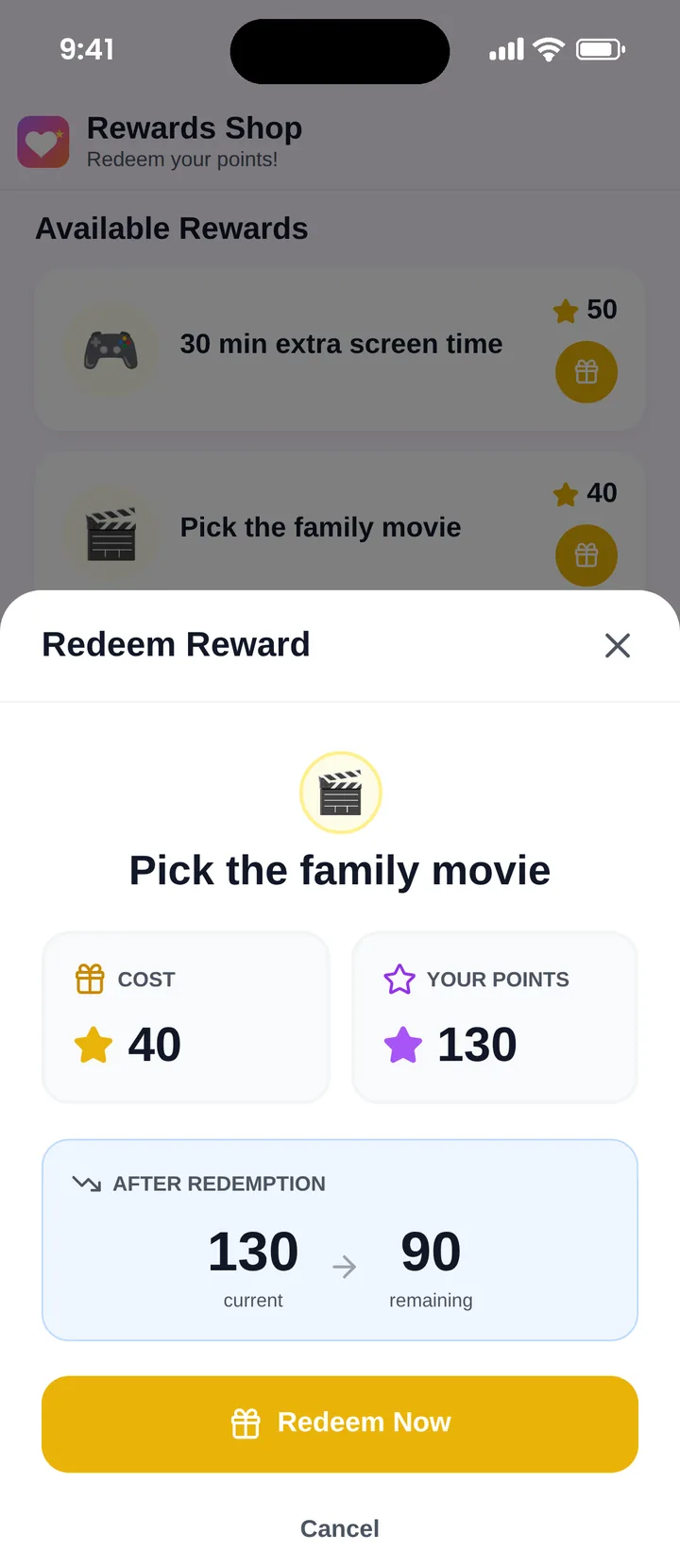
Famiyo is a free family app for iPhone and Android that combines a shared family calendar, chores with points and a rewards shop; kids join with a code, no email needed. The rewards shop works like a reward jar that never runs out of slips. You create rewards with a price in points, how many are available and when. Kids redeem from their own phone and see how many points they will have left. Chores that are done add points, and you get a notification when something is redeemed.
For other ways to track rewards, see our list of the best reward chart apps for kids.
Start with one jar and ten slips. You can expand it once the first week goes well.
Frequently asked questions
What is a chore jar?
A chore jar is a jar of folded slips or sticks, each with a chore or a reward written on it. Kids draw one at random. It turns assignment into a small game and removes the argument about who does what.
What do you put in a chore jar?
Write short, specific tasks that take 5 to 15 minutes, such as 'wipe the kitchen table' or 'sort the shoes by the door.' Use a different color of stick for each child's age, so little kids draw only age-appropriate jobs.
Do chore jars work for kids who don't like chores?
They help, because the chance element feels more like a game than a command. They do not fix a chore load that is too big. If chores are still a fight after two weeks, shrink the jobs or reduce the number per day.
How many chores should a kid draw from the jar each day?
One to three. A preschooler might draw one, a school-age child two or three. Add up the minutes: about 15 to 20 minutes a day for ages 6 to 7, and 20 to 30 for ages 8 to 9.
Try Famiyo With Your Family
Chores with points, a rewards shop for kids and one shared family calendar. Set it up in a couple of minutes.



Free to download • No credit card required • Available on iOS & Android