Token System for Kids With ADHD: How to Set One Up
A token system for kids with ADHD works when tokens come fast, rewards are cheap and frequent, and the rules are visible. Here is how to build one, step by step.
By Famiyo Editorial Team6 min read
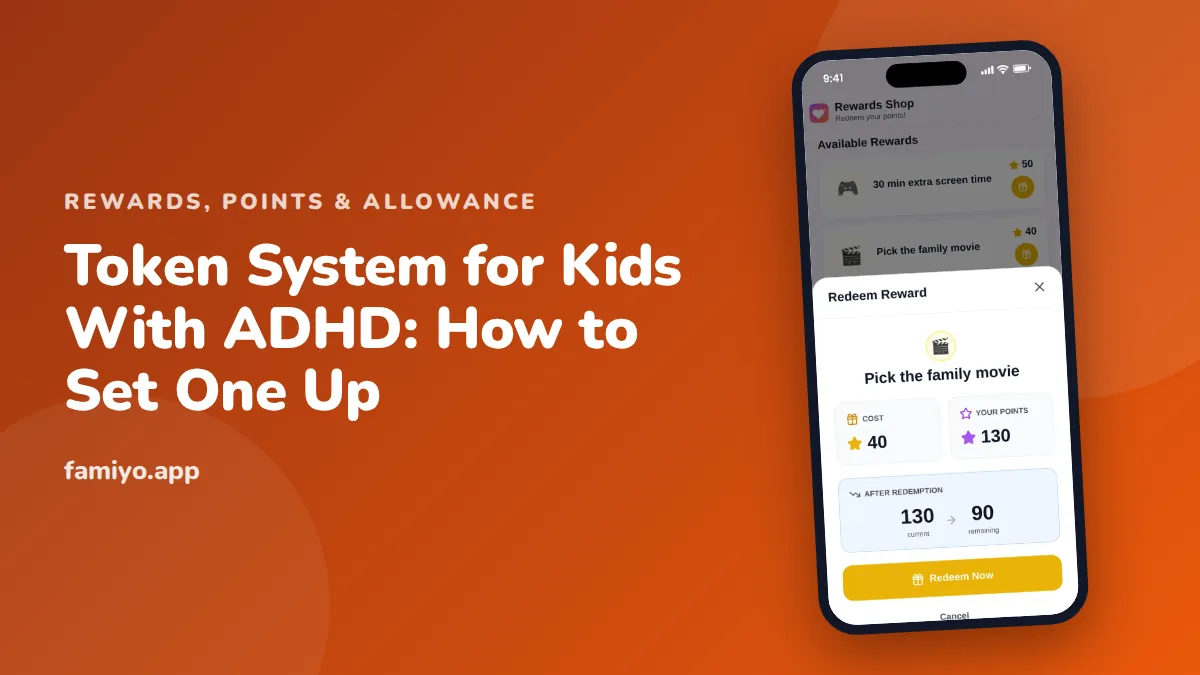
If your child has ADHD, you have probably noticed that "you'll get a treat on Friday" has almost no grip on a Tuesday afternoon. Tokens exist to fix exactly that: they bring the reward close to the behavior, in small pieces, in a form the child can see. This guide explains why the format suits kids with ADHD, how to design the targets, the token values and the reward menu, how to run a sample week, and what to change when the novelty wears off.
A note before we start. This is general parenting information, not medical advice. Your child's pediatrician or therapist knows their situation and can help you fit a system into their wider plan.
Why tokens suit kids with ADHD
Children with ADHD often struggle with working memory, with sustaining effort on tasks that are not interesting, and with waiting for a payoff that is far away. Widely published guidance, including from the American Academy of Pediatrics and the CDC, names behavior management training for parents as a core part of ADHD care, and consistent, immediate positive feedback is a central idea in it.
A token system puts that idea into practice:
- The token is immediate. It bridges the gap between the behavior and a bigger reward.
- It is visible. A jar, a board or an app screen shows progress, so the child doesn't need to hold it in memory.
- It is predictable. The same action earns the same tokens, which makes the adult's reaction less emotional.
- It teaches saving, in small steps. A child can choose between a small reward now and a bigger one later.
None of this works as a cure for attention differences, and it won't fix every difficult morning. It is a structure that makes it easier to notice and reward what goes right.
Step 1: Choose two or three targets
Pick behaviors you can see and count. "Be responsible" is not a target. "Put your shoes and bag by the door" is.
Good starter targets for a school-age child:
- Get dressed and brush teeth by the time on the visual schedule.
- Start homework within five minutes of being asked, without more than one reminder.
- Put dishes in the sink after dinner.
- Pack the school bag the night before.
Keep the list short and positive: what to do, not what to stop doing. If you try to cover everything the first week, the system collapses and so does your credibility with the child. Add a fourth target only after the first three feel routine, usually after two to three weeks.
Step 2: Set the token values
Small tasks get small amounts, and bigger jobs get more. If you want a ready scale, the one Famiyo suggests is a useful reference.
| Task size | Example | Points |
|---|---|---|
| Small (2 to 5 minutes) | Make the bed, feed the pet | 5 |
| Medium (10 to 15 minutes) | Empty the dishwasher, tidy the room | 10 |
| Big (30 minutes or more) | Clean the bathroom, mow the lawn | 20 |
| Bonus | Done without a reminder | +2 |
For a child with ADHD, the bonus is worth keeping for the targets you most want to become automatic. And pay the token on the spot. If you are not near the board or the phone, say it aloud ("That is five for the bag") and record it within a few minutes.
Step 3: Build a reward menu with real choices
A weak reward menu is the usual reason token systems stall. The rewards should be things your child actually wants, available in many sizes, and cheap enough that something is always within reach.
| Reward size | Examples | Price |
|---|---|---|
| Small | 15 extra minutes of screen time, choose dessert | 30 to 50 points |
| Medium | Pick the family movie, stay up 30 minutes later | 100 points |
| Big | A day out, a toy around $20 | 300 to 500 points |
Aim for a child to afford a small reward every 2 to 3 days. For a child who needs quick wins, it can help to start even tighter in the first week, so they cash in something within a day, and then widen the gap as the habit settles. Let your child help write the menu. It adds buy-in and tells you what actually motivates them.
Rewards that are experiences with a parent often work better than more stuff, and they cost nothing. Time with you is one of the strongest choices on any menu.
Step 4: Make it visible and make it simple
Out of sight, out of mind is doubly true with ADHD. Put the board on the fridge or keep the app on the home screen. A few design rules:
- Show tokens as they are earned, not as a total at the end of the week.
- Keep the system on one page or one screen.
- Use pictures or short words for young children.
- Review the rules once, calmly, before you start, not in the middle of a conflict.
What a first week can look like
Say your 8-year-old has three targets: get ready for school on time (10 points), start homework when asked (10), and dishes to the sink (5), plus a +2 bonus for no reminder.
| Day | Targets met | Points |
|---|---|---|
| Monday | Ready on time, homework, dishes | 25 |
| Tuesday | Ready on time (with bonus), dishes | 17 |
| Wednesday | Homework, dishes | 15 |
| Thursday | Ready on time, homework, dishes (homework bonus) | 27 |
| Friday | Dishes | 5 |
That is 89 points in a week, enough for a small reward most days and a medium one by the weekend. Wednesday and Friday are not failures. A child who hits two of three targets is doing the thing the system is built to reward. Keep your tone flat and warm: "You earned fifteen today. Want to cash in or save?"
When tokens stop working
Almost every system loses steam around week three or four. That does not mean it failed. Try these in order:
- Refresh the reward menu with one or two new items the child picked.
- Make rewards easier to reach for a few days.
- Add a time-limited bonus, such as double points on one target this week.
- Check the targets. If a child never earns, the task is too big; split it into steps.
- Look at your own consistency. Skipped tokens are the quickest way to lose trust.
Take tokens away only with care. A small, predictable cost for one specific behavior can work for some children, but many with ADHD respond to loss with shutdown or anger. Earning is the safer default.
If your system is meant to cover more than ADHD behaviors, such as general family chores, our guide to the token economy for kids covers the wider setup, and the page on positive reinforcement for kids with ADHD covers praise and feedback outside the token system. For families whose child also has autism, see the token system for kids with autism.
Running the reward shop in Famiyo
Some children lose the paper board in a week. A phone screen they already carry is harder to lose.
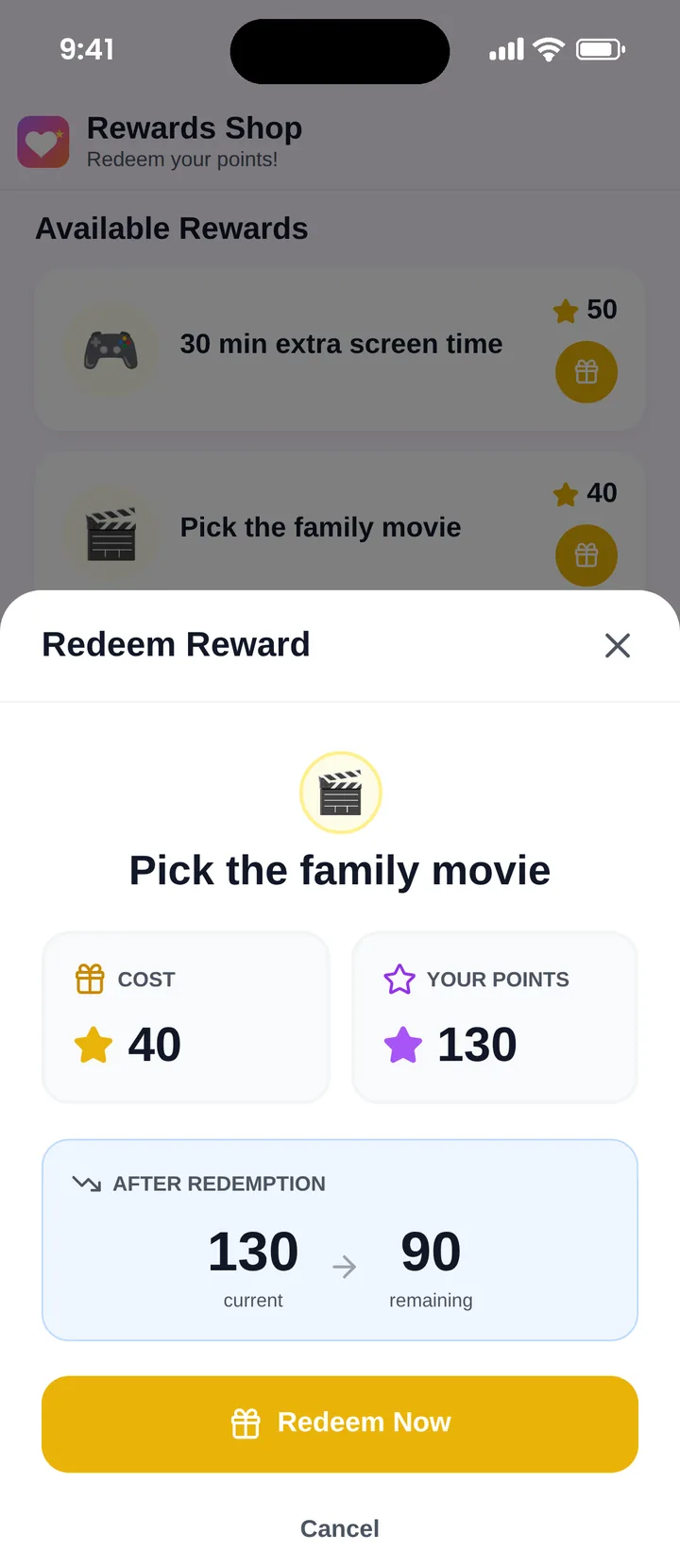
Famiyo is a free family app for iPhone and Android that combines a shared family calendar, chores with points and a rewards shop; kids join with a code, no email needed. In the rewards shop you create each reward with a price in points, set how many are available and choose when it can be claimed, so "movie pick" can be limited to once a week. Your child redeems from their own phone and sees how many points they will have left, which makes the trade-off concrete. You get a push notification when a reward is redeemed. Chores can carry their own points for each child, so siblings can have different targets.
Want to compare apps first? See our list of the best reward chart apps for kids.
Start this week with two targets, six or seven rewards and a rule that tokens are paid on the spot. Review it after two weeks with your child, and change one thing at a time.
Frequently asked questions
Do token systems work for kids with ADHD?
Many families find them useful, and behavior-based strategies like token systems are a standard part of the guidance for parents of children with ADHD. Results depend on the child. Speed of feedback and small, frequent rewards matter most.
How fast should a child with ADHD get the token?
As close to the behavior as you can manage, ideally within seconds or minutes. Delayed rewards, like a sticker at bedtime, tend to lose their pull. Start with immediate tokens and stretch the gap slowly.
Should I take tokens away for bad behavior?
Use it sparingly, if at all. Losing tokens can feel crushing and lead to giving up. Many parents start with earning only, then add a small, predictable cost for one or two specific behaviors if needed.
What if my child loses interest in the tokens?
That is common after a few weeks. Refresh the reward menu, add a surprise or a short-term bonus, and check that targets are still the right size. A system that never changes tends to fade.
How many behaviors should I track at once?
Start with two or three clear, observable ones, such as getting dressed or starting homework when asked. Tracking ten things at once overwhelms children and parents alike, and nobody can tell what is being rewarded.
Try Famiyo With Your Family
Chores with points, a rewards shop for kids and one shared family calendar. Set it up in a couple of minutes.



Free to download • No credit card required • Available on iOS & Android