Chore Point System: How Many Points per Chore?
How many points each chore should be worth, how to price rewards so kids can actually afford them, and a worked week of points for a 9-year-old.
By Famiyo Editorial Team6 min read
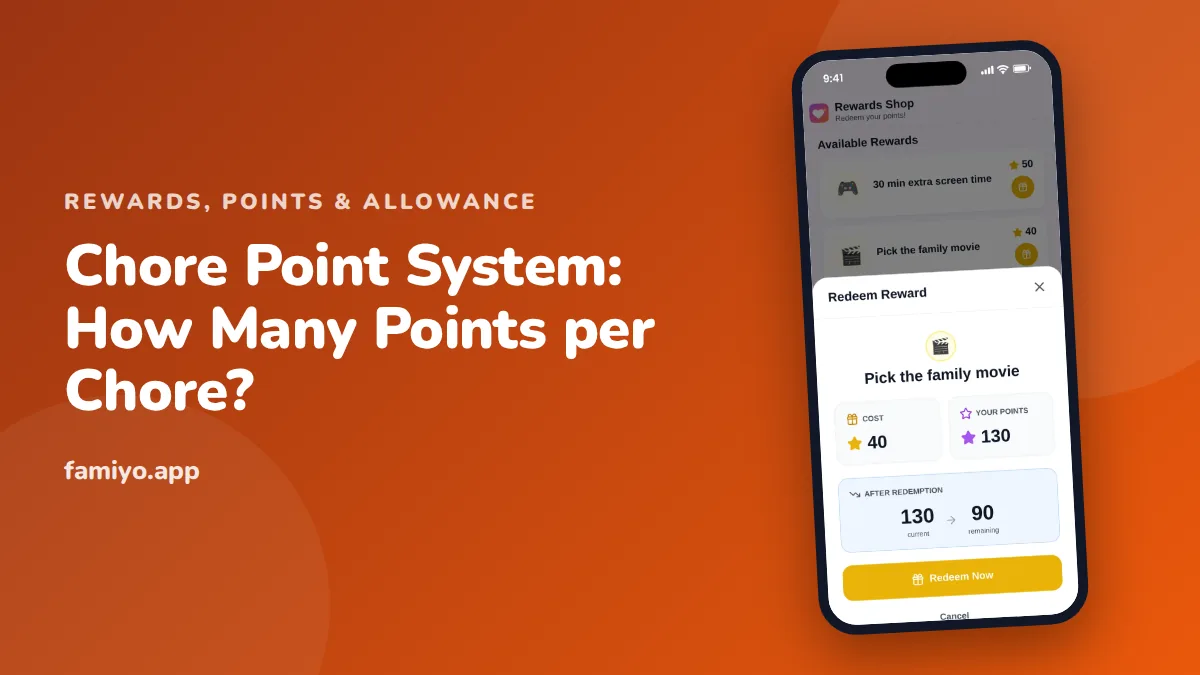
Points suit chores well because they turn effort into a number a child can watch grow. The hard part is choosing the numbers. Price chores too low and kids lose interest; price rewards too high and the whole system stalls by week two. Below you'll find a point scale, reward prices that balance against it, a worked example week, and the reasoning behind each choice.
How many points should a chore be worth?
Base the value on how long the chore takes, not on how much you dislike doing it yourself. Time is something a child can see and predict, so the scale feels fair, and it ends the "why is that worth more?" negotiation before it starts.
Three sizes are enough:
| Size | Time | Example chores | Points |
|---|---|---|---|
| Small | 2 to 5 minutes | Make the bed, feed the pet, hang up the towel, put shoes away | 5 |
| Medium | 10 to 15 minutes | Empty the dishwasher, tidy the room, set and clear the table, fold a basket of laundry | 10 |
| Big | 30 minutes or more | Clean the bathroom, mow the lawn, wash the car | 20 |
| Bonus | Any size | Done without a reminder | +2 |
Why not a finer scale with 7-point and 12-point chores? Children under about 8 can't meaningfully compare small differences, and older kids tend to treat them as an opening bid. A three-step scale is easy to remember and hard to argue with.
The bonus does more work than its size suggests. It rewards the specific behavior most parents want, which is doing the job without being asked, and it keeps the base values stable.
One refinement: the same chore can be worth different points to different children. Making the bed is a real stretch for a 5-year-old and trivial for a 12-year-old. Giving the younger child 10 points and the older one 5 reflects effort, not favoritism, and most kids accept that when you explain it in those terms.
How to price rewards so the system balances
A chore point system is really two price lists that have to match: what chores pay and what rewards cost. Here is the reward side.
| Reward size | Examples | Price |
|---|---|---|
| Small | 15 extra minutes of screen time, choose dessert | 30 to 50 points |
| Medium | Pick the family movie, stay up 30 minutes later | 100 points |
| Big | A day out, a toy around $20 | 300 to 500 points |
The target pace: a child should be able to afford a small reward every 2 to 3 days and a big one every 3 to 4 weeks. To check your own numbers, follow these steps:
- List every chore a child has in a normal week and add up the points they could earn, including the weekly big job.
- Assume they won't hit every box. Missed days are normal, especially at the start.
- Price small rewards at roughly 2 to 3 days of earnings, so the first one is reachable within the first half of the week.
- Price big rewards at roughly two weeks of full earnings. Since kids spend some points along the way, saving up takes 3 to 4 weeks in practice.
- Run the numbers on paper for one week before you announce anything.
- If the balance is off later, change reward prices or add new rewards rather than cutting chore values. A lower price on a reward reads as a sale; a lower value on a chore reads as a pay cut.
A sample week of points for a 9-year-old
Say your 9-year-old has three daily chores: make the bed (5), feed the dog (5) and load the dishwasher after dinner (10). That's 20 points on a full day. On Saturday they also vacuum the living room and hallway, a big job worth 20.
| Day | What got done | Earned | Spent | Balance |
|---|---|---|---|---|
| Mon | Bed (no reminder), dog, dishwasher | 22 | 0 | 22 |
| Tue | Dog, dishwasher (bed missed) | 15 | 0 | 37 |
| Wed | Bed, dog, dishwasher | 20 | 40, choose dessert | 17 |
| Thu | Bed and dog without reminders, dishwasher | 24 | 0 | 41 |
| Fri | Bed, dog, dishwasher | 20 | 0 | 61 |
| Sat | All three plus vacuuming, bed without reminder | 42 | 40, 15 minutes of screen time | 63 |
| Sun | Bed, dog, dishwasher | 20 | 0 | 83 |
The week brings in 163 points. The child buys two small rewards and still ends with 83 saved, which puts a 300-point day out about four weeks away. That's the pace you want: something to enjoy midweek, something bigger to plan for.
Notice Tuesday. The bed was missed, so those 5 points simply weren't earned. Nothing was taken away, and Wednesday started normally.
Adjusting the scale by age
The scale above fits most children from about 6 to 9. Outside that range, change the rhythm more than the numbers.
- Ages 3 to 5: Numbers are abstract at this age, so make points visible, such as stickers or tokens in a jar, and keep the first reward reachable within a day or two. Waiting a week is too long for most preschoolers.
- Ages 6 to 9: Use the standard scale. This is the age when watching a balance grow becomes motivating in its own right.
- Ages 10 to 12: Add bigger weekly jobs and bigger goals. A 500-point reward that takes a month to reach is a good, low-stakes way to practice waiting, which our piece on delayed gratification for kids explains in more depth.
- Teens: Points can feel babyish unless they buy something real. Many families convert at 100 points = $1 or tie points to privileges a teen cares about. If you're weighing money against points, see our complete guide to allowance for kids.
Why a chore point system works, and when it backfires
A point system is a simple version of what psychologists call a token economy, an approach used for decades in classrooms and behavior programs. The principle behind it is well established: behavior that is followed quickly and consistently by something pleasant tends to happen more often. That's why 5 points tonight usually beats a promised prize at the end of the month. The American Academy of Pediatrics also encourages parents to put more attention on praising the behavior they want than on punishing what they don't, and points give that praise a concrete form.
The same principle explains the common failures:
- Points for everything. If passing the salt earns points, kids start asking "how many points?" before helping with anything. Keep points for real chores.
- Inflation. Raising chore values every time motivation dips makes rewards feel cheap and the numbers lose meaning. Refresh the reward list instead.
- Deductions. Taking points away turns a reward system into a punishment system. Children with a low balance often just stop trying.
- Rewarding what they already love. Motivation researchers have long described an "overjustification effect": paying a child for something they enjoy can make it feel like work. If your daughter loves baking, don't put baking on the points list.
- Never fading. Once a chore has been automatic for 2 to 3 weeks, move it off the points list and add a new one. The aim is a habit, not a lifelong paycheck. Our article on intrinsic motivation in kids covers how to make that shift.
Pair points with specific words, every time: "You fed Max before I even asked. That's 7 points, and he was happy." The points carry the signal; the words explain what earned them.
Running the points in Famiyo
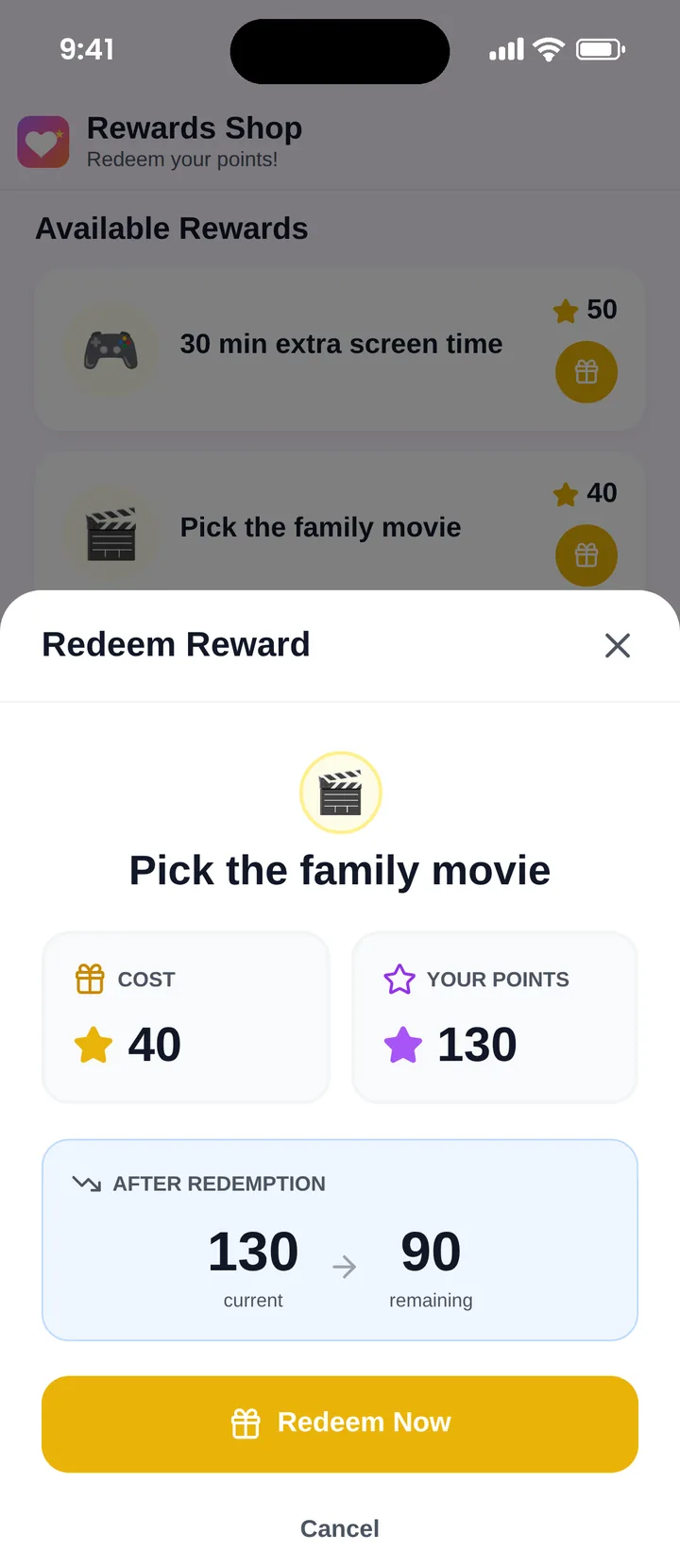
Famiyo is a free family app for iPhone and Android that combines a shared family calendar, chores with points and a rewards shop; kids join with a code, no email needed. Each chore gets a point value, and the same chore can be worth a different number of points for each child, so the 10-for-the-5-year-old, 5-for-the-12-year-old split takes one setting. In the rewards shop you set each reward's price in points, how many are available and when, for example "Pick the family movie, 100 points, Fridays only." Kids redeem from their own phone and see how many points they'll have left before they confirm, and you get a notification.
For other options, see our list of the best reward chart apps for kids.
Start this week with the three-size scale and three rewards, one at each price level. After 2 to 3 weeks, look at the balances and adjust prices, not chore values.
Frequently asked questions
Should you take points away for bad behavior?
Most families do better keeping chore points earn-only. Deducting points mixes chores with discipline, and a child whose balance drops to zero has little reason to keep going. Handle behavior separately. If a chore isn't done, the consequence is simply that those points weren't earned that day.
How many points should a child earn in a week?
Enough to afford a small reward a couple of times a week and still save for a big one in about 3 to 4 weeks. With small rewards at 30 to 50 points and big ones at 300 to 500, a school-age child usually needs to earn somewhere around 150 to 170 points a week.
Can chore points be converted to money?
Yes. A common conversion is 100 points = $1, which keeps the math easy for kids to follow. Many families keep everyday chores in points and use cash only for extra paid jobs, so money doesn't replace the basic expectation that everyone helps at home.
Do point systems hurt a child's intrinsic motivation?
They can if you reward things a child already enjoys, or if the system never changes. Points work best for chores kids find dull, paired with specific praise, and faded as habits form. Moving a chore off the points list once it's automatic is a normal and healthy step.
Try Famiyo With Your Family
Chores with points, a rewards shop for kids and one shared family calendar. Set it up in a couple of minutes.



Free to download • No credit card required • Available on iOS & Android