How to Reward Your Child Without Spoiling Them
How to reward your child without spoiling them: what to reward, how big rewards should be, when to use praise instead, and what to say so it motivates.
By Famiyo Editorial Team5 min read
Every parent has had the moment: a child asks for a treat for doing something they were going to do anyway, and you wonder whether you are building a negotiator. Rewards are not the problem. Unplanned rewards, large rewards and rewards for the wrong things are. This guide covers what to reward, how big to make it, and how to phase rewards out so they help rather than spoil.
What spoiling actually looks like
Spoiling is not giving a child nice things. It is when a child expects rewards for ordinary expectations, when the size of the prize keeps growing, or when rewards appear mainly to stop a tantrum. A few signs to watch for:
- "What do I get?" before any request, even small ones
- Rewards that have to get bigger to work
- Effort that disappears when the reward is not on offer
- You offering something while your child is mid-meltdown
The American Academy of Pediatrics recommends positive attention and praise as the first tool for encouraging good behavior. Rewards sit on top of that. They are useful for specific habits, but they do not replace warmth.
Reward, bribe or praise?
These three are easy to mix up. This table separates them.
| Praise | Reward | Bribe | |
|---|---|---|---|
| When it is offered | After, unplanned | Agreed before, given after | During a problem |
| Example | "You tied your own shoes!" | 30 points for 3 days of making the bed | "Stop screaming and I'll buy you candy" |
| Best for | Everyday good behavior | Building a habit that is hard or dull | Nothing, avoid it |
| Risk | Almost none | Dependence if never faded | Teaches that bad behavior pays |
Most days, praise is enough. Use a reward system when the task is dull, the habit is new or you keep having the same argument.
How to reward your child, step by step
- Pick one habit. Reward "makes the bed before school" or "puts shoes in the basket", not "being good". A child cannot aim at something vague.
- Decide the reward before you start, and tell your child in a calm moment. "This week, if you feed the dog every morning, you can pick the Friday movie."
- Make it close. Young children need a reward within a day or two. Older kids can wait a week.
- Give it every time they earn it, quickly, with a few words about what they did. "You fed the dog without me asking. That helped."
- Keep it small. A reward should feel like a pleasant bonus, not a payday.
- After a few weeks, make the reward less frequent, then stop it. Keep the praise.
How big should a reward be?
Use a ladder: many small rewards, a few medium ones and a rare big one. A points system lets the child see the ladder.
| Reward size | Examples | Price in points |
|---|---|---|
| Small | 15 extra minutes of screen time, choose dessert | 30 to 50 |
| Medium | Pick the family movie, stay up 30 minutes later | 100 |
| Big | A day out, a toy around $20 | 300 to 500 |
A sensible target is that a child can afford a small reward every 2 to 3 days and a big one every 3 to 4 weeks. If a big reward takes months, a young child will give up. If a small one comes every day, it stops meaning anything.
Rewards that rarely backfire
Some rewards teach better habits than others. Rewards that tend to work well are time and choice: a game with a parent, choosing the dinner or the weekend outing, a later bedtime on a non-school night. They cost little and they also strengthen your relationship. Our list of free rewards for kids has 50 ideas.
Food rewards deserve caution. Using sweets as a regular prize can teach children to connect treats with good behavior, and that pattern is hard to undo. An occasional special dessert is fine. A daily candy bargain is worth rethinking.
For a different format that suits younger children, see our chore jar ideas for kids.
What to say when you give the reward
The words matter as much as the prize. Name the action, the effort and the effect, in that order, in a calm voice. "You packed your bag without me asking, so you're ready before breakfast. Here's your 10 points." Skip the vague "good job" and avoid comparing with a sibling. Specific feedback tells the child what to repeat, and it keeps the reward tied to something they did rather than to who they are.
If your child asks for a reward in advance, answer gently: "That's something you earn after the job. Want to pick what you're working toward?" It acknowledges the want without turning it into a negotiation.
What not to reward
Do not reward basic expectations like brushing teeth, being kind to a sibling or telling the truth. Those are family rules. Do not reward the outcome of something outside the child's control, and be careful with rewards for activities they already enjoy. If your child loves reading, a prize for every book may make reading feel like a job. For help with that specific case, see how to reward kids for good behavior.
What to do when rewards stop working
If your child stops caring about the reward, check four things. Is it too far away? Is it too small or too repetitive? Has the habit become easy enough that a reward is no longer needed? Or are the rules unclear? Often the fix is shortening the wait or letting your child choose from a few rewards. If the habit is now automatic, that is a success: fade the reward and say thank you.
Doing this with Famiyo
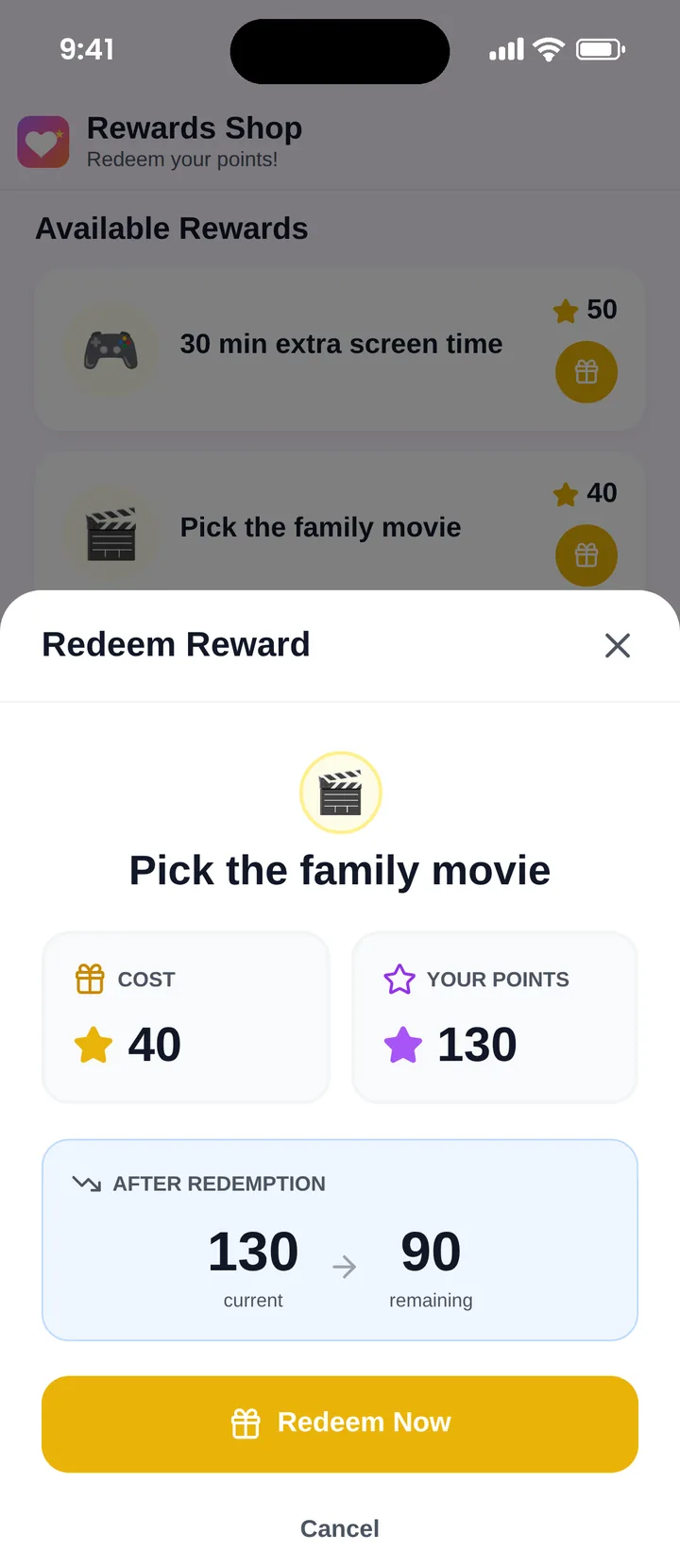
Famiyo is a free family app for iPhone and Android that combines a shared family calendar, chores with points and a rewards shop; kids join with a code, no email needed. In the rewards shop you create rewards with a price in points, how many are available and when. Kids see the shop on their own phone, pick a reward and see how many points they will have left before they confirm. You get a notification when something is redeemed, which makes the follow-through easy.
For other options, see our list of the best reward chart apps for kids.
Start with one habit and one small reward this week. You can always add more once that works.
Frequently asked questions
What is the difference between a reward and a bribe?
A reward is agreed in advance and given after the task. A bribe is offered in the middle of a meltdown to make it stop. If you only offer a treat when your child is already misbehaving, they learn that misbehaving gets treats.
Do rewards make kids lose motivation?
They can. Research on motivation has long suggested that paying children for something they already enjoy, like drawing, can reduce interest in it. Use rewards for tasks kids find dull, such as chores, and rely on praise and attention for things they like doing.
How often should I reward my child?
While building a new habit, reward often and quickly: a small reward every 2 to 3 days works for most children. Once the habit is steady, make rewards less frequent and less predictable, and lean on praise and thanks.
Should I reward good grades?
Reward the effort you control, such as finishing homework before dinner or studying for 20 minutes, rather than the grade itself. A reward tied to a grade can feel unfair to a child who worked hard and still got a B.
Try Famiyo With Your Family
Chores with points, a rewards shop for kids and one shared family calendar. Set it up in a couple of minutes.



Free to download • No credit card required • Available on iOS & Android