Paid Chores for 6-Year-Olds: Jobs to Earn Money and What to Pay
Paid chores for a 6-year-old: 15 extra jobs worth $0.25 to $5, what to keep unpaid, a sample week, and how to run it with cash, points or both.
By Famiyo Editorial Team5 min read
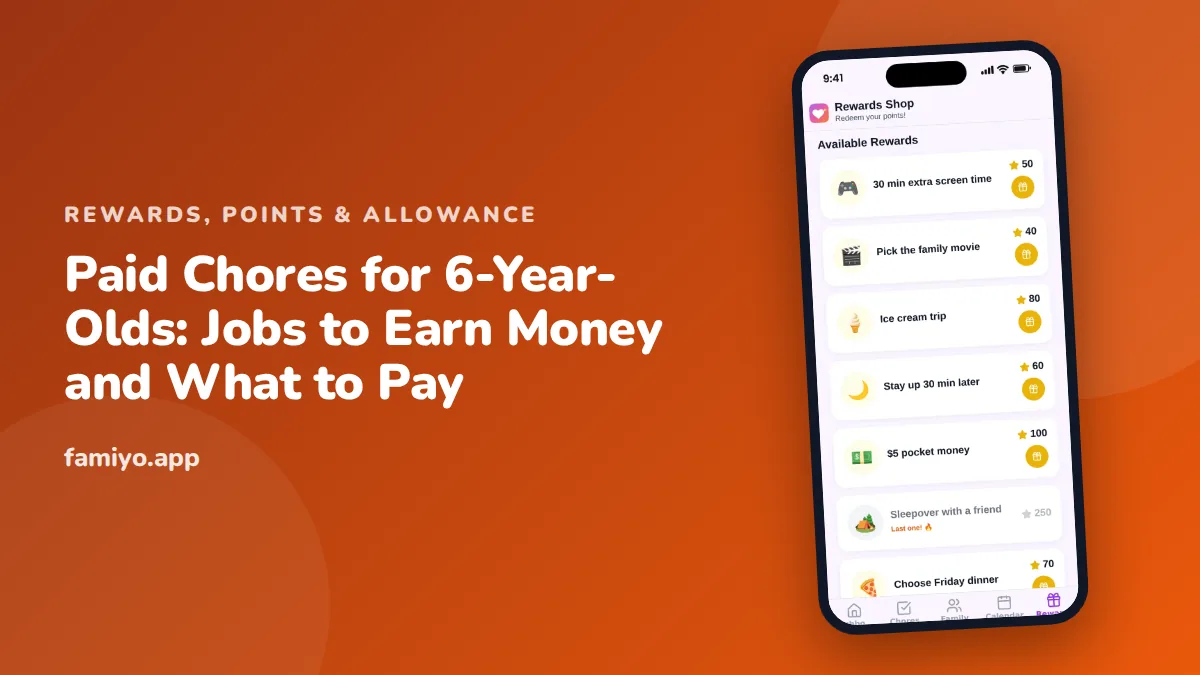
A 6-year-old who asks "can I earn money?" is usually asking something bigger: how does stuff get bought? That curiosity is worth using. This page lists 15 paid extra jobs sized for a first-grader, what each one should pay, what to leave unpaid, and a few ways to handle the money now that most of it lives on a screen.
Paid chores vs. chores that are just part of the family
Before the list, one line to draw. Basic chores stay unpaid. Making the bed, clearing their own place, putting dirty clothes in the hamper and tidying their room are what a person who lives in a house does. A 6-year-old can do about 15 to 20 minutes of those daily, as in our guide to chores for 6-year-olds.
Paid jobs are extras, the kind of thing you might otherwise hire out or skip. That keeps the lesson clean: you are part of a family and you help, and you can also choose to work for extra money.
If you want to hear the full argument for and against, our page on whether kids should get paid for chores lays out both sides.
15 paid jobs a 6-year-old can really do
Pay is a starting point, in line with the usual ranges: $0.25 to $1 for a small job, $2 to $5 for a big one. If you use points, a handy rate is 100 points = $1, so 25 points is a quarter.
| Job | What done looks like | Typical pay | Points |
|---|---|---|---|
| Match and roll a basket of socks | All pairs found, rolled, in the drawer | $0.25 | 25 |
| Wipe the kitchen table after dinner | No crumbs, chairs pushed in | $0.25 | 25 |
| Water the houseplants | Every plant, no puddles | $0.25 | 25 |
| Bring in the mail | All of it on the counter | $0.25 | 25 |
| Sort the recycling | Paper, cans and plastic in the right bins | $0.50 | 50 |
| Dust the baseboards with a sock | One room, low surfaces | $0.50 | 50 |
| Pull weeds | One bucket filled | $0.50 | 50 |
| Wipe the bathroom mirror and sink | Streak-free, counter clear | $0.50 | 50 |
| Help wash the car | Lower doors and tires, with a sponge | $1 | 100 |
| Rake a small patch of leaves | One pile, off the path | $1 | 100 |
| Organize a toy shelf | Items grouped, labels or pictures on bins | $1 | 100 |
| Sweep the porch or garage floor | Pile in the dustpan | $1 | 100 |
| Help clean out the car | Wrappers in a bag, toys in a box | $2 | 200 |
| Wash and dry unbreakable dishes with you | Done together, put away | $2 | 200 |
| Help with a big weekend clean-up | A job list of their own | $3 to $5 | 300 to 500 |
You'll notice nothing sharp, hot or chemical. For a 6-year-old, the job should be doable without an adult hovering.
How to set it up so it doesn't become a negotiation
A few ground rules save you from daily haggling.
- Post the price before the job. "Raking the leaf pile is a dollar" avoids "how much for this?" after the fact.
- Pay for finished jobs only. If it isn't done, there's nothing to pay, and you don't need to scold.
- Let paid jobs be optional. A child can say no. That's part of the lesson: money comes from choices.
- Limit how many extras count each week. A cap around the $3 to $7 weekly range for ages 5 to 7 keeps it from becoming a part-time job.
- Pay promptly. A 6-year-old's sense of "later" is short, and a payment the same day makes the link obvious.
Sample week, with daily basics unpaid:
| Day | Paid extra | Pay |
|---|---|---|
| Monday | Water the plants | $0.25 |
| Wednesday | Sort the recycling | $0.50 |
| Saturday | Help wash the car | $1 |
| Saturday | Pull weeds, one bucket | $0.50 |
| Sunday | Organize the toy shelf | $1 |
That adds up to $3.25. It fits the range and leaves room for a bigger job if there is a goal.
Teach what to do with it
Money earned at 6 has to land somewhere. A simple split works well: spend, save, give, such as 50%, 40% and 10%. With $3.25 that is about $1.60, $1.30 and $0.35. Three clear jars make this concrete. You'll round, and that's fine.
Pick a goal together, like a toy around $10. Count the weeks. Seeing the coins pile up teaches saving better than a lecture. For the bigger picture, see our guide to point systems for kids, which covers how earning and spending loop together.
What to say when your child asks for money
A 6-year-old will ask for money at the worst moments, usually in a store. Having a few lines ready keeps you calm and consistent.
- At the checkout: "That costs $4. You have $2.50 in your save jar. Want to add jobs this week and buy it on Saturday?"
- After a finished job: "You raked the whole pile. That's $1, and you choose which jar it goes in."
- When a job is skipped: "The weeds are still there, so no payment today. They'll be here tomorrow if you want them."
- When they want pay for a basic job: "Making your bed is a family job, like brushing teeth. Paid jobs are the extra ones on the list."
Keep it matter-of-fact. The aim is for money to feel like a result of effort and choice, not a mood or a bargaining chip.
What if interest fades after a few weeks?
It often does. A 6-year-old's attention for any system runs about two to three weeks before it needs a nudge. Rotate the job list, add one new paid job, or raise the goal ("one more week and the $10 toy is yours"). If they stop caring about money altogether, offer a non-cash choice like a park trip or a movie pick, which a points system handles easily.
Cash, points or both?
Plenty of kids' money is digital now, so a 6-year-old sees cards and phones more than coins. That does not mean skipping cash. Coins and bills are easier to count, and they teach what a dollar is.
Points offer something cash can't: choice. A child can trade 300 points for a family movie night, a small toy or $3 of pocket money. The one catch is that points have to mean something, so keep the rate fixed and don't change it mid-week.
Whatever you pick, the real money, if there is any, changes hands outside any app.
Doing this with Famiyo
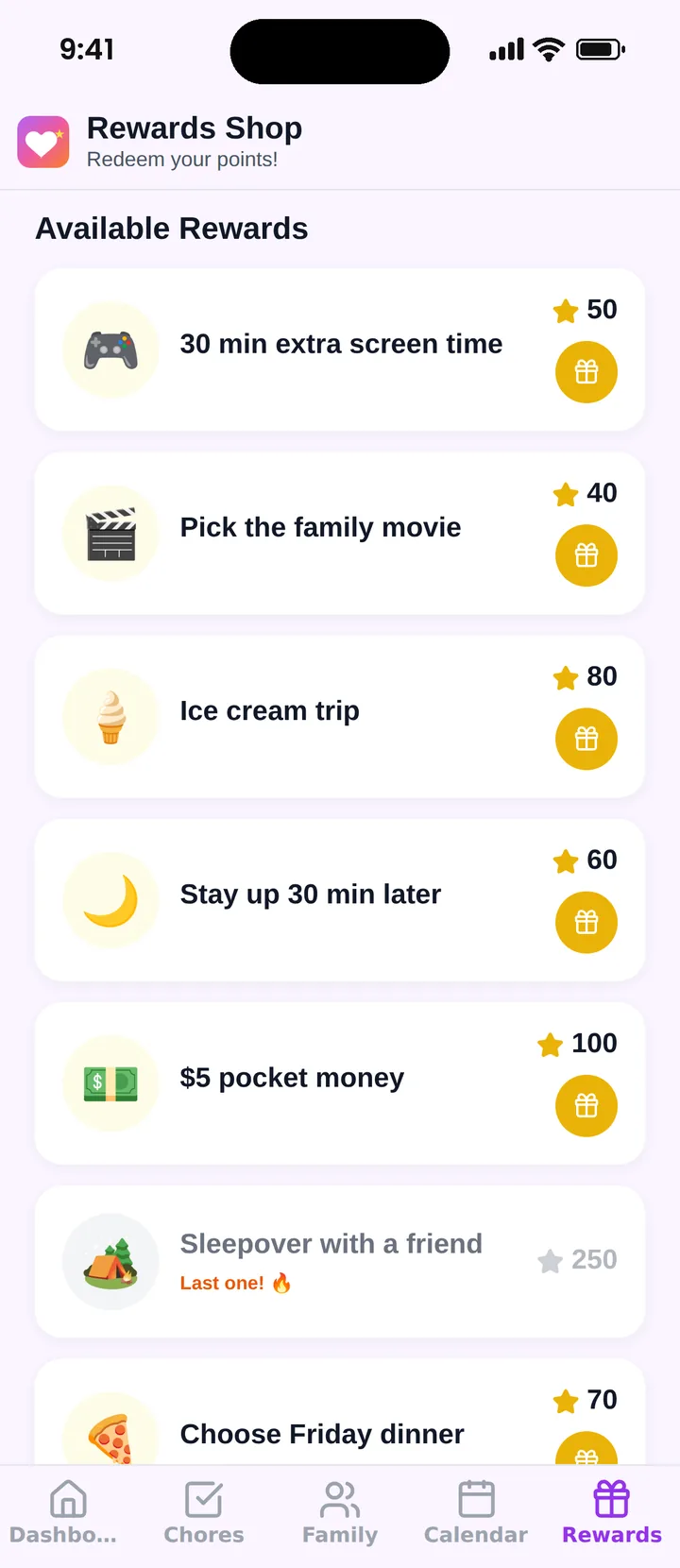
Famiyo is a free family app for iPhone and Android that combines a shared family calendar, chores with points and a rewards shop; kids join with a code, no email needed. Set each extra job as a chore with points, and let your child check it off on their own phone, or approve it yourself first. Points then go to the rewards shop, where you set the price, how many are available and when. One reward can be pocket money, for example $1 for 100 points, and you hand over the cash yourself.
Compare options in our list of the best allowance apps for kids. For the next year up, see paid chores for 7-year-olds.
Pick three jobs from the table this weekend, post the prices on the fridge, and let your child choose which one to try first.
Frequently asked questions
How much should I pay a 6-year-old for chores?
Pay $0.25 to $1 for a small extra job and $2 to $5 for a big one. Total weekly money for ages 5 to 7 usually lands between $3 and $7, so a few paid jobs a week is plenty.
Which chores should a 6-year-old not be paid for?
Keep everyday family jobs unpaid: making the bed, putting dirty clothes in the hamper, clearing their own plate and tidying their room. These are part of living in the house. Pay only for extra jobs that go beyond them.
Should I pay in cash or points?
Either works. Cash makes money real, which suits a 6-year-old who is just learning coins. Points let kids choose between rewards, including pocket money. If you convert, 100 points equal $1 keeps the math easy.
What if my 6-year-old only wants to do the paid jobs?
That means the unpaid jobs lost their importance. Make the basics a condition: daily jobs first, then paid extras. Paid jobs should be optional and limited, so they don't replace what the family expects of everyone.
Is a 6-year-old too young to learn about money?
No. Six is a good age to start with coins, simple prices and the idea of waiting for something. Keep it concrete: a jar they can see, a goal they can count toward, and a short wait.
Try Famiyo With Your Family
Chores with points, a rewards shop for kids and one shared family calendar. Set it up in a couple of minutes.



Free to download • No credit card required • Available on iOS & Android