Chore Schedule for the Family: A Weekly Plan That Works
How to build a family chore schedule that covers adults and kids: daily, weekly and monthly jobs, a sample week for a family of four and a weekly check-in.
By Famiyo Editorial Team6 min read

Most chore charts list the kids' jobs and stop there. A family chore schedule covers the whole house: who empties the dishwasher, who takes the bins out on Tuesday night, who cleans the bathroom and on which day. Below is a setup you can finish in one evening, plus a sample week for a family of four you can copy and adjust.
What goes on a family chore schedule
A schedule that lasts has three layers. Each one gets a different kind of slot, so the small daily jobs never compete with the bigger weekly ones.
| Layer | Typical jobs | When it happens |
|---|---|---|
| Daily | Dishes, wiping counters, a 10-minute tidy of shared rooms, feeding pets, one load of laundry | Tied to fixed moments: after breakfast, after school, after dinner |
| Weekly | Cleaning bathrooms, vacuuming, changing sheets, trash and recycling night, grocery shopping, yard work | One named day each, mostly weekends and lighter weeknights |
| Monthly | Cleaning out the fridge, wiping baseboards, washing the car, changing filters, sorting outgrown clothes | First weekend of the month, or spread over four weekends |
Adult jobs go in all three layers too. Paying bills, filling in school forms and booking appointments are chores. Writing them down is the simplest way to make the household load visible.
How to build the schedule in one evening
Set aside about an hour, ideally with both adults, before you bring the kids in.
- Brain-dump every recurring job. Walk through the house room by room and write down everything that has to happen more than once. Don't sort yet.
- Tag each job daily, weekly or monthly. Some will surprise you. Many families find laundry is really a daily job, not a weekend one.
- Put a rough time on each. Five minutes, fifteen, an hour. This is what stops one person ending up with three hours on Saturday.
- Assign jobs by age. As a guide, 6- and 7-year-olds can handle 15 to 20 minutes a day, 8- and 9-year-olds 20 to 30, and teenagers 30 to 45. Our chore chart ideas for 7-year-olds and our list of chores a 13-year-old should handle show what fits at each end.
- Anchor every job to a moment. "After dinner" sticks better than "7:00," because dinner moves and the anchor moves with it.
- Check the adult split. Add up each adult's weekly minutes, including the invisible jobs. If one column is much longer, move something now, before it becomes a quiet resentment.
- Post it and book the first check-in. Put the schedule where everyone walks past it and pick a 15-minute slot, such as Sunday after dinner, to review it.
A sample week for a family of four
Here's a hypothetical family: two working parents, a 13-year-old and a 7-year-old. Everyone also has three daily basics that aren't in the table: make their bed, clear their own plate and join a 10-minute reset of the living room after dinner.
| Day | Parent A | Parent B | 13-year-old | 7-year-old |
|---|---|---|---|---|
| Mon | Cook dinner | Dishes and counters | Own laundry, start to finish | Set the table, feed the cat |
| Tue | Grocery shopping | Cook dinner | Trash and recycling to the curb | Put away unbreakable dishes |
| Wed | Leftovers, minimum night | Dishes | Load the dishwasher | Tidy bedroom |
| Thu | Bills and school forms | Cook dinner | Vacuum the living room | Sort laundry by color |
| Fri | Rest night, order in | Rest night | Rest night | Rest night |
| Sat | Clean main bathroom | Yard work | Mow the lawn or clean own bathroom | Sweep the kitchen |
| Sun | Change sheets with the kids | Plan the week and calendar | Cook a simple family meal | Pack the school bag |
A few things to notice. Wednesday is deliberately light because, in this example, both kids have practice that night. Friday is a rest day for everyone, and that helps more than it looks: a schedule with no breathing room is the first one to be abandoned. The 13-year-old owns whole jobs (all of their laundry, a full family meal), while the 7-year-old has short, finishable tasks.
If your family is bigger, add a column. If one parent travels, move their weeknight jobs into the weekend instead of handing them all to the other adult.
How to introduce the schedule to your kids
Bring the draft to a short family meeting rather than taping it up as a surprise. Kids accept a plan more readily when they've had a hand in it, even a small one.
Open with the reason, in one or two sentences: "Running this house takes a lot of jobs, and right now most of them land on the grown-ups. We want everyone to have a fair share, so we made a plan." Then show the adults' columns first. Seeing that the parents have the longest lists takes a lot of the "why me" out of the room.
Next, give each child a real choice. Offer two or three jobs that fit their age and let them pick one, or let them choose which evening their weekly job happens. A 7-year-old might pick between feeding the cat and setting the table. A 13-year-old might pick laundry day.
Finish with when you'll review it: "We'll try this for a week and talk about it Sunday after dinner." That tells everyone the plan can change, which makes it easier to agree to now.
Timing: what to schedule when
Mornings are the worst time for chores. A school-day morning usually takes 30 to 45 minutes from wake-up to leaving, and that time is already full. Keep morning chores to one or two tiny ones, like making the bed and feeding a pet.
After school works for kids' daily jobs, as long as there's a snack and a short break first. After dinner is the natural slot for the kitchen and the 10-minute reset; set a timer and have everyone work at once, which feels faster than working alone.
Keep chores out of bedtime. A bedtime routine usually takes 20 to 30 minutes and runs best when it starts at the same time every night. A forgotten chore can wait until tomorrow's after-school slot.
Weekends hold the weekly jobs. Many families do a single Saturday morning block, an hour where everyone works on their weekly job at the same time, then the rest of the day is free.
Keeping the schedule fair as weeks change
No family schedule survives every week unchanged. These habits keep it alive.
Keep ownership for skills, and rotate the jobs nobody likes. A 13-year-old should keep their laundry week after week, because owning it is the point. Scrubbing the toilet, on the other hand, can rotate monthly among the people old enough to do it.
Have a minimum version ready. On nights with sickness, late work or tournaments, drop to dishes, trash and pets. Saying "tonight is a minimum night" out loud keeps the schedule from feeling broken.
Run the weekly check-in. Fifteen minutes, three questions: What worked? What didn't? What's one change for next week? Let the kids answer first. They're more likely to stick to a change they suggested.
Give it time. A new routine needs 2 to 3 weeks of consistent use before it's fair to judge. Week one is usually rough. If reminders are taking over your evenings, our guide to getting kids to do chores without nagging has practical fixes.
Running the schedule in Famiyo
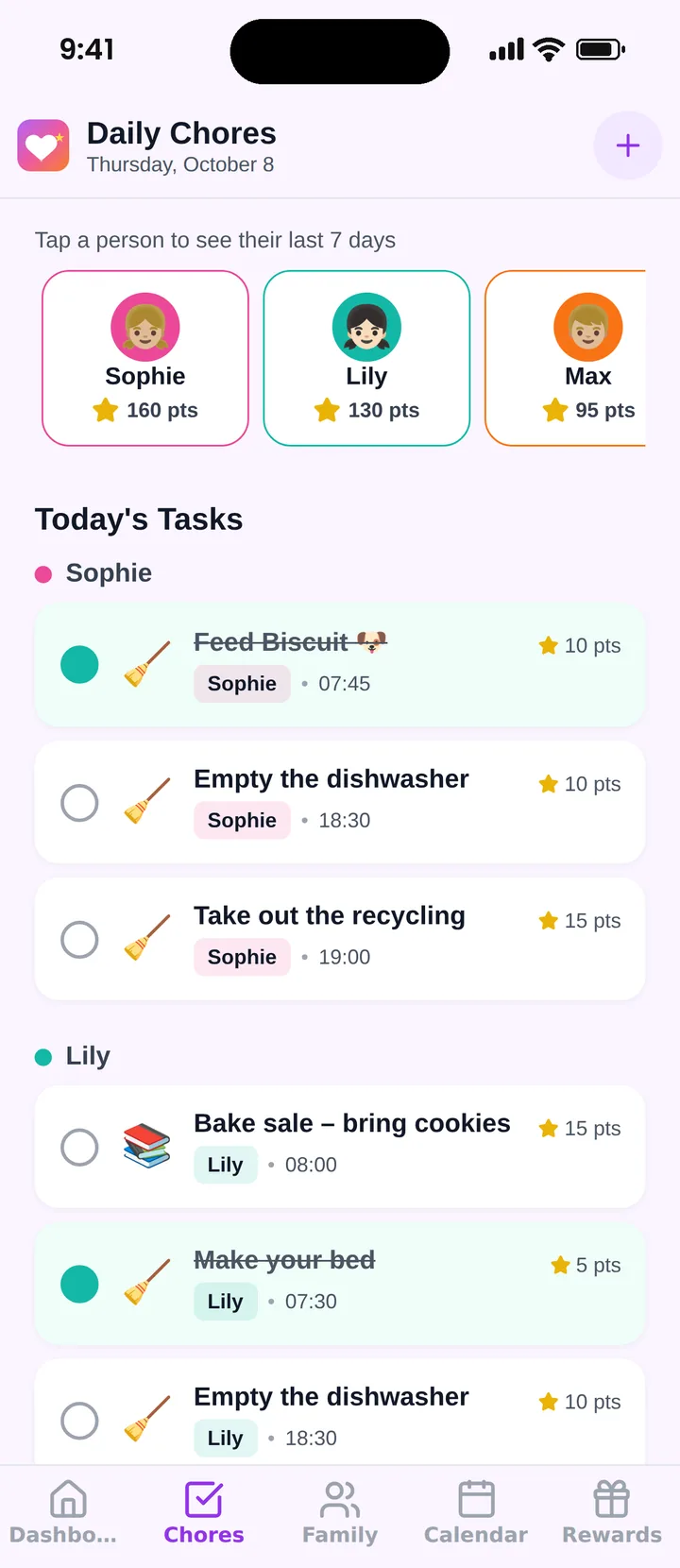
Famiyo is a free family app for iPhone and Android that combines a shared family calendar, chores with points and a rewards shop; kids join with a code, no email needed. Each job from your schedule becomes a repeating chore, daily, weekly or every few days, assigned to one person and shown in their color on the calendar next to practices and appointments. That makes a light Wednesday easy to plan. Kids get a notification when a task is added, check it off on their own phone, and parents hear when it's done, with live sync across every phone. The free plan covers up to 3 family members and 1 repeating task, so a family of four with a full schedule would need Premium. For other options, see our list of the best chore chart apps.
Tonight, do the brain-dump. It takes twenty minutes, and everything else in this guide builds on that list.
Frequently asked questions
How do you make a chore schedule for a family?
List every recurring job in the house, sort the jobs into daily, weekly and monthly, then give each one a person and a time. Match kids' jobs to their age, give adults named jobs too, and post the schedule where everyone sees it. Review it after the first week and adjust.
How much time should kids spend on chores each day?
A common guideline is 5 to 10 minutes for 2- and 3-year-olds, 15 to 20 minutes at 6 or 7, 20 to 30 minutes at 8 or 9, about 30 minutes from 10 to 12 and 30 to 45 minutes for teenagers. School nights can be lighter, with bigger jobs saved for the weekend.
Should parents be on the family chore schedule?
Yes. When adults' jobs sit next to the kids', children see that everyone contributes, and less visible work like bills, forms and appointments gets shared more evenly between partners. It also makes it easier to swap jobs when someone is sick or away.
What do you do when the chore schedule falls apart?
Plan for it. Keep a short minimum version, just dishes, trash and pet care, for nights with late practice or late work, and switch to it without guilt. Restart the full schedule at the next weekly check-in instead of trying to catch up on everything at once.
Try Famiyo With Your Family
Chores with points, a rewards shop for kids and one shared family calendar. Set it up in a couple of minutes.



Free to download • No credit card required • Available on iOS & Android