Chore Schedule for Kids: Daily, Weekly and Monthly Plans
Build a chore schedule for kids that fits school days: what goes daily, weekly or monthly, when in the day chores work best, and sample weeks by age.
By Famiyo Editorial Team6 min read

Most chore charts list what kids should do. A chore schedule answers the harder question: when. Without the when, chores drift to the end of the day and land on a tired child at 8:15 pm. Below is how to sort chores into daily, weekly and monthly, where to put them in the day, two sample weeks for different ages, and a template you can copy.
Daily, weekly or monthly: sorting the chores first
Before you build anything, sort every chore by how often it actually needs doing. This keeps the daily list short, which is the single biggest reason schedules survive past the second week.
| How often | Typical chores | Ages | Time it takes |
|---|---|---|---|
| Every day | Make bed, clear own plate, feed a pet, put clothes in the hamper, pack school bag | 4 and up | 2 to 5 minutes each |
| Every day, older kids | Load or empty the dishwasher, take dirty dishes from bedrooms, wipe the kitchen counter | 8 and up | 5 to 10 minutes each |
| Once a week | Vacuum one room, fold and put away own laundry, take out the trash on trash day, change bed sheets | 8 to 12 and up | 15 to 30 minutes |
| Every two weeks | Clean the bathroom sink and toilet, wipe the inside of the microwave, sweep the porch | 10 and up | 15 to 20 minutes |
| Once a month | Clear out the backpack, sort outgrown clothes, wash the car, wipe down baseboards in their room | 6 and up | 20 to 45 minutes |
The rule of thumb is 2 to 3 daily tasks for preschoolers, 3 to 4 for school-age kids, and one weekly bigger job from about age 8. If you're unsure what fits your child's age, our age-appropriate chores list has the full breakdown.
When in the day chores work best
Clock times rarely work for kids. "Feed the dog at 5:00" means nothing to a 7-year-old who can't see a clock from the trampoline. Anchors work better. An anchor is something that already happens every day, and the chore goes right after it.
These five anchors cover almost every family:
- After getting dressed: make the bed, open the curtains.
- After breakfast: clear own dishes, feed the pet.
- After coming home from school: unpack the lunchbox, hang up the backpack.
- Before dinner: set the table, fill water glasses.
- After dinner: clear the table, a 10-minute tidy of shared spaces.
Say it to your child as "after X, we do Y". "After breakfast, you feed Biscuit" sticks in a way that "remember to feed the dog" never does.
Two times to avoid: the first 30 minutes after school, when most kids need food and quiet, and the hour before bed, which belongs to the bedtime routine. If the only free slot is right after soccer practice, that's a sign the day needs a smaller chore, not a later one.
Two sample weekly schedules
Here's how the same school week can look for a 6-year-old and a 10-year-old in one house. Wednesday is a soccer day for the 10-year-old, so it's deliberately lighter. Saturday holds the one bigger job.
| Day | 6-year-old (about 15 minutes) | 10-year-old (about 30 minutes) |
|---|---|---|
| Monday | Make bed, clear plate, pack school bag | Make bed, empty dishwasher, take trash and recycling to the curb |
| Tuesday | Make bed, clear plate, feed the cat | Make bed, load dishwasher after dinner, wipe the kitchen counter |
| Wednesday | Make bed, clear plate, put shoes away | Make bed, unpack sports bag (soccer night, nothing else) |
| Thursday | Make bed, clear plate, sort laundry by color | Make bed, empty dishwasher, fold and put away own laundry |
| Friday | Make bed, clear plate, tidy room for 5 minutes | Make bed, load dishwasher, clean bathroom sink |
| Saturday | Make bed, sweep the kitchen with a parent | Make bed, change bed sheets, vacuum own room |
| Sunday | Make bed, water the plants | Make bed, help cook dinner, pack bag for Monday |
Notice what repeats. Making the bed and clearing a plate happen every day without exception, because daily chores only become automatic if they really are daily. The variety lives in the third or fourth slot.
How to build your own chore schedule in five steps
- Write down the fixed week. School hours, practices, lessons, the trash pickup day, any evening a parent works late. These are the walls your schedule has to fit between.
- Pick the daily chores for each child and attach each one to an anchor from the list above.
- From age 8, give each child one weekly job and put it on their lightest day, often Saturday morning.
- Add monthly jobs to the first weekend of the month so you never have to remember which month it was.
- Put the schedule where the kids can see it, then run it unchanged for 2 to 3 weeks before you decide what isn't working.
If you want a chore schedule template, a simple grid does the job. Make one row per child and columns for Morning, After school, Evening and This week's big job. Fill in only the boxes that apply. A blank box is fine; it means that part of the day is free.
Keeping the schedule going when the week falls apart
Every schedule meets a week with a stomach bug, a school concert and a visiting grandparent. Plan for it instead of pretending it won't happen.
Use a swap rule, not a skip rule. If Tuesday's chore can't happen, it moves to Wednesday instead of disappearing. Kids learn the job still matters, and you avoid the slow slide where every busy day becomes a day off.
Keep the daily anchors even in chaos. On a hard day, drop the extras but keep the bed and the plate. Two tiny tasks done every day protect the habit better than a perfect schedule that collapses for a week.
Hold a 10-minute check on Sunday. Look at the coming week together, spot the heavy days and lighten them in advance. With more than one child, this is also when you swap jobs so nobody is stuck with the bathroom forever; our guide to chore rotation shows a few ways to rotate fairly. If you're planning for the adults too, see the chore schedule for the whole family.
Changing the schedule for weekends and summer
A school-week schedule doesn't survive summer break as-is, and it shouldn't. Kids have more time but less structure, which means chores can be bigger but need firmer anchors.
On weekends, keep the daily basics at the same anchors and put the weekly job in the first part of Saturday morning, before plans pull everyone out the door. A job left for "sometime this weekend" usually turns into Sunday at 7 pm and a grumpy kid.
In summer, swap the after-school anchor for a fixed morning block. Something like "after breakfast, 20 minutes of chores, then the day is yours" gives kids a clear finish line. This is also a good season to teach one new skill, because there's time to practice: an 8-year-old learning to fold and put away laundry, or a 10-year-old learning to cook a simple meal with you nearby. When school starts again, the new skill can slot into the regular week.
Running the schedule with Famiyo
Famiyo is a free family app for iPhone and Android that combines a shared family calendar, chores with points and a rewards shop; kids join with a code, no email needed. Each chore on your schedule becomes a repeating task: daily for the bed, weekly for the sheets, or every few days for jobs like watering plants. You choose who does it and how many points it's worth.
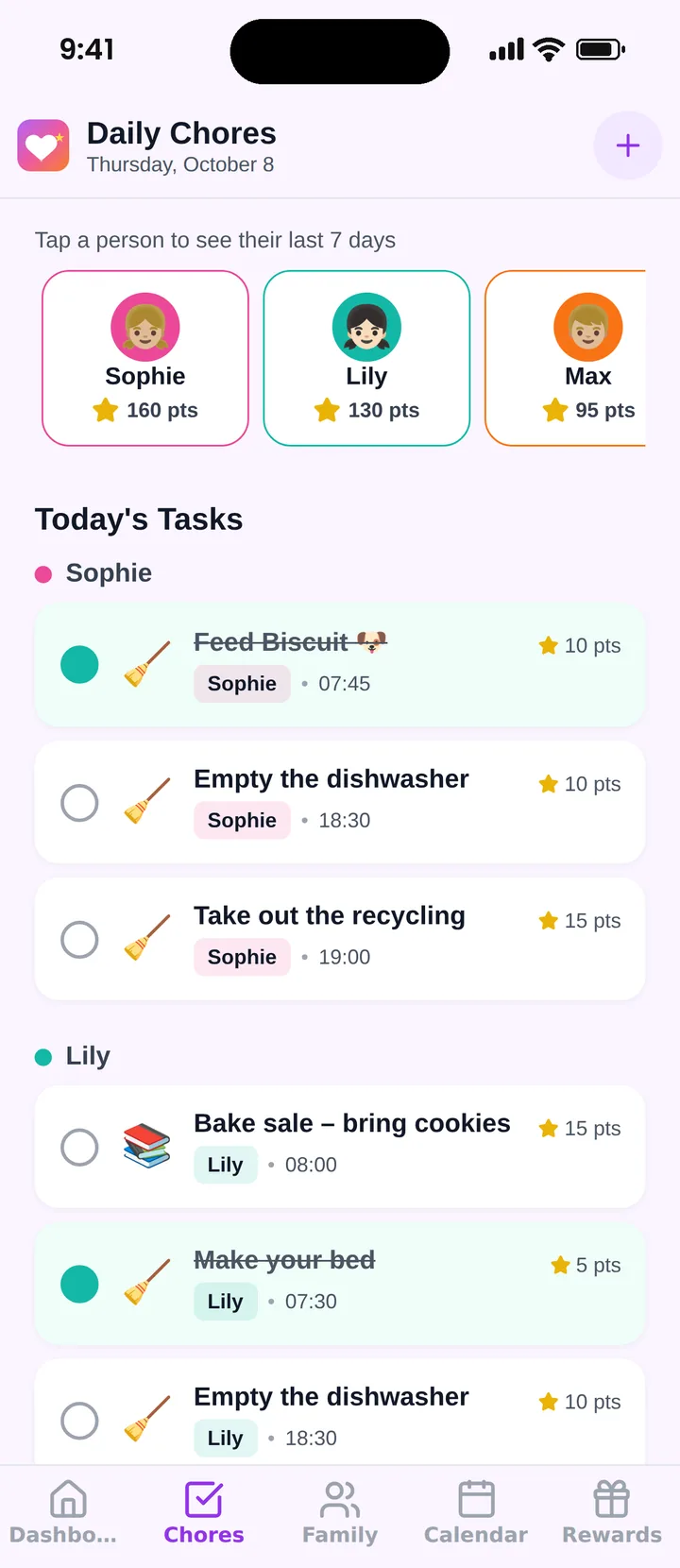
Kids get a notification when a new task is assigned and check it off on their own phone, and you get one when it's done. Chores sit on the shared calendar next to soccer and lessons, so heavy days are easy to spot. The free plan includes 1 repeating task; Premium removes that limit. Compare it with other options in our best chore chart apps.
Tonight, pick one anchor and one chore per child. Add the rest next week, once the first one sticks.
Frequently asked questions
How many chores should be on a kid's daily schedule?
Start with 2 to 3 daily tasks for preschoolers and 3 to 4 for school-age kids. That usually adds up to 10 to 15 minutes a day at ages 4 to 5, 15 to 20 minutes at 6 to 7, and 20 to 30 minutes from about age 8.
What's the best time of day for kids to do chores?
Right after something that already happens every day: getting up, eating breakfast, coming home, finishing dinner. A chore attached to an existing moment needs far fewer reminders than one scheduled for a clock time. Avoid the hour right after practice or a long school day.
Should kids do chores on weekends?
Yes, but differently. Keep the small daily chores going so the habit doesn't break, and use one weekend slot for the bigger weekly or monthly job. Many families pick Saturday morning before any plans so the job is done and forgotten by lunch.
How often should I change a chore schedule?
Give a new schedule 2 to 3 weeks of consistent use before judging it. After that, review it once a month or when the family week changes, such as a new sport season or the start of the school year.
Try Famiyo With Your Family
Chores with points, a rewards shop for kids and one shared family calendar. Set it up in a couple of minutes.



Free to download • No credit card required • Available on iOS & Android