Fair Play Chores: The Card System Explained
Fair Play chores explained: how the card system splits household work, what conception, planning and execution mean, and how to adapt a card list for kids.
By Famiyo Editorial Team5 min read
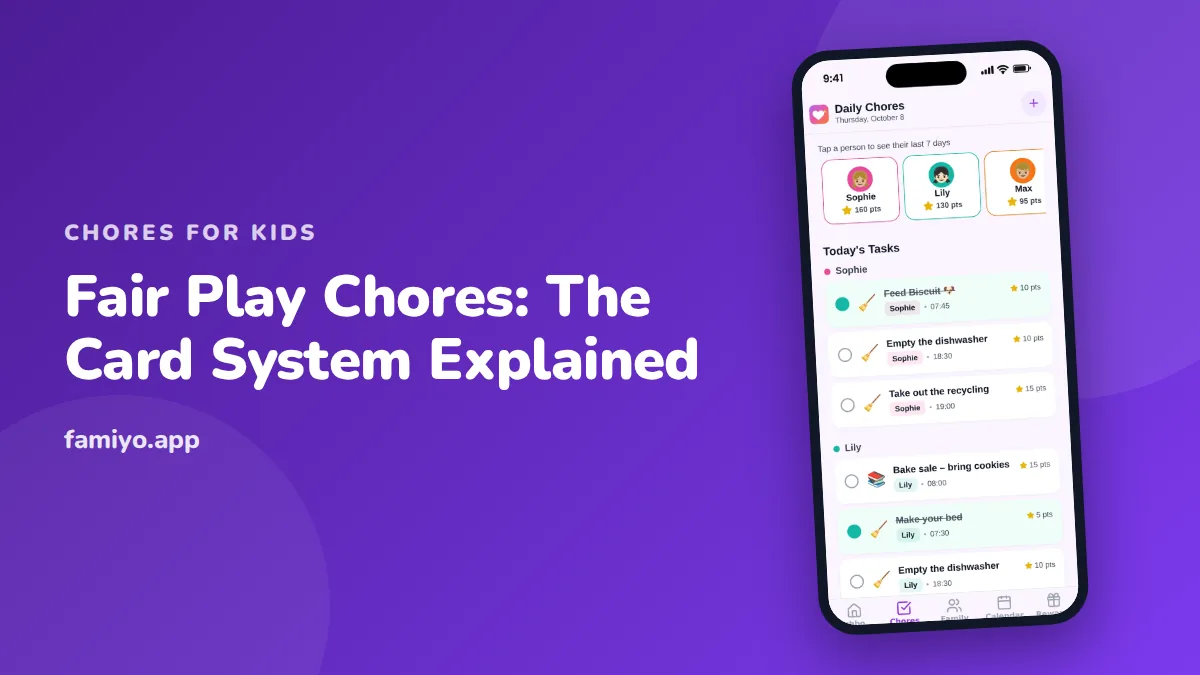
Most family chore charts answer the question "who does it?" Fair Play asks a harder one: who notices it needs doing, who decides how, and who follows through? That difference is why the system caught on among couples who were tired of being the household manager. This guide explains how the cards work, how to run a Fair Play style split at home, and how to shrink it down for kids.
What Fair Play is
Fair Play is a book and card deck by Eve Rodsky, published in 2019, aimed at partners who share a home. The deck has about 100 cards, each naming a household task. The tasks are grouped into five areas: Home, Out, Caregiving, Magic and Wild. Home covers the usual indoor jobs, Out covers things outside the house, Caregiving covers child and family care, Magic covers the special moments like birthdays, and Wild covers unpredictable situations.
Partners sort the cards, deal them between themselves and agree on who holds which. The person who holds a card is responsible for it, without reminders.
It is a method for adults. The reason it appeals to parents is that it targets the invisible work in a household, the part where one person remembers everything and the other waits to be told. Kids can borrow the principle even if the deck itself is not made for them.
Conception, planning and execution
The core idea fits in three words.
| Part | What it means | Example: school lunches |
|---|---|---|
| Conception | Noticing the task exists and needs doing | Seeing that the lunch bags are low and the week is starting |
| Planning | Deciding how, when and with what | Choosing what goes in, writing the grocery list |
| Execution | Doing it | Packing the lunches each morning |
In a lot of homes, one person executes and the other does a lot of the conceiving and planning without it showing. Fair Play says whoever holds a card does all three. If you hold "school lunches", you notice when the bread runs out and you buy it. Nobody asks you.
The second principle is the minimum standard of care: an agreed description of what done looks like. If the standard for the kitchen is "dishes in the dishwasher, counters wiped, floor swept", nobody redoes it afterward.
How a Fair Play style split works
- Write out the tasks. Use the deck, or list everything your household does in a typical month. Include invisible jobs, like booking dentist appointments and tracking permission slips.
- Sort them. Each adult takes the cards they care about most or are best placed to handle.
- Trade and negotiate. Look at the load. Is one person holding much more than the other, in time or in mental effort? Move cards until it feels fair.
- Agree on the standard. For each card, one sentence on what done means and one on timing.
- Hold the card. The owner handles it start to finish. The other person does not remind or check.
- Review regularly. Cards change as life changes. A monthly check-in is enough.
The most important part is step five. Fair Play falls apart the moment someone says "can you remind me?" The point is that you do not need to.
Adapting Fair Play cards for kids
The original deck is not designed for children, but the structure works if you scale it down. A child's card is simpler, and the parent still handles the planning for younger ones.
Here is a sample card layout for an elementary-age child.
| Card | Standard of care | When | Who plans |
|---|---|---|---|
| Feed the dog | Fresh water, one scoop of food in the bowl | Morning and 5 p.m. | Child (parent buys food) |
| Dishwasher | All dishes from the counter in, soap added, button pressed | After dinner | Child |
| Trash and recycling | Bins emptied, bag replaced, cans out Tuesday night | Tuesday | Child |
| School bag | Homework, water bottle, notes in the bag | Night before | Child |
| Room reset | Floor clear, bed made, clothes in the hamper | Saturday morning | Child |
For kids around 10 and up, you can hand over the planning too. They own the "laundry" card: they check the hamper, pick the day, run the load and put it away. Our guides to chores for 8-year-olds and what goes on a chore chart can help you fill in the cards with age-appropriate tasks.
For toddlers and preschoolers, hold the card yourself and hand them the execution part only. "Feed the cat" is their job. Remembering to buy the food is yours.
Fair Play and a chore wheel: which to use
They solve different problems. A chore wheel or rotation spreads jobs evenly and gives everyone variety. Fair Play gives each job one owner, who gets good at it. If you are asking which fits your family, a rotation works best when the tasks are quick and the goal is equal effort. Fair Play suits jobs with a lot of thinking, or jobs that fall apart when passed around.
You can mix the two. Keep a few long-term cards for each child and rotate the rest. Our guides to the chore wheel generator and chore rotation show the rotating side.
Who holds which card
A first deal between two adults usually surprises both of them. The person who has been doing the invisible work often holds a long list without realizing it, because the tasks were never named. Writing every card on the table, even small ones like "birthday gifts for classmates" or "renew the car registration", makes the load visible. Then you can look at it together. Count the cards, but also weigh them. Ten quick cards can be lighter than two that need constant thinking, such as "school paperwork" or "medical appointments". Aim for a split that feels fair to both of you, not one that is mathematically equal.
Common problems
- Cards pile up on one person. Count them. If one adult holds far more, or holds the planning-heavy ones, redistribute.
- The standard is vague. "Clean the kitchen" will be argued over. Write exactly what done looks like.
- Someone hovers. If you are checking, you have not handed over the card. Pick one check-in time and stay away until then.
- Kids lose interest. Cards that never change get boring. Swap one card a month, and attach points or a reward.
- Life changes. Illness, a new baby and a new school all call for a reshuffle. Treat the deal as a living arrangement.
Making the cards work in an app
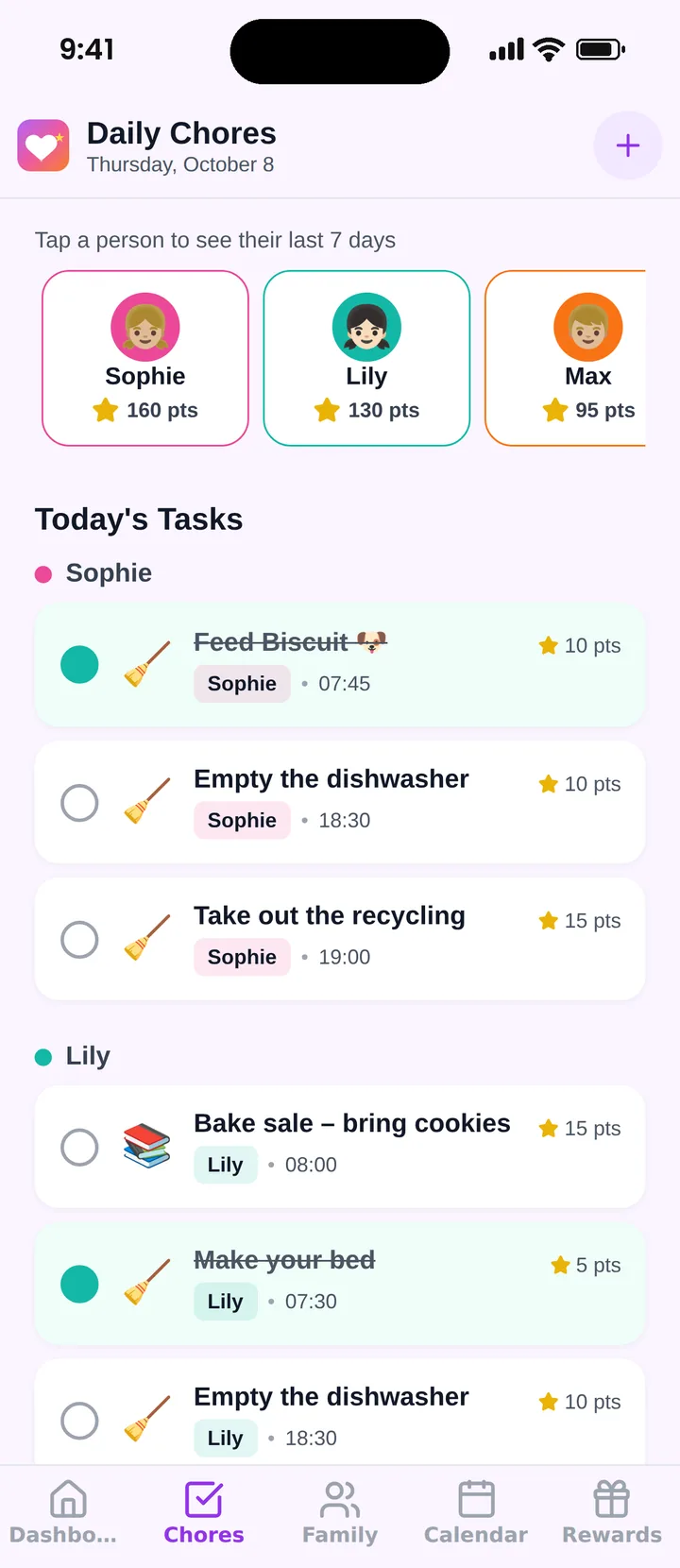
Famiyo is a free family app for iPhone and Android that combines a shared family calendar, chores with points and a rewards shop; kids join with a code, no email needed. It does not include the Fair Play deck, but it handles the follow-through that paper cards leave to memory. Each card becomes a chore: pick the owner, set it to repeat daily, weekly or every few days, and give it points. The owner gets a notification and sees the task on their phone, and you are told when it is done, so nobody has to remind anyone. The Today screen shows every family member's tasks. For other options, see our list of the best chore chart apps.
Try it with five cards
Pick five tasks that regularly cause friction. Write each on an index card with the standard of care, the timing and the owner. Run them for two weeks without reminders and see which ones hold. Then add more.
Frequently asked questions
What is the Fair Play chores system?
It is a method from Eve Rodsky's book Fair Play for dividing household work between partners. Tasks are written on cards, each card has an owner, and the owner handles everything about that task, not only the doing.
What do conception, planning and execution mean?
They are the three parts of any task. Conception is noticing it needs doing, planning is deciding how and when, and execution is doing it. Fair Play says one person should hold all three for each card.
Can kids use Fair Play cards?
The original is written for adult partners, but the idea adapts well. Give older kids a few cards they own fully, with a clear standard, and give younger kids execution only, with a parent still handling the planning.
Is there a free printable Fair Play chores list?
The official deck is sold with the book. You can make your own version for free by writing chores on index cards, with a standard of care and a schedule on each one. That is often better suited to kids.
What is a minimum standard of care?
It is an agreed description of what done looks like for a task. For example, bathroom cleaned means sink, toilet and floor wiped. Both people agree on it in advance so the owner is not second-guessed afterward.
Try Famiyo With Your Family
Chores with points, a rewards shop for kids and one shared family calendar. Set it up in a couple of minutes.



Free to download • No credit card required • Available on iOS & Android