Daily Summer Chores for Kids: A Realistic List by Age
Daily summer chores for kids that fit around camp, pools and boredom: a short list by age, a sample day, and how to keep it going past the second week.
By Famiyo Editorial Team6 min read
School ends, the routine disappears, and by day four the house looks like a lost-and-found. Kids are home for ten weeks, and they are not going to spend them folding towels on their own. This list is about what to actually ask for every day, by age, and how to keep it up when summer gets loose.
What "daily" should mean in summer
Daily is the word that matters. A weekly cleaning blitz on Saturday sounds efficient, but kids forget it, you end up doing half, and the week in between is chaos. A short list every day, done at the same time, is easier on everyone. It also gives the day a shape, which kids secretly need more than they admit.
Keep it small. Two to four chores, and they should be done in under half an hour for most kids. The 2 to 3 chores a day rule for preschoolers and 3 to 4 for school-age kids still holds in July. Summer is not the time to launch a giant new system. It is the time to pick a few things and make them boringly regular.
One honest note: the first week will go well, the second will wobble, and somewhere around week four you will want to quit. That is normal. Plan for it, and the list below helps because it leans on habits rather than willpower.
Daily summer chores by age
These ages match what kids can really do without you standing over them. Younger kids need you nearby at the start. Older kids need you to stop hovering.
| Age | Daily chores | Time |
|---|---|---|
| 2 to 3 | Put toys in the bin, put dirty clothes in the hamper, wipe up a spill, help feed the pet | 5 to 10 minutes |
| 4 to 5 | Make the bed (roughly), clear their own place, water the plants, put wet swimsuits and towels on the hook | 10 to 15 minutes |
| 6 to 7 | Pack the pool or day bag, sweep the kitchen floor, tidy their room, feed the pet | 15 to 20 minutes |
| 8 to 9 | Empty the dishwasher, take out the trash, hang up towels, make a simple snack and clean up after it | 20 to 30 minutes |
| 10 to 12 | Do the lunch dishes, tidy the shared living space, water the garden, walk the dog | About 30 minutes |
| 13 and up | Start a load of laundry, cook one meal or lunch for the family, mow or rake, watch a younger sibling for an hour | 30 to 45 minutes |
If you have a toddler in the mix, our list of easy chores for toddlers has more options than fit in one table row.
The summer-specific jobs that actually matter
School-year chores still apply. But summer creates its own mess, and these jobs are the ones that show up in July and rarely in October.
- Swimsuit and towel patrol. Wet things go on a hook or the line, not on the floor or in the bag. Mildew in a pool bag is one of the least pleasant summer discoveries.
- Sunscreen and water bottle station. Kids refill their own bottle and restock the bag by the door the night before.
- Shoe pile control. A basket by the back door for sandals and cleats. Sand and grass are coming in anyway; the basket keeps it to one spot.
- Plants and the garden. Watering is a perfect job for a 4-year-old with a small can and a 12-year-old with a hose.
- Picnic and snack cleanup. Whoever eats outside carries the plate back in. Nobody is excused from this.
These are small, visible and tied to things kids are already doing. That is why they stick better than "clean your room" does.
A sample summer day
Here is how it can look for a family with kids aged 7 and 11, with camp three days a week.
- Wake up, get dressed, breakfast.
- Right after breakfast, the morning list: make the bed, put the plate in the dishwasher, feed the dog (7-year-old); make the bed, empty the dishwasher, take out the trash (11-year-old).
- Check with a parent, then screens, bikes or friends are allowed.
- After lunch, one short reset: dishes and wiping the table, 10 minutes.
- Before dinner, the bag is repacked and towels are hung up.
On camp days the morning list shrinks to two things, because the bus is the deadline. On free days, add a bigger job once or twice a week, like washing the car or weeding one bed.
How to keep it going past week two
Most summer chore plans die the same way. The first days feel productive, then a few things slip, a parent reminds, a kid pushes back, and the list quietly stops existing. A few habits help.
Tie the list to a trigger, not a time. "After breakfast" works better than "by 9:30." Kids and parents both lose track of clock times in summer.
Finish before fun. No negotiation, no lecture. The sentence is: "As soon as the list is done, you're free." It works because it is the same sentence every day.
Check in once, not five times. Walk past, look, say thanks or "the dishwasher still needs doing." Then leave it. Constant reminders teach kids to wait for the reminder.
Let some things slide. A bed made badly is still a bed made. If you redo everything, they stop trying. Fix only what matters for safety or hygiene.
Expect a bad day. On Wednesday the dog will go unfed and someone will melt down. Say "we'll do it tomorrow" and move on. One missed day is not a trend.
If a child digs in and refuses outright, read what to do when your child refuses to do chores before escalating. And if the issue is that they don't know how, teaching kids to do chores step by step is worth ten minutes.
Should summer chores earn anything?
Basic daily chores are the price of living in the house, so we would not pay for them. But summer is long, and kids like having something to work toward. A points system for extras works well: a small chore is 5 points, a medium one 10, and a big one 20, with a +2 bonus for finishing without a reminder. Rewards could be 15 extra minutes of screen time or a choice of dessert for 30 to 50 points, a family movie pick for 100, and a day out for 300 to 500.
Chores that go beyond the daily list, like washing the car or weeding the whole front bed, can pay in points or cash. The usual range is $0.25 to $1 for a small job and $2 to $5 for a big one.
Keeping the list in Famiyo
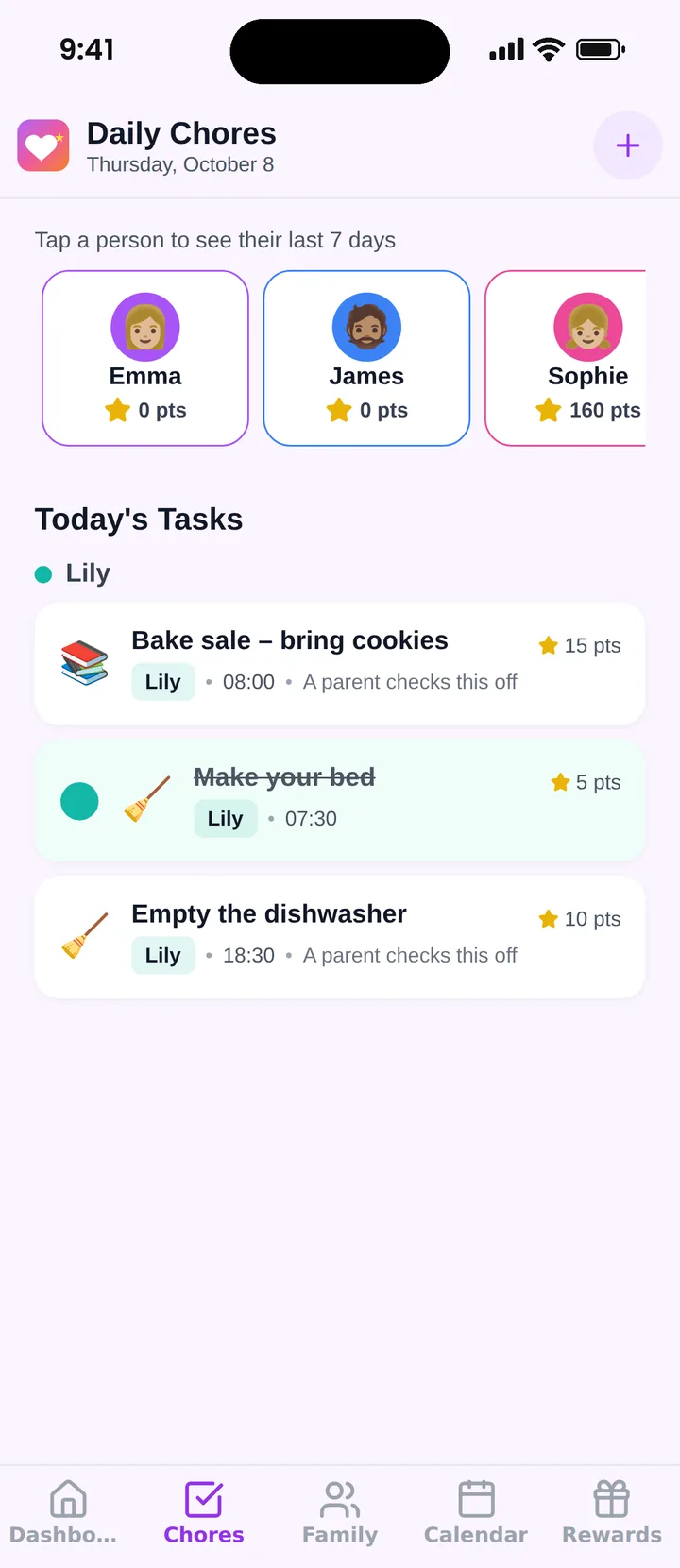
Famiyo is a free family app for iPhone and Android that combines a shared family calendar, chores with points and a rewards shop; kids join with a code, no email needed. For summer, the useful part is that the app does the reminding. Make each daily chore repeat, give each child their own list and points, and kids hear about new tasks by push notification on their own phone. You get a notification when a chore is done, so you stop checking and stop nagging. See our list of the best chore apps for kids if you want to compare options.
Start with one change
Pick one anchor, like right after breakfast, and one short list per child. Run it for two weeks before you add anything. If it works, a second tier of weekly jobs is easy to bolt on. If you prefer physical reminders, chore cards for kids on the fridge do the same job without a screen.
Frequently asked questions
How many chores should a kid do each day in summer?
Two to four daily chores is plenty. Preschoolers need two or three that take 5 to 10 minutes total, school-age kids three or four, and teens a bit more. Add one bigger weekly job from about age 8 if the daily ones are going smoothly.
Should kids get paid for summer chores?
Keep the daily basics unpaid, because they are part of living in the house. Pay or award points for extra jobs, like washing the car or weeding, at roughly $0.25 to $1 for a small job and $2 to $5 for a big one.
What time of day is best for summer chores?
Mornings, before the day gets interesting. Chores that are tied to breakfast get done; chores that float until later lose to the pool, the friend next door or the tablet. Finish the list, then summer starts.
What do I do when my kids say they're bored and refuse to help?
Stay calm and point to the list. Boredom is not a reason to skip, and the chores take less time than the argument. If refusal is a pattern, see our article on what to do when a child refuses to do chores.
Try Famiyo With Your Family
Chores with points, a rewards shop for kids and one shared family calendar. Set it up in a couple of minutes.



Free to download • No credit card required • Available on iOS & Android