Easy Chores for Toddlers: 20 Jobs for Ages 2 and 3
Easy chores for toddlers that really work: 20 safe jobs for ages 2 and 3, how long each takes, how to teach them, and what to do when your toddler says no.
By Famiyo Editorial Team5 min read

A toddler with a cloth in one hand and a wet floor in front of them is not helping, exactly. They are enthusiastic. And that is the point. Between about 18 months and 3 years, kids badly want to do what you do, and if you let them, you end up with a small person who thinks carrying a basket is a privilege. This list has 20 jobs that toddlers can really do, how to set them up, and what to do on the days when nothing works.
What counts as a chore at this age
Toddler chores are not the same as school-age chores. They are tiny, they need you next to them, and the result will be uneven. A toy bin that is only half full is a success. A wiped table that is just damp is a success. What you are building is the idea that this family works together, and that your child is part of it.
The basics from our chores-by-age table are: put toys in a bin, put clothes in the hamper, wipe up spills, help feed a pet. These take 5 to 10 minutes a day in total. Start with two or three. More than that and the whole thing starts to feel like a job you are forcing.
One honest warning: toddlers are often at their most "no" at exactly this age. Some days the answer to every request will be a flat refusal. That is developmentally normal and not a sign that you are doing it wrong.
20 easy chores for toddlers
All of these assume you are in the room. Pick a few from each group.
Tidying
- Put toys in a bin or basket
- Put books back on a low shelf
- Put shoes in a shoe basket by the door
- Carry stuffed animals to their bed
- Put dirty clothes in the hamper
Kitchen and meals
- Carry a napkin or plastic cup to the table
- Help put spoons or plastic bowls away in a low drawer
- Wipe the table with a damp cloth
- Tear lettuce leaves for a salad
- Wash a vegetable or fruit in a bowl of water (with you watching)
Around the house
- Wipe up small spills with a cloth
- Put socks in a basket while you fold laundry
- Throw trash in the bin
- Dust low shelves with a sock on their hand
- Water a plant with a small cup
Pets and outdoors
- Help scoop dry food into a pet's bowl
- Put a pet's water bowl back on the mat
- Carry a small bag of sand toys to the car or yard
- Pick up sticks or leaves into a bucket
- Carry in a very light grocery bag
A few jobs may not suit your home or your child. A toddler who still puts things in their mouth should skip the dusting. A cat that bites should skip the food scoop. Use your judgment, and supervise anything near water, stairs or cleaning products. Cleaning products stay out of reach, always, and a damp cloth with plain water is a fine substitute.
A sample toddler day
Here is how three tiny jobs fit into a normal day for a 2-and-a-half-year-old.
| When | Chore | Time |
|---|---|---|
| After breakfast | Carry cup to the sink, wipe the table with you | 3 minutes |
| Before lunch or nap | Put toys in the bin (sing the cleanup song) | 3 minutes |
| Before bath | Put clothes in the hamper | 1 minute |
Total: about 7 minutes. Notice that every job is attached to something that already happens. Anchors work better than clock times, since toddler schedules shift constantly.
How to teach it
The method is simple, but it takes patience.
- Show it first, slowly. "Watch me. Toy goes here."
- Do it together, hand over hand if needed.
- Let them do a small part. You pick up nine toys, they put one in the bin.
- Praise what they did specifically. "You put the blocks in the bin. Thank you."
- Repeat it at the same time every day for a few weeks.
Don't redo their work in front of them. If the bin is messy, fix it later when they are busy. Doing it over while they watch tells them their help was wrong.
Short phrases work better than explanations. "Toys in the bin, then snack." "Your turn to wipe." "Let's help the dog." A big pile of toys is overwhelming, so break it down: "Let's put away all the cars first."
When your toddler says no
Say you ask and the answer is "No!" with the full-body flop on the floor. A few things that tend to help:
- Offer a choice. "Do you want to put the blocks away or the books?" Either one is fine with you.
- Make it a race or a game, with a song, a timer or "can you beat me?"
- Do it side by side. A toddler is far more likely to join in when you are already doing it.
- Lower the bar. If they only do one thing, that counts.
- Walk away and try again later. A toddler who refuses today often joins in tomorrow.
Raised voices and threats tend to make things worse. If refusal becomes a pattern as your child grows, our guide on what to do when your child refuses to do chores has more.
Do toddlers need a chart or rewards?
A chart can help, mainly for you. A simple picture chart with three tasks and a checkmark box gives your toddler something to look at and gives you a record. Our reward chart for a 3-year-old shows what to track at this age.
Rewards beyond praise are usually not needed. A high five, a hug, a sticker are plenty. Save points and prizes for later, when your child is old enough to understand saving up.
How Famiyo helps with the reminders
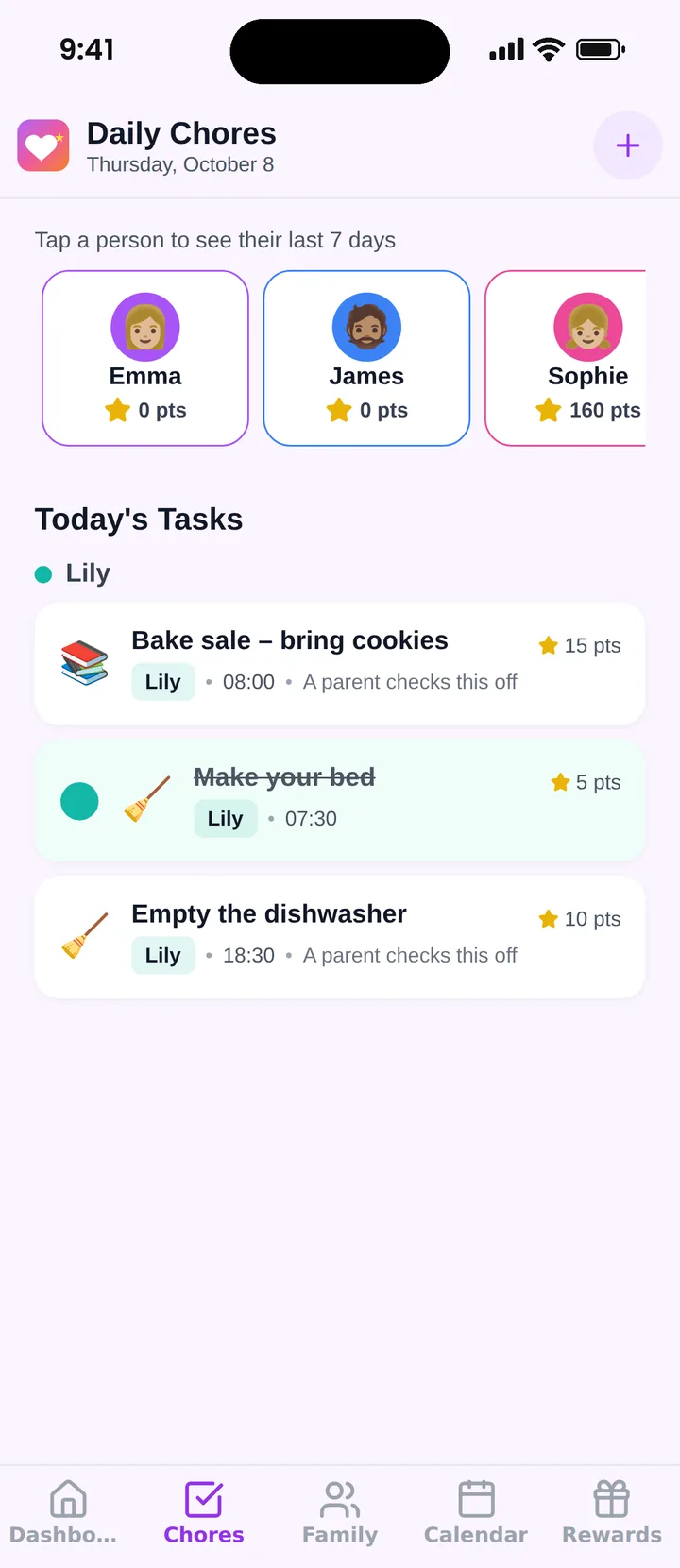
Famiyo is a free family app for iPhone and Android that combines a shared family calendar, chores with points and a rewards shop; kids join with a code, no email needed. A toddler is too young to use it alone, but it takes reminder duty off you. Add the daily jobs as a repeating task, and the app sends a notification so nobody has to nag. When a chore is done, a parent approves it, and the points appear on your child's profile. The free plan includes 1 repeating task. See the best chore apps for kids for more options.
What comes next
Run two or three of these for a few weeks. Then, as your toddler grows, add a job or two and look ahead: our chores for 5-year-olds are the next step. And if your toddler is already in the middle of a summer break, there is a list in daily summer chores for kids.
Frequently asked questions
At what age can toddlers start doing chores?
Around 18 months to 2 years, toddlers can imitate simple tasks like putting a toy in a basket or carrying a spoon. Real, repeated chores usually start at 2 to 3 and work best when you do them together.
How many chores should a toddler have?
Two or three a day is plenty for ages 2 to 3, adding up to 5 to 10 minutes. More than that and the whole thing turns into a battle. Pick jobs that happen at the same point every day, such as after breakfast and before bath.
My toddler says no to everything. What should I do?
Expect it. Offer a choice between two jobs, make it a game, and do the chore with them. Keep your tone light and don't force. If your toddler walks away, try again tomorrow. Consistency over days matters more than winning one moment.
Should toddlers get rewards for chores?
Toddlers don't need rewards, and big prizes can backfire. Praise, a high five, or a sticker is enough. A simple chart with one small checkmark per task is a good visual. Save points for around age 4 or 5.
Try Famiyo With Your Family
Chores with points, a rewards shop for kids and one shared family calendar. Set it up in a couple of minutes.



Free to download • No credit card required • Available on iOS & Android