Kids To-Do List: How to Make One They Actually Follow
How to make a kids to-do list that works: what to put on it, how many items by age, wording kids can check off, and sample lists for ages 5, 8 and 12.
By Famiyo Editorial Team6 min read
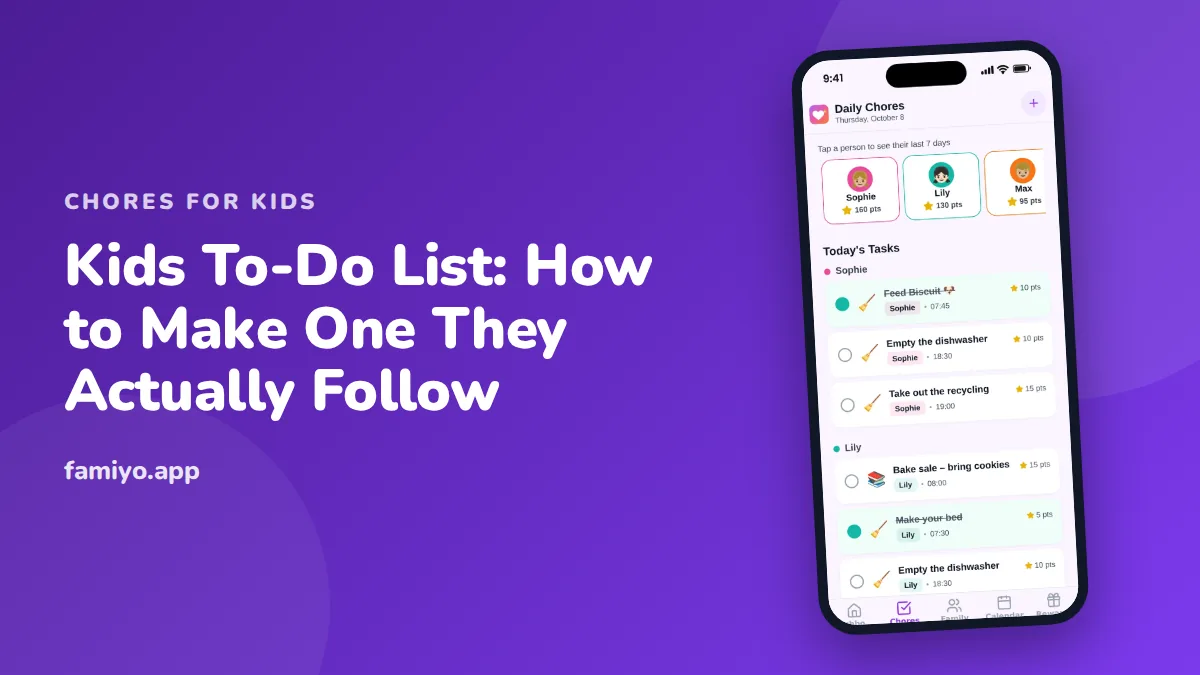
Every family has the same morning: a parent repeating "shoes, teeth, backpack" while a child wanders off to look at the cat. A to-do list moves those reminders out of your mouth and onto a page your child can read, or look at, on their own. Here's how to set one up, what to put on it at each age, and three sample lists you can copy tonight.
What goes on a kids to-do list
A kids to-do list is a daily checklist of everything your child is responsible for, in the order they'll do it. That's different from a chore chart, which tracks household jobs across a week. The to-do list mixes three kinds of tasks:
- Looking after themselves: getting dressed, brushing teeth, putting on shoes.
- School and activities: packing the bag, reading for 20 minutes, practicing piano.
- Helping at home: feeding the dog, clearing their plate, tidying their room.
What stays off the list matters just as much. Leave out one-off requests ("help me carry the groceries"), things that only happen once a month, and anything your child can't do without you. If a task needs an adult every time, it belongs on your list, not theirs.
How many items, by age
Long lists don't get done, they get ignored. The right length depends on whether your child can read and how long their attention holds.
| Age | Format | Items per day | Notes |
|---|---|---|---|
| 3 | Pictures only | 6 to 8, in 2 short routines | 2 to 3 of them are chores, 5 to 10 minutes of work |
| 4 to 6 | Pictures with one or two words | 8 to 12, in 3 routines | 4 to 6 steps per routine works best |
| 7 to 9 | Short written items | 8 to 10 | 3 to 4 chores, the rest self-care and school |
| 10 to 12 | Written, by time of day | 8 to 10 | Add one weekly bigger job from age 8 |
| 13+ | Their own list, you agree on the must-dos | Varies | Teens add their own items |
The chore part of the list should take about 10 to 15 minutes a day for a 4- or 5-year-old, 15 to 20 for ages 6 and 7, and 20 to 30 minutes for ages 8 and 9.
How to make a kids to-do list in 7 steps
- Write down everything you currently remind your child about, for one full day. This is your raw list.
- Cross out anything they can't do alone yet, and anything that doesn't happen daily.
- Sort what's left into time blocks: before school, after school, before bed. Weekends get their own, shorter version.
- Rewrite each item so it has a clear finish line. "Get ready" becomes "Clothes on, shoes on, bag by the door."
- Choose the format. Picture cards for pre-readers, a written list for readers, a phone for kids who already carry one.
- Put it where the task happens. The morning list goes by the front door or the bathroom mirror, not on the fridge in another room.
- Walk through it once together, out loud, then hand it over. "This is your list. When it's done, you're done."
Kids to-do list ideas by age
These are starting points. Pick the items that match what your child already does, plus one new one to grow into.
| Age | Before school | After school | Before bed |
|---|---|---|---|
| 5 | Get dressed, eat breakfast, brush teeth, shoes on | Bag on the hook, lunchbox on the counter, water the plants | Toys in the bin, clothes in the hamper, pick a book |
| 8 | Make the bed, get dressed, pack the bag, feed the dog | Snack, homework, empty the dishwasher | Shower, lay out clothes, set the table for breakfast |
| 12 | Make the bed, breakfast, check the calendar, pack the bag | Homework, practice, take out the trash | Pack lunch, charge devices outside the bedroom, lights out on time |
If you're stuck on chores for the younger end, our guide to a chore chart for a 4-year-old has a full list of jobs at that age with the points to go with them.
Writing items your child can check off
Most lists fail because of wording. A child can't tick "be responsible" or "clean up". They can tick something they can see is finished.
| Instead of | Write |
|---|---|
| Clean your room | Clothes in the hamper, toys in the bins, bed pulled up |
| Get ready for school | Dressed, teeth brushed, shoes on, bag by the door |
| Help in the kitchen | Clear your plate and cup to the counter |
| Do your homework | Homework done and in your folder |
| Be nice to your sister | (leave it off: it's a behavior, not a task) |
That last row is worth a second look. Behaviors like "be kind" or "listen the first time" don't fit a to-do list because you can't finish them. Keep them for a separate conversation, or a behavior chart if you use one.
Order matters too. Put items in the sequence your child will do them, so the list reads like a path through the morning. Kids who can't read yet can follow pictures in a row from left to right. A photo of your child actually doing the task works better than clip art, because there's no guessing what "teeth" means.
A template you can copy
If you want a quick starting point, this structure works for most kids from about 6 to 11. Write it on an index card or a whiteboard and fill in the gaps.
Morning (before 7:45)
- Dressed and bed made
- Breakfast and teeth
- Bag packed, shoes on
After school
- Lunchbox emptied
- Homework done
- One home job: _____
Evening (before 8:00)
- Shower or bath
- Clothes for tomorrow laid out
- Screens off and charging
Three blocks, three items each, plus one rotating home job. That's short enough to finish and long enough to cover what matters. A morning routine for school-age kids usually takes 30 to 45 minutes from wake-up to leaving, so if the morning block takes longer than that, trim it.
Keeping the list going after week one
The first few days are easy because the list is new. The hard part is week two, when your child knows what's on it and stops looking.
A few habits keep it alive:
- Point, don't repeat. When something's missed, ask "What does your list say?" and wait. It feels slow the first few times. It gets faster.
- Let your child do the checking off. A tick, a magnet moved to the "done" side, a sticker. Crossing it off themselves is half the motivation.
- Check the list once at a fixed time, say right before dinner, rather than all day.
- Change one thing at a time. If you add a new item, keep everything else the same for a week.
- Give it 2 to 3 weeks of consistent use before you decide it isn't working.
If it still stalls, the list is usually too long, too vague or in the wrong place. Our nine rules for chore charts that actually work apply to to-do lists too, especially the ones about placement and how many items to start with. And when the problem is less the list and more the daily reminding, the strategies in getting kids to do chores without nagging pair well with it.
Weekends need their own list. Most kids do better with a shorter version: two self-care items, one home job and free time once it's done. Rotating the weekend jobs between siblings is covered in our chore schedule for kids.
A to-do list on every phone with Famiyo
A paper list stays on the wall. Once kids have their own phone or tablet, the list can travel with them. Famiyo is a free family app for iPhone and Android that combines a shared family calendar, chores with points and a rewards shop; kids join with a code, no email needed. Each item on the list becomes a task that repeats daily, weekly or every few days, and you can give it points (5 for a small task like feeding the dog, 10 for emptying the dishwasher). Your child gets a notification when a new task is added, checks items off on their own phone, and you hear when they're done. Changes sync live between every phone, so the list is never out of date.
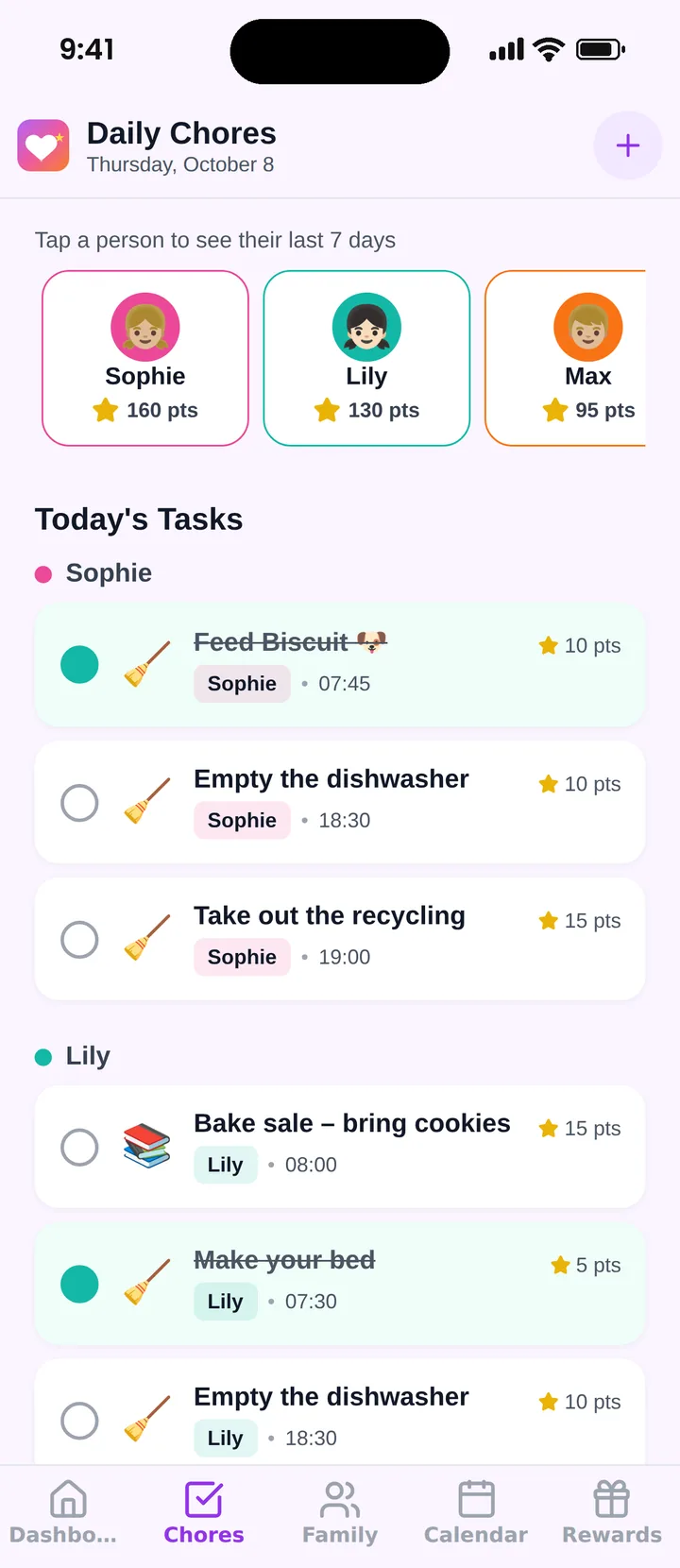
The free plan includes 1 repeating task; Premium removes that limit. For other options, see our list of the best chore chart apps.
Tonight, write down every reminder you give tomorrow morning. That list, trimmed and reworded, is your child's first to-do list.
Frequently asked questions
What is the difference between a kids to-do list and a chore chart?
A chore chart tracks household jobs across a week. A kids to-do list covers one day and mixes everything a child is responsible for: getting dressed, packing the school bag, homework and a chore or two. Many families use both, with the to-do list as the daily checklist and the chart as the weekly record.
How many items should be on a child's to-do list?
For kids under 7, keep each routine to 4 to 6 picture steps, which adds up to about 8 to 12 small items across a whole day. School-age kids can follow 6 to 10 written items. If your child regularly finishes fewer than half, the list is too long or too vague.
Should a kids to-do list be on paper or on a phone?
Paper works well for young children because they can see it and touch it. Once kids have their own phone or tablet and their days get busier, a digital list is easier to update and can send reminders. Pick the format your child will actually look at every day.
What should I do if my child ignores the to-do list?
Point to the list instead of repeating the task. Ask, "What does your list say?" Then check whether the items are clear and the list is short enough. Give the routine 2 to 3 weeks of consistent use before deciding it doesn't work.
Try Famiyo With Your Family
Chores with points, a rewards shop for kids and one shared family calendar. Set it up in a couple of minutes.



Free to download • No credit card required • Available on iOS & Android