Chores Kids Should Do Every Day (and the Ones That Can Wait)
The few chores kids should do every day, by age, and the bigger jobs that can wait for a weekly slot. With daily minutes and a sample school day.
By Famiyo Editorial Team6 min read

Some chores have to happen every day or the house tips over by Thursday. Others can sit for a week and nobody notices. Below you'll find a simple way to tell the two apart, the everyday chores a child can take on at each age, and a sample school day that shows where those chores actually fit.
How to tell an everyday chore from one that can wait
A chore earns a daily spot when it passes at least one of these three tests:
- It undoes itself within 24 hours. Beds get slept in, plates get used, backpacks get emptied. Skip a day and the job doubles.
- Something alive depends on it. A dog that eats at 7 a.m. can't wait for Saturday.
- The child made the mess today. Their plate, their towel, their shoes in the hallway.
Everything else, from scrubbing the tub to washing the car, belongs on a weekly or monthly schedule. Those jobs matter, but doing them daily wastes effort and wears down a child's patience.
There's also a learning reason to keep daily chores separate. Young children learn a sequence by repeating it, and a short task done every morning sticks far faster than a bigger task done once a week. A 4-year-old who pulls up the blanket every day for three weeks usually stops needing the reminder. The same child asked to "help clean the bathroom" on Saturdays will need you standing there for months.
The everyday chores, and when kids can start each one
These eight chores cover what most homes need from children daily. Ages are typical starting points, not deadlines.
- Make the bed. From about 4, pulling the blanket up and putting the pillow on top counts. By 6 or 7, kids can straighten the sheet and arrange the pillows so it looks finished.
- Put dirty clothes in the hamper. Even a 2-year-old can carry socks to the basket. By 6, this should happen at bath time without anyone asking.
- Clear their own dishes. At 3 or 4, plate and cup go to the counter. At 6 or 7, kids can scrape the plate and help put away unbreakable dishes. From 8, they can load their own dishes into the dishwasher.
- Do a short room reset. Toddlers put toys in a bin. School-age kids can get the floor clear and books back on the shelf in about 10 minutes. Teens own the whole space, desk included.
- Pack and unpack the school bag. From 6, a child can pack the bag the night before with a short checklist, and empty the lunchbox into the sink after school.
- Put shoes, coat and towel where they belong. Kids can manage this from 3 if the hooks are low and the shoe spot is obvious.
- Feed a pet. Toddlers can help scoop dry food. Preschoolers can feed a pet while you check the bowl. By 8 or 9, many kids can own feeding and fresh water entirely.
- Do one shared kitchen job after dinner. Preschoolers set and clear their own place. A 7-year-old can wipe the table. An 8-year-old can load the dishwasher. A teenager can run the whole cleanup on their assigned nights.
A daily chore list for each age
You don't need all eight at once. The rule of thumb is 2 to 3 daily tasks for preschoolers and 3 to 4 for school-age kids. Here is what a realistic daily set looks like, with the time it usually takes.
| Age | Everyday chores to choose from | Daily time |
|---|---|---|
| 2-3 | Toys in the bin, clothes in the hamper, help feed the pet | 5 to 10 minutes |
| 4-5 | Make the bed roughly, clear own plate, shoes and coat away | 10 to 15 minutes |
| 6-7 | Make the bed, pack the school bag, tidy the room | 15 to 20 minutes |
| 8-9 | Make the bed, room reset, feed the pet, load the dishwasher after dinner | 20 to 30 minutes |
| 10-12 | Own room, full pet care, an after-dinner kitchen job | 30 minutes |
| 13+ | Own space, kitchen cleanup on set nights, help a younger sibling | 30 to 45 minutes |
Kids keep the chores from earlier ages as they grow. A 10-year-old still makes the bed; it just takes 90 seconds now. If you want a wider pool of tasks for each age, our list of age-appropriate chores for kids goes year by year.
The chores that can wait
These jobs are real work and worth teaching, but they don't need a daily slot. From about age 8, add one of them as a weekly "big" job.
| Chore | How often | Typical starting age |
|---|---|---|
| Water the plants | Twice a week | 4 |
| Sort laundry by color | Laundry day | 6 |
| Sweep the kitchen floor | Twice a week | 6 |
| Fold and put away laundry | Once or twice a week | 8 |
| Vacuum one room | Weekly | 8 |
| Take out the trash and recycling | Collection days | 8 |
| Clean the bathroom sink and toilet | Weekly | 10 |
| Change the bed sheets | Weekly or every other week | 10 |
| Wash the car | Monthly | 10 |
| Do their own laundry start to finish | Weekly | 13 |
| Mow the lawn | Weekly in season | 13 |
Give each weekly job a fixed day. "Saturday after breakfast, Maya vacuums the living room" works much better than "sometime this weekend," because a child under 10 has a hard time planning around an open window of time.
Fitting daily chores into a school day
The easiest way to make daily chores stick is to attach each one to a moment that already happens. Here's a sample day for an 8-year-old with four everyday chores:
- 7:00, before breakfast: make the bed.
- 7:25, after breakfast: plate into the dishwasher, food and water for the dog.
- 3:45, home from school: lunchbox in the sink, shoes and bag in their spot.
- 7:40, before the bath: 10-minute room reset, clothes in the hamper, bag packed for tomorrow.
Short "when, then" sentences carry most of the load. "Bed first, then breakfast." "When the bag is packed, the tablet comes out." Say it the same way every day so the routine does the reminding instead of you.
For children under 7, a picture chart with 4 to 6 steps for the morning or evening helps a lot, since they can't read a list yet. And give any new routine 2 to 3 weeks of steady use before deciding it doesn't work. The first week is usually the bumpiest.
On sick days, travel days or the day before a big test, shrink the list to one chore rather than dropping it entirely. Keeping the habit alive matters more than the size of the job.
Setting up daily chores in Famiyo
Famiyo is a free family app for iPhone and Android that combines a shared family calendar, chores with points and a rewards shop; kids join with a code, no email needed. You add each everyday chore once, pick which child does it, give it a point value and set it to repeat daily. Each morning the list is waiting on the child's own phone, and they tick chores off as they go, or you approve them first if you want to see the bed before the points land. One screen shows every child's chores and points for the day.
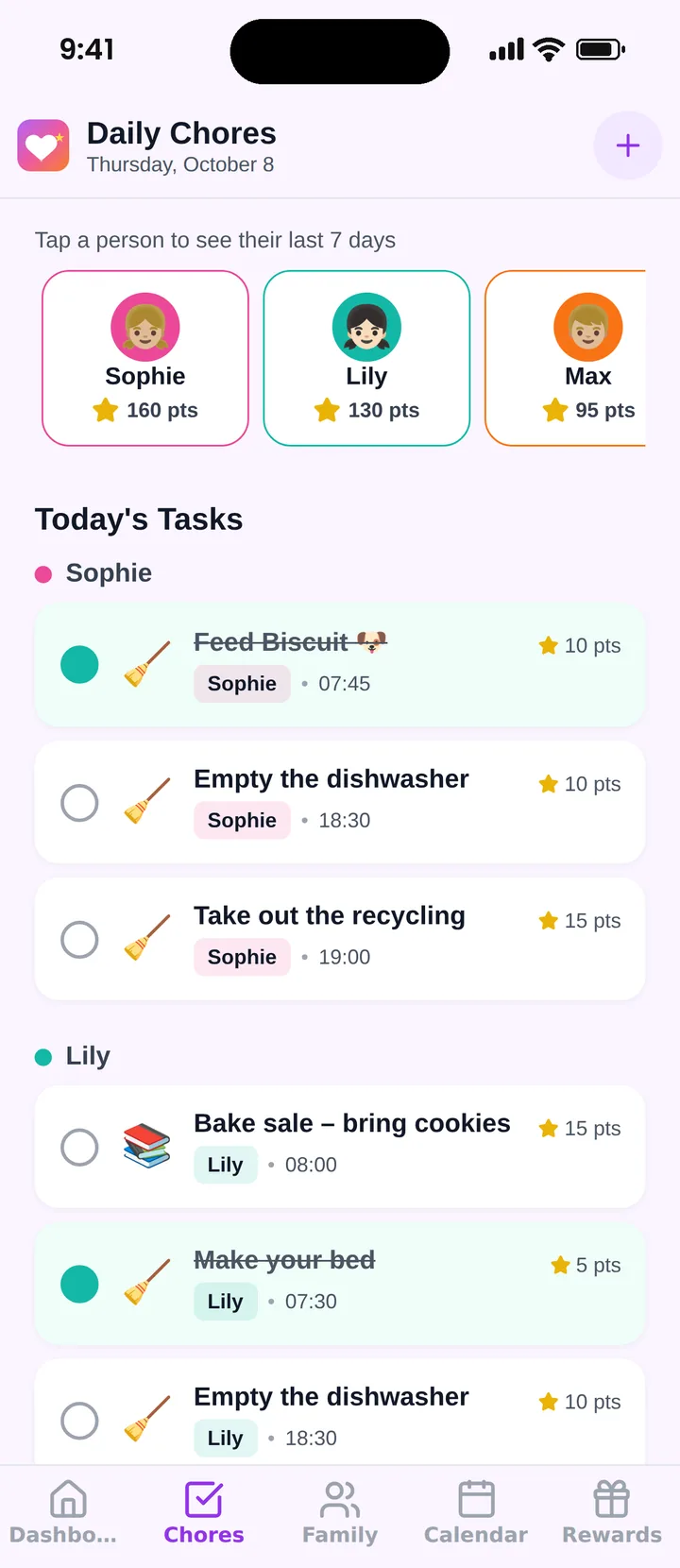
The free plan includes one repeating task, so several daily chores need Premium. For other options, see our list of the best chore apps for kids.
Tonight, pick two everyday chores per child from the table and tie each one to a moment in your day. Once those run without reminders, add a third. Our guide to making a chore chart for kids shows how to put it all on one page, and chore charts that actually work covers what keeps a chart going past the first month.
Frequently asked questions
How many chores should a child do every day?
Preschoolers usually do well with 2 to 3 daily tasks, about 5 to 15 minutes in total. School-age kids can handle 3 to 4 daily tasks, roughly 15 to 30 minutes depending on age. Teens can manage 30 to 45 minutes, which often includes one shared household job on top of their own space.
Should kids do chores on school days?
Yes, but keep school-day chores short and tie them to moments that already happen, like making the bed before breakfast or clearing plates after dinner. Save longer jobs, such as vacuuming or cleaning the bathroom sink, for the weekend so homework, activities and sleep still fit.
What chores can wait until the weekend?
Anything that doesn't get messy again within a day: vacuuming, cleaning the bathroom, changing sheets, washing a full load of laundry, yard work and washing the car. Many families give each child one weekly big job from about age 8 and attach it to a fixed day, such as Saturday morning.
Should kids get points or money for daily chores?
That depends on your family. Many parents treat daily chores as part of living together and keep them unpaid, then reward extra or bigger jobs. If you use points, valuing small daily tasks at around 5 points each keeps the math simple and lets kids watch steady progress through the week.
Try Famiyo With Your Family
Chores with points, a rewards shop for kids and one shared family calendar. Set it up in a couple of minutes.



Free to download • No credit card required • Available on iOS & Android