Homeschool Daily Routine for Kids (Sample Schedules by Age)
Sample homeschool daily routines for ages 3 to 5, 6 to 8, 9 to 12 and teens, with times, lesson blocks, breaks and how to adjust when the day falls apart.
By Famiyo Editorial Team6 min read
Most homeschool plans fail at the schedule, not the curriculum. The books are chosen, the supplies are bought, and then 9:15 arrives and one child is still in pajamas while another has not started. This guide gives you sample daily routines for four age groups, the reasoning behind each block, and a way to adjust when a day goes sideways.
What every good homeschool routine has in common
Age changes the length of lessons, but the structure underneath stays the same. Four parts show up in almost every routine that lasts.
- A fixed start. Same time, same first activity, every day. A child who knows the day opens with breakfast and a 10-minute chore block does not need to be talked into beginning.
- Short lesson blocks with breaks. Focus is limited, especially under 10. A short block followed by movement works better than one long sit.
- A shared anchor. One time of day when everyone is together, such as read-aloud after lunch. It gives the day a heartbeat and covers all ages at once.
- An early, clear finish. When children can see the end, they work toward it. Finishing by early afternoon also leaves room for outdoor play, sports and friends.
Aim for the routine to be an order of events with approximate times. A routine that depends on exact minutes is easy to break and hard to forgive.
Sample routine for ages 3 to 5
Preschoolers learn through play, so their routine is mostly a rhythm for the day, with one short, focused block. About an hour of structured learning is plenty, split into pieces of 10 to 15 minutes.
| Time | Activity |
|---|---|
| 7:30 | Wake up, get dressed |
| 8:00 | Breakfast, then clear own place |
| 8:30 | Chores: feed the pet, put toys in the bin |
| 9:00 | Circle time: songs, calendar, a story |
| 9:20 | Table activity: letters, counting, cutting, or play dough |
| 9:50 | Outside play |
| 10:30 | Free play while you teach older siblings |
| 12:00 | Lunch |
| 12:30 | Quiet time or a nap |
| 3:00 | Craft, baking or a walk |
Keep the number of steps low. A visual routine for kids under 7 works best with 4 to 6 steps, so show the child only the morning picture, then the next one. For the sleep end of the day, see our bedtime routine chart for 4- and 5-year-olds.
Sample routine for ages 6 to 8
Early elementary kids can sit for 20 to 30 minutes at a stretch, and they love ticking things off. Plan about 2 to 3 hours of lessons with a break after every block. A morning routine for school-age kids usually takes 30 to 45 minutes from wake-up to starting, and the same applies to the start of a homeschool day.
| Time | Activity |
|---|---|
| 7:30 | Wake up, get dressed, breakfast |
| 8:15 | Chores: make the bed, tidy the room, pack the "school" bag |
| 8:45 | Reading and writing |
| 9:30 | Break: outside or stretching, 15 minutes |
| 9:45 | Math |
| 10:30 | Snack and free play |
| 11:00 | Science, history or a project |
| 12:00 | Lunch, then load the dishwasher |
| 1:00 | Read-aloud together |
| 1:30 | Done: free time, sports, library, playdates |
If you want a closer look at what a single day can include, our guide to the daily routine for a 6-year-old covers school days and weekends in more detail.
Sample routine for ages 9 to 12
Older children can work for 30 to 45 minutes before a break and can handle some independent work. Plan about 3 to 4 hours. This is the stage to hand over a written list and let them choose the order within a block, which builds planning skills.
| Time | Activity |
|---|---|
| 7:30 | Wake up, get ready |
| 8:15 | Chores: make the bed, empty the dishwasher |
| 8:45 | Math, independent with you nearby |
| 9:45 | Break and snack |
| 10:00 | Language arts: reading, writing, grammar |
| 11:00 | Science or history, with a project twice a week |
| 12:15 | Lunch |
| 1:00 | Read-aloud, then free reading |
| 1:45 | Electives: coding, art, music, a language |
| 2:30 | Done |
By this age a checklist can replace a lot of reminders. Our list of life skills for kids by age shows what to build into the afternoons, such as cooking a meal or managing a small budget.
Teens: let them plan the blocks
Teenagers need 8 to 10 hours of sleep, so a school start at 7:00 is often a mistake in a house where bedtime is late. Let them set the order and times for their own work within a weekly plan. Your role changes to check-in: 10 minutes on Monday to look at the week, and a short review on Friday. A fixed block for chores and any outside commitments still belongs on the calendar. For how to get there, our article on independence for kids explains how to step back in stages.
How to handle several ages at the same time
This is the real challenge in most homes. Three tactics help.
Rotate your attention. Spend 20 to 30 minutes of focused teaching with one child while the others do independent work. Then swap.
Give the youngest a "my work" box with 3 or 4 quiet activities that only come out during school hours, so it stays interesting.
Share one block. Read-aloud, a science experiment or a morning song works for all ages at once, and it saves you an hour of teaching.
How to start a new routine without a rough first week
Do not launch the full schedule on Monday. Start with the first two blocks only, the morning chores and the first lesson, and keep the rest loose for a week. In week two, add the break and the lunch block. In week three, fix the afternoon.
Say the plan out loud at breakfast: "After you clear your plate, it's beds and the dog, then reading at the table." A child who hears the next two steps knows where the day is going. Let older kids help write the schedule, since a plan they chose gets pushback less often than one handed down.
Also decide what happens at the end of a block. A kitchen timer works well, and so does a short song for little ones. A clear signal that one thing is over and the next begins removes a lot of daily negotiation.
When the day falls apart
It will, on some days. A sick child, a missed nap or a spilled bag of flour changes everything. Do not rebuild the schedule; return to the order. Pick up from the next block and drop what you missed. Core subjects first, extras later. A bad day does not mean the routine failed. Give a new routine 2 to 3 weeks of consistent use before judging it.
Putting the routine on the family calendar
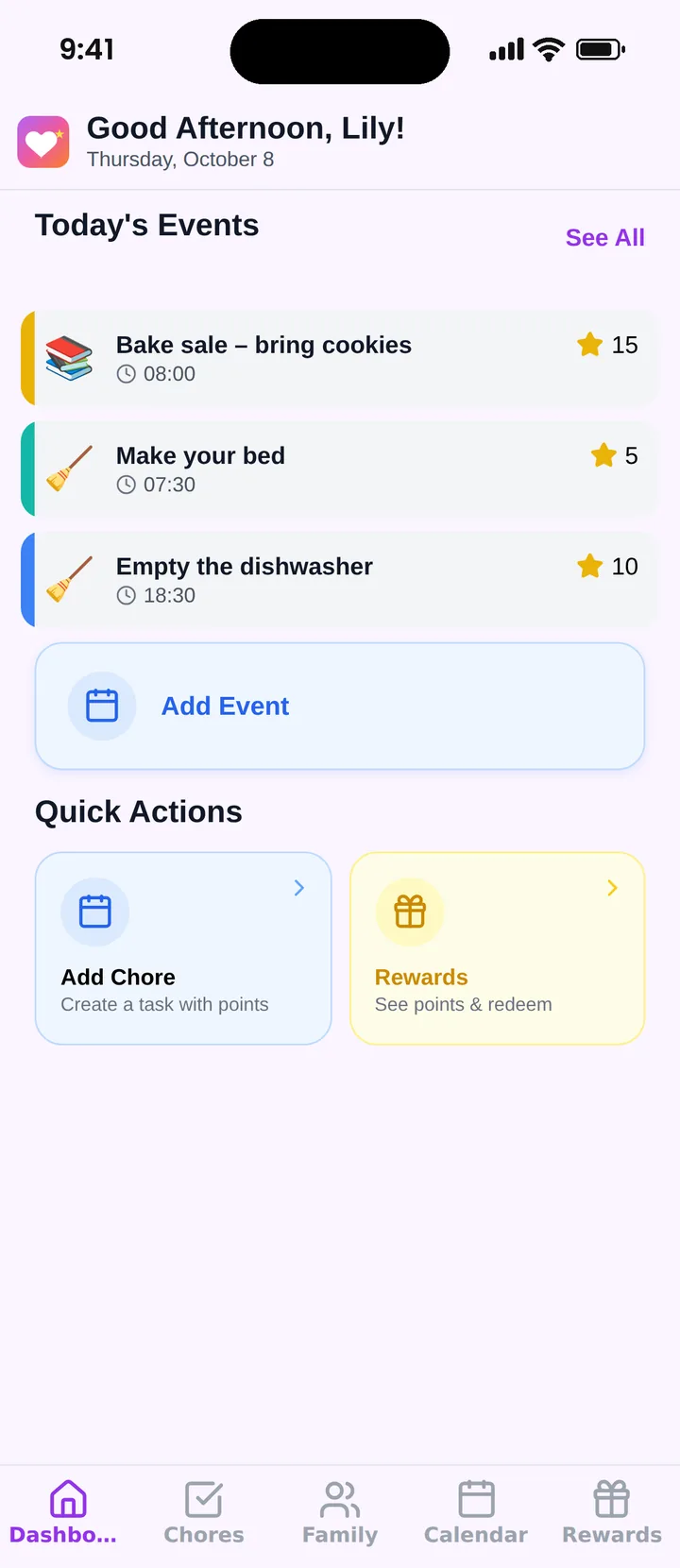
Famiyo is a free family app for iPhone and Android that combines a shared family calendar, chores with points and a rewards shop; kids join with a code, no email needed. For a homeschool routine, you add the repeating blocks to the calendar, such as math every weekday at 9:45 and a read-aloud at 1:00, give each child their own color, and add the daily chores as repeating tasks. Each child opens their own home screen and sees today's events and chores, and you get a push notification when a task is done.
The free plan covers up to 3 family members and 1 repeating task, and Premium removes the limits. See our list of the best family organizer apps for other options.
Write the first three blocks of tomorrow on a sticky note tonight, and start there.
Frequently asked questions
What time should a homeschool day start?
Start when the family is fed and dressed, usually between 8:00 and 9:30. Wake-up should still protect sleep: ages 6 to 12 need 9 to 12 hours and teens need 8 to 10. A fixed start matters more than an early one.
How long should a homeschool day be?
Far shorter than a school day, because there is no waiting in lines or switching rooms. Preschoolers do well with about an hour, early elementary children with 2 to 3 hours, and older kids with 3 to 4. Teens often need more, on their own schedule.
Do homeschool kids need a strict schedule?
They need a predictable order more than exact times. Doing the same things in the same sequence, such as chores, reading, math, lunch, tells children what comes next. Times can slide by half an hour without trouble.
How do I schedule homeschool for kids of different ages?
Teach one child while the other does independent work, and swap. Put the youngest on a quiet activity, like play dough or books, during your focused time with the oldest. Keep one shared block, such as read-aloud, so everyone learns together.
What do I do when the routine falls apart?
Go back to the order, not the clock. Restart from the next block on the list and skip what you missed. A routine that bends survives; one that demands a perfect day gets dropped by Thursday.
Try Famiyo With Your Family
Chores with points, a rewards shop for kids and one shared family calendar. Set it up in a couple of minutes.



Free to download • No credit card required • Available on iOS & Android