How to Get Kids to Clean Their Room (Without a Nightly Fight)
Why 'clean your room' fails and what works instead: a clear definition of done, a 10-minute reset, a script for the first ask and a plan for when it all falls apart.
By Famiyo Editorial Team5 min read

You say "clean your room" and 40 minutes later your kid is lying on the floor reading a comic from the pile you wanted gone. Everyone's tired, nobody's calm. This page is a plan that works better than shouting: how to define the job, how to shrink it, what to say, and what to do on the days it falls apart, which it will.
Why "clean your room" doesn't work
To an adult, a clean room is obvious. To a 7-year-old standing in the middle of a floor covered with Lego, clothes and paper, it's a cloud. They don't know where to begin, so they begin nowhere.
Three things go wrong most often:
- The job has no edges. There's no point at which a child can say "done."
- There's too much stuff. A room with no home for most of its contents will never stay tidy, no matter how well the child behaves.
- The timing is wrong. Asking right when they're deep in a game or tired after school sets you up to lose.
Notice that none of these is "my kid is lazy." If you want the longer version of why kids resist this particular chore, we cover it in why kids hate cleaning their room. Here we'll stay with fixes.
Step 1: Write down what "clean" means
Sit down once, when nobody is annoyed, and decide on three or four things. Write them on a card or take a photo of the room when it looks the way you mean. A good version:
- Dirty clothes in the hamper.
- Toys and games in their bins or on the shelf.
- Books and papers on the desk or shelf.
- Bed made (pulled up counts).
Floor visible, that's the test. You can add "trash in the bin" or "plates and cups back to the kitchen" if they live in the room. Keep the list short enough to hold in your head. For a younger child, swap the words for pictures.
This is the single most useful thing on the page. When the child knows exactly what finished means, you get to stop saying "that's not clean" and start saying "you've got one thing left."
Step 2: Fix the room before you fix the kid
Look at the room itself for ten minutes. A few small changes remove half the argument.
- Give every category a home. One bin for dress-up, one for cars, one for art stuff. Labels with pictures for kids under 7.
- Cut the volume. If clothes don't fit in the drawers, there are too many clothes. If toys can't go in bins, rotate half of them into a closet.
- Make putting away easy. Hooks at their height, open bins instead of lids, a hamper that is not on the far side of the room.
- Clear a floor path. The bed, the door and the hamper should never be separated by a mine field.
Then pick a size for the job that fits the child. A 6-year-old can do a 10-minute reset with you in the doorway. A 12-year-old should be able to do it alone in the same time, as long as they know the list.
Step 3: Shrink the job and fix the time
A daily reset beats a weekly rescue. Ten minutes at the same moment each day, with a timer, is much easier to defend than "sometime this weekend."
| Time | What it is | Length | Who |
|---|---|---|---|
| Before breakfast or before leaving | Bed and dirty clothes | 2 to 3 minutes | Child alone |
| After school or before dinner | Toys, books, papers back in place | 5 to 10 minutes | Child, you nearby |
| Once a week (Saturday morning is common) | Floor cleared, trash out, clothes put away, surfaces wiped | 20 to 30 minutes | Child, with help at first |
Attach the reset to something that already happens. "After dinner, before the tablet." Tying it to a screen is not bribery, it is sequence, and kids understand sequence.
Step 4: What to say, and how many times
Pick your moment, not theirs, and keep it flat. Here's a script:
- Warn them. "In five minutes it's room reset time."
- Ask once. "It's time. You've got the four things on the card. I'll set a timer for ten minutes."
- Stay close, say little. Sit in the doorway or work in the next room. You aren't there to supervise, only to stay present.
- Name progress. "The clothes are done. Toys next."
- Finish with the check. Look at the list together, not at your own standard.
If you hear "in a minute," answer "okay, the timer's still going" and leave it there. If you end up repeating yourself five times, you've lost the thread, so drop the repeats and use a result instead. Our piece on getting kids to do chores without yelling goes deeper on keeping your voice level.
When it falls apart (it will)
Say your 9-year-old agreed to everything on Sunday and by Thursday the floor is a landfill. Don't treat it as a betrayal. Go back to the card.
- Do a reset together once. Fifteen minutes, both of you, with music. Then hand it back.
- Use a short, connected consequence. Things left on the floor go into a box for a day. Screen time starts after the reset is done.
- Skip the big threats. Taking away a favorite toy for a month or bagging up belongings in anger teaches your child that the room is a battlefield, and the battle goes on for years.
- Check the load. If this is the fifth thing you've asked of them today, the room is not the problem.
For older kids, the rules change. A 12-year-old may really need some say over how the room looks, and the deal becomes "floor clear, food dishes out, laundry in the hamper, the rest is yours." You can see how that sort of agreement fits with household chore rules for the whole family, which helps when siblings compare.
Younger kids are different again. A first grader can do most of this with a picture list, and our list of chores for 7-year-olds shows where room tidying sits among the other jobs at that age.
Letting an app do the reminding
Famiyo is a free family app for iPhone and Android that combines a shared family calendar, chores with points and a rewards shop; kids join with a code, no email needed. Set "room reset" as a repeating chore with points (10 is the default for a medium job, +2 if they do it without a reminder). Your child gets a push notification when it's time and sees it on their own phone.
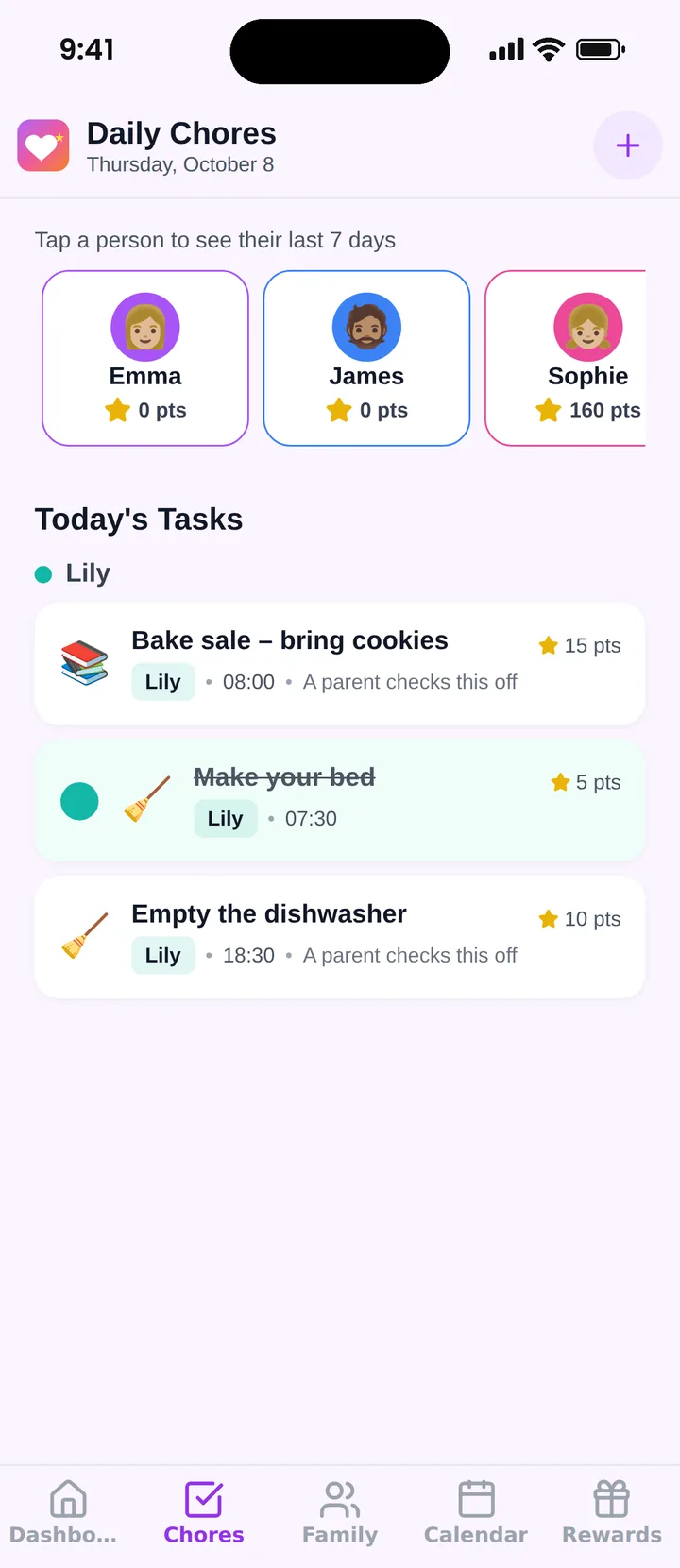
The point is that the phone does the asking, so you don't have to. You can choose whether they tick it off themselves or you approve it, and you get a notification when it is done. Points go toward rewards you pick. If you are comparing options, see our list of the best chore apps for kids.
A first week, in practice
Day one, make the card and fix the bins. Day two to seven, run the reset at the same time, and say nothing about quality until day four. Judge it after two to three weeks, not after two days. The goal is a child who knows what clean means and does the job on most days, not a room that looks like a catalog.
Frequently asked questions
Why won't my child clean their room?
Usually the job is too big or too vague. A room with 80 things on the floor looks impossible, and 'clean it' doesn't say where to start. Break it into three or four steps and set a timer, and most kids stop stalling.
How long should it take a kid to clean their room?
A daily reset should take 5 to 10 minutes. A deeper weekly clean can run 20 to 30 minutes for a school-age child. If it regularly takes an hour, there is probably too much stuff in the room, not a problem with the child.
Should I clean my child's room for them?
Occasionally, as a one-off reset with their help, yes. Doing it for them every time teaches them that waiting works. Help with the first pass, then hand it back with a smaller job.
What are good consequences for a messy room?
Keep them short and connected: toys left on the floor go in a 'rest box' for a day, or screen time starts after the reset is done. Avoid taking things away for weeks or throwing out belongings in anger.
Try Famiyo With Your Family
Chores with points, a rewards shop for kids and one shared family calendar. Set it up in a couple of minutes.



Free to download • No credit card required • Available on iOS & Android