How to Get Teens to Clean Up After Themselves
Teens leave cups, towels and shoes everywhere. Here's how to get them to clean up after themselves: clear standards, a fixed time, real consequences, less nagging.
By Famiyo Editorial Team4 min read
Your teenager is perfectly capable of carrying a plate eight feet. They just don't, and by Thursday there are three cups in the living room, a towel on the bathroom floor and a pair of shoes parked exactly where you walk. This page explains why that happens and gives you a setup that works without you becoming the household alarm clock.
Why teens leave their mess behind
Mostly it isn't rebellion. A teen's brain is busy with school, friends, sleep debt and a phone that never stops. Mess in their own space doesn't register as a problem, and if a parent has quietly cleaned up for 15 years, the system has taught them that mess disappears on its own.
The other piece is that "clean up after yourself" is vague. To you it means plate, cup, wrapper and towel. To a 15-year-old it might mean "don't leave a pile of garbage." The fix is to make the rule smaller and more specific, then make it automatic.
Write the rule down in concrete items
Sit down once, at a calm moment (not in the middle of a fight about a cereal bowl), and agree on a short list. Keep it to things a teen can check in 10 to 15 minutes.
- Dishes and cups go to the kitchen, and into the dishwasher if there's room.
- Dirty clothes and wet towels go in the hamper, not on the floor or the bed.
- Shoes, jacket and bag go in one spot by the door.
- Food wrappers, tissues and drink bottles go in the trash, not on the desk.
- Anything borrowed from a shared room goes back there.
Five items is plenty. If you add twelve, you'll spend your energy policing the list instead of the habit. Ask your teen to suggest one change to it. They'll push back less on a rule they helped edit.
Pick one daily reset time
Constant reminders are what turn this into a fight. A single, fixed moment replaces them. Choose a time that already exists in the day, like right after dinner or before the phone comes out for the evening, and call it the reset.
What you say, once, in a normal voice: "Every night after dinner there's a ten-minute reset. Dishes, laundry, shoes, trash. When it's done, the evening is yours. If it isn't, phone time waits until it is."
Notice what's missing: no threat, no sarcasm, no running commentary. The condition is built into the schedule. If your teen has a job or practice that night, move the reset earlier, don't skip it.
What to do when they forget anyway
They will. This is the part where the honest answer is that it falls apart some Wednesdays, and the plan has to survive that. Use the same response every time, so it stops being personal.
| Situation | Calm response |
|---|---|
| Cup left in the living room | "Reset isn't done yet, phone's on hold." Say it once. |
| Towel on the floor, again | Leave it. Dry towel tomorrow only after it's in the hamper. |
| Shoes in the hallway | Into a "retrieval box". Getting them back costs 10 points or a small task. |
| Shared-space mess (kitchen, bathroom) | The reset isn't complete until that space is clear. |
| Arguing about it | "We can talk about the rule on Sunday. Tonight the reset still counts." |
Consistency matters more than severity. A small consequence that happens every time beats a dramatic one that happens twice a month. And skip the lecture, because a teen who is being lectured is no longer thinking about the cup.
Stop rescuing their stuff
A lot of messy-teen households run on a quiet rescue system: Mom finds the shoes, Dad rinses the bowl, someone washes the one shirt that's in the wrong pile. It feels helpful and it is the reason the habit never sticks.
Tell your teen in advance what you're changing: "I'm not picking up after you in your room or on the way through the house anymore. If it's in the hamper on laundry day, it gets washed. If it's not, it doesn't." Then do exactly that. Being warned makes it fair. Following through makes it work.
Your own room standard can stay flexible. Shut the door on a messy bedroom if you need to, and hold the line on food, dishes, wet laundry and shared spaces. Those are the messes that affect other people. The same logic runs through our guide to getting teens to do chores without a daily battle, which goes deeper on bigger weekly jobs.
Teach the skill if it's missing
Sometimes the mess is a skill gap. A teen who has never run the dishwasher, sorted laundry or wiped a counter properly may be avoiding it because they're not sure what "done" looks like. Show them once, then step back. For laundry specifically, our article on getting kids to do their own laundry walks through it step by step, and the full list of chores for teenagers by age helps you decide what to add next.
Letting the app do the reminding
Famiyo is a free family app for iPhone and Android that combines a shared family calendar, chores with points and a rewards shop; kids join with a code, no email needed. For this problem, the useful part is that the reset becomes a short list your teen sees on their own phone instead of a sentence you say out loud.
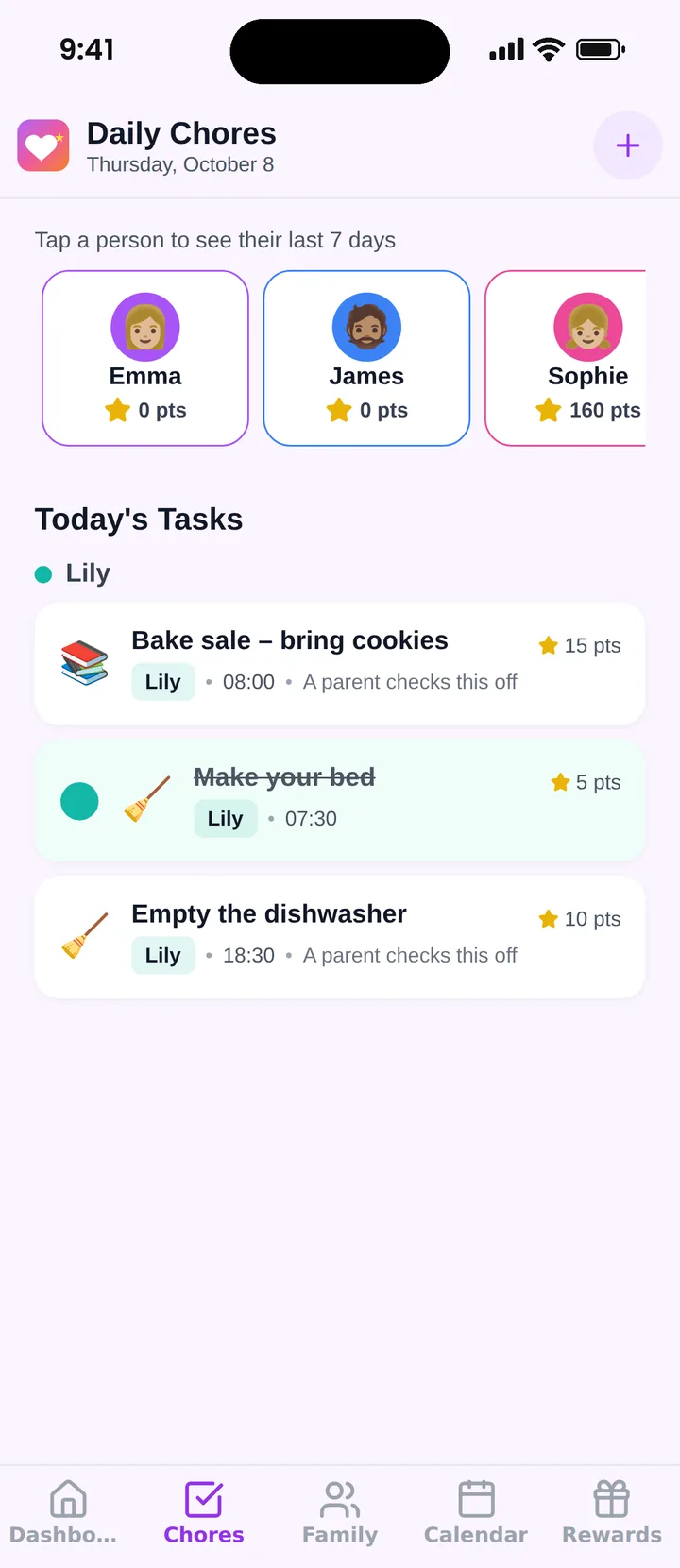
Set up a repeating daily chore for the reset, give it points, and the notification does the nagging. Add a small bonus for doing it without a reminder, and decide whether your teen checks it off or you approve it. See our list of the best chore apps for kids if you want to compare options.
Give it three weeks
Habits like this take 2 to 3 weeks of consistent use before you can fairly judge them. Expect the first week to be rough and the third to be quiet. If it's still a fight after that, shrink the list rather than raising the stakes. A shorter list that gets done teaches more than a long one that doesn't.
Frequently asked questions
Why does my teenager leave a mess everywhere?
Usually it's not defiance. Teens are busy, tired and used to someone else resetting the house. If nobody ever stated a standard or a consequence, the mess costs them nothing. Clear rules and a fixed time fix more than lectures do.
Is it okay to just stop picking up after my teen?
Yes, for their own stuff. Stop washing the cup, moving the towel or rescuing the shoes. Tell them first so it isn't a trap, then let the natural result happen. Shared spaces still need a firm rule, because that mess affects everyone.
What consequences work for a teen who won't clean up?
Pick something connected and predictable: the item goes in a box and costs points to get back, or phone time starts after the reset is done. Avoid big punishments like a week without a phone. Small, certain consequences work better than huge, rare ones.
How long should a daily reset take a teenager?
Ten to fifteen minutes is realistic for a teen's own mess: dishes to the kitchen, laundry to the hamper, trash out of the room, shoes and bag in their place. If it takes longer, the room has too much stuff or the reset is being skipped.
Try Famiyo With Your Family
Chores with points, a rewards shop for kids and one shared family calendar. Set it up in a couple of minutes.



Free to download • No credit card required • Available on iOS & Android