How to Get Kids to Pick Up Their Toys (Without Nagging)
How to get kids to pick up toys: shrink the mess, set a daily time, use a script that works and stop doing it for them. Steps by age, plus what to say.
By Famiyo Editorial Team6 min read
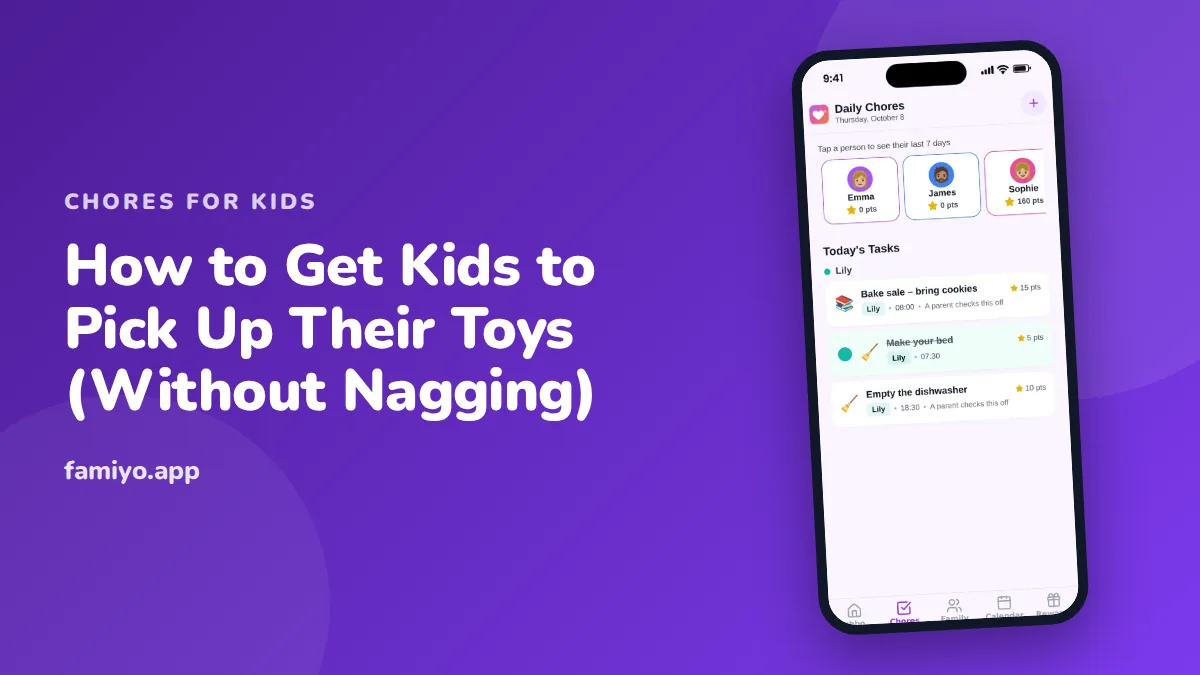
You ask nicely. You ask again. By the fourth request your voice has changed, and your child is lying on the rug with a dump truck, apparently deaf. Meanwhile there are 40 pieces of plastic between you and the couch. This page walks through why toy pickup goes wrong and the setup that fixes most of it, with scripts you can use tonight.
Why kids ignore the toy mess
Start with the child's view. A floor covered with puzzle pieces, blocks, dolls and a half-built train track is not "a few toys". It is an enormous, unclear job with no obvious first step. Adults freeze in front of a messy garage for the same reason.
Three things usually sit underneath a refusal:
- The pile is too big for the child's age.
- "Clean up" is vague, so they don't know what done looks like.
- The timing is bad. Pickup demanded mid-play, or at the moment they are exhausted, goes badly for almost every kid.
Notice that none of these are about attitude. Fix the setup first and the attitude often shows up fixed too.
Step 1: Own fewer toys
This is the least fun advice and the most effective. If cleanup takes 25 minutes, no child will do it willingly, and you will end up doing it. Put about half the toys in a closet and swap them every few weeks. The rotation also makes old toys feel new.
A rough test: can your child put everything away in 5 to 10 minutes? For ages 2 to 3, that is the total time per day that fits their chore load. If not, take more toys out of circulation.
Step 2: Give every toy a home
"Put it away" means nothing if away is a vague idea. Make it physical.
- Use open bins, not lids. A lid is one more step, and one step too many for a 3-year-old.
- Put bins at child height, within reach without a stool.
- Label with a photo or drawing for kids who can't read yet. Blocks, cars, dolls, books, art supplies.
- Keep categories broad. Five bins are easier than fifteen.
- Let the child help set it up and choose where things go. They are more likely to use a system they built.
Small pieces such as LEGO or puzzle sets get one container each, and the rule is that only one set is out at a time. That alone cuts the mess in half.
Step 3: Pick a fixed time
Pickup works when it is predictable, and it fails when it is a surprise. Choose one daily anchor and stick with it. Good ones:
- Right before dinner ("toys away, then we eat")
- Before screens or a bedtime story
- After the afternoon play block, before the next activity starts
Avoid the last five minutes before leaving the house, which is when everyone is rushed and angry. If the evening is the hardest part of your day, do a quick tidy right after school instead, and again at night only if needed.
Step 4: Say it in a way a child can follow
Vague: "Clean up this mess!" Clear: "Blocks go in the red bin. Start with those."
Give one instruction at a time. For a young child, a single step is enough. For a 6- or 7-year-old, try two or three. A scripted version you can borrow:
- Give a heads-up: "Five more minutes, then pickup."
- Announce it: "Pickup time. Cars first."
- Stay close. Sit on the floor and start with the first bin together, then step back.
- Name progress: "The cars are done. Now the animals."
- Finish with a specific thanks: "You got every block in the bin. Dinner's ready."
Sitting nearby is not rewarding bad behavior. It is how kids learn a job, in the same way you taught them to tie shoes. See our guide on getting toddlers to clean up their toys if yours is under 3.
Step 5: Make it a little fun
Games work well with children up to about 7. They are not a trick, just a way to make a boring job feel shorter.
- Race a song: all cars home before the chorus ends.
- Beat the timer, then try to beat yesterday's time.
- Be a garbage truck, a crane or a vacuum cleaner that "eats" only the blocks.
- Sort by color first, then by type.
Skip the games if they turn into negotiations. The point is a faster start, not entertainment.
What to expect at each age
| Age | What pickup looks like | Your job |
|---|---|---|
| 2 to 3 | Dropping toys into a bin, with you | Do about half, narrate, keep it under 10 minutes |
| 4 to 5 | Full pickup with a short reminder and a picture label | Give one prompt, check the result |
| 6 to 7 | Pickup mostly on their own, including small pieces | Reminder at the fixed time, then step away |
| 8 and up | Pickup without help, sometimes without a reminder | Notice it when it happens |
For a closer look at younger kids, our chore chart for a 4-year-old shows where toy pickup fits in a day. For a bigger picture of what to expect from all ages, see how to get kids to do chores.
What to do when they still won't
Some days they won't, and that is normal. You will have a Wednesday where nothing works. Here is what to do on the bad days.
First, check whether you skipped a step: too many toys, no fixed time, too vague. If not, use a consequence you announced earlier, and keep your voice flat. For example: "Toys left on the floor at 6:00 go in the box until Saturday." Then do it, without a lecture. The box is not a punishment. It is the result of the rule.
Avoid bribing in the moment ("I'll give you a cookie if you pick up now"). It teaches that the price goes up when they refuse. Pay in advance for routines, not in the middle of a standoff.
Also avoid cleaning up for them as soon as they walk away. If you always finish the job, they learn they never have to. Leave it, calmly, until the next pickup time. If safety is an issue, such as a toy on the stairs, move it yourself without comment and keep the rule going.
Make pickup count with points
A small reward helps while the habit is new. Use the standard small-task value: 5 points for finishing a pickup. Add 2 bonus points when the child starts without a reminder. At that rate, a child earns a small reward (30 to 50 points) every few days, which is about the right pace for a young kid. Our reward chart for a 5-year-old shows what else to put on the chart beside toys.
Plan on easing the points off in a couple of months, once pickup is routine. Keep the thank-you, though.
Letting an app do the reminding
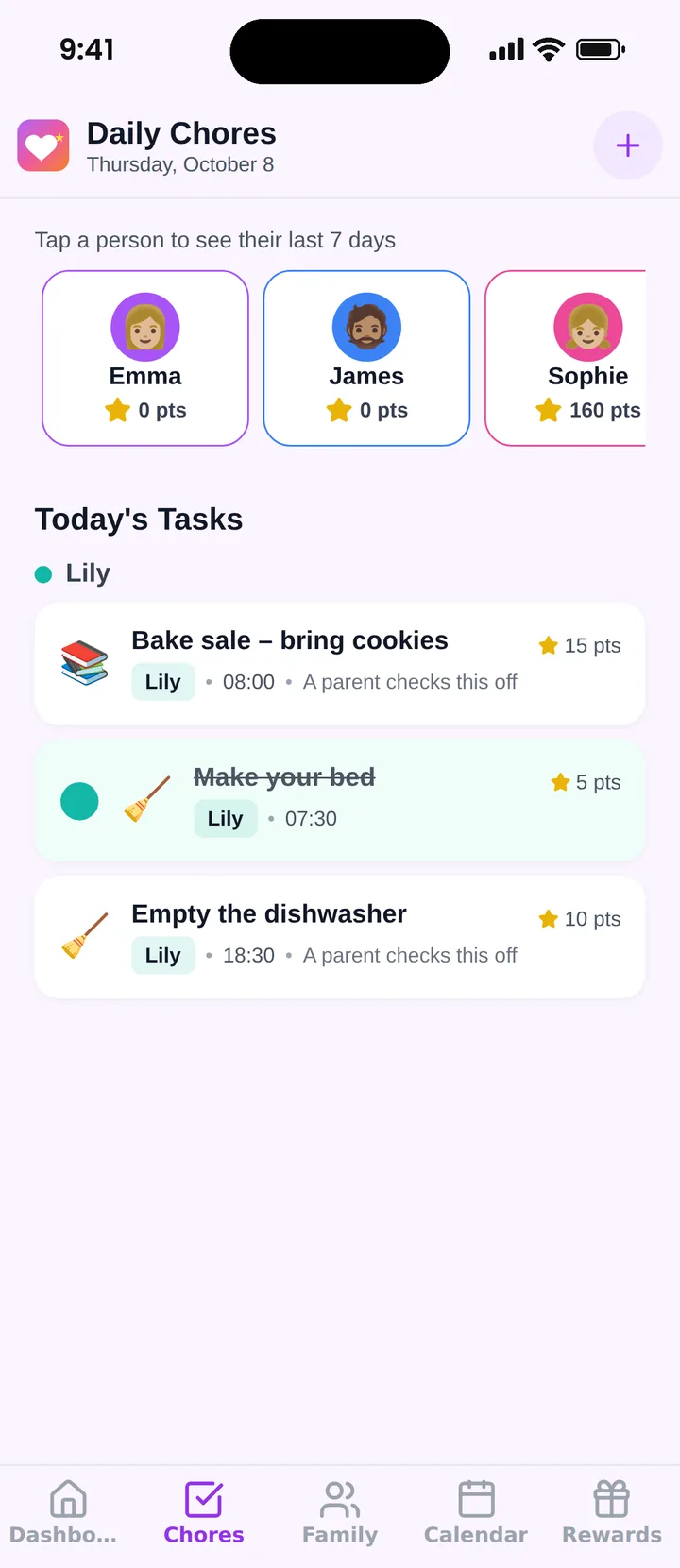
Famiyo is a free family app for iPhone and Android that combines a shared family calendar, chores with points and a rewards shop; kids join with a code, no email needed. You add "Pick up toys" as a repeating chore worth 5 points, and your child hears about it on their own phone or tablet, so the reminder comes from the app and not from you. They check it off themselves, or you approve it first, whichever you choose. You get a notification when it is done. For a list of tools that do this, see our look at the best chore apps for kids.
Tonight, cut the toy count in half and choose one pickup time. That is the whole plan for the first week.
Frequently asked questions
Why won't my child pick up their toys?
Usually the job is too big, too vague or too late in the day. A floor covered in 60 items looks impossible to a child. Fewer toys, labeled bins and a short, specific instruction fix most cases before any discipline is needed.
At what age should kids pick up their own toys?
Around 2, with you doing most of the work and the child dropping things in a bin. By 4 or 5 they can do a full pickup with a short reminder. By 6 or 7 it should happen with little prompting.
Should I take away toys that are left out?
A calm, pre-announced version works: toys left on the floor at pickup time go into a box for a few days. Announce the rule once beforehand and do it without anger. Taking toys in the heat of the moment tends to start a fight.
Should I reward kids for picking up toys?
A small reward works well while the habit forms, such as 5 points for a finished pickup. Treat it as a bridge. Once pickup happens most days without a reminder, you can ease the reward off and keep the routine.
How long should toy cleanup take?
For a young child, 5 to 10 minutes is plenty, which matches the 5 to 10 minutes a day of chores typical for ages 2 to 3. If it takes longer, there are too many toys out or the bins are too hard to use.
Try Famiyo With Your Family
Chores with points, a rewards shop for kids and one shared family calendar. Set it up in a couple of minutes.



Free to download • No credit card required • Available on iOS & Android