How to Get Teens to Do Chores (Without a Daily Battle)
Teens do chores when they have a say, a deadline instead of a nag, and consequences that arrive on their own. Here is the setup, the scripts and a sample week.
By Famiyo Editorial Team5 min read
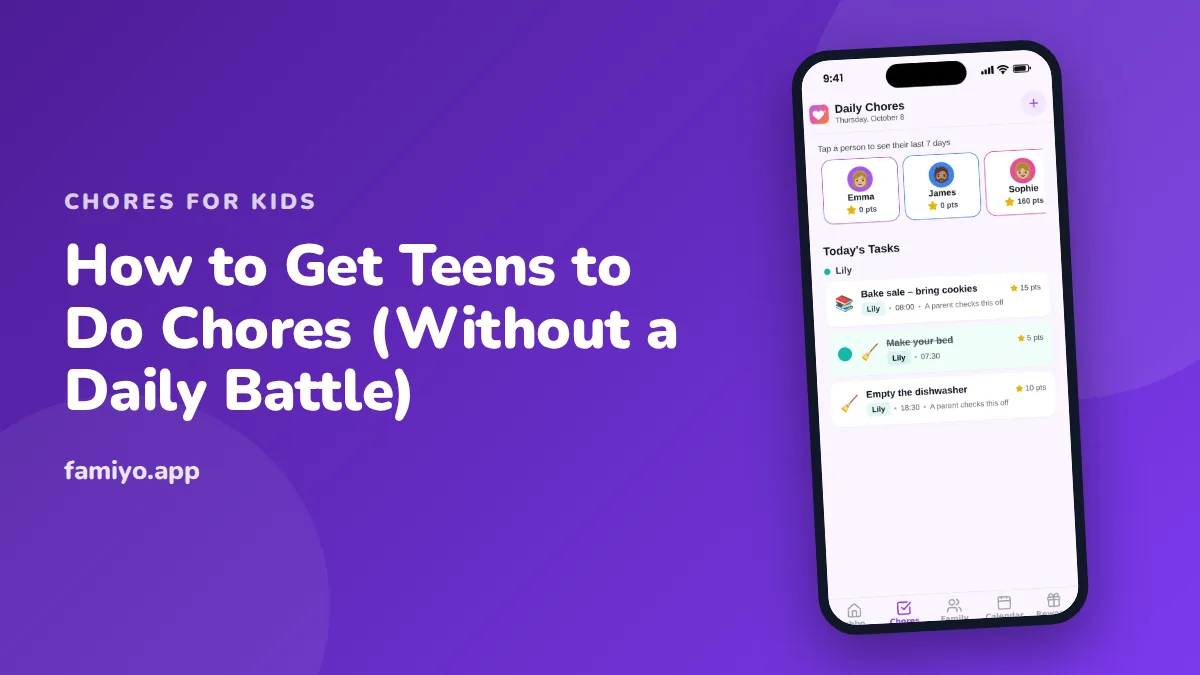
Your teenager heard you the first time. And the second. By the fifth you are standing in a doorway saying the word "dishwasher" in a voice you swore you would never use. It is exhausting for both of you.
Teens are not lazy so much as busy, tired and very interested in being treated like adults. The way out is to stop managing them like a small child and start running chores like a household agreement. This page walks through the setup, what to say, and what a realistic week looks like.
Why the nagging stopped working
When your kid was seven, "please set the table" worked because you were the authority and the job was small. A 15-year-old hears the same sentence as a demand on a free evening, delivered by someone who happens to control their phone. They dig in, and now the fight is about respect, not about the dishes.
Two things make it worse. The first is vague timing: "Can you help out later?" invites an argument about what later means. The second is the audience of one. If you are the only person who ever brings up chores, you become the problem. The goal is a system that does the reminding, so you do not have to.
Start with one conversation, not one more reminder
Pick a calm moment, not right after a mess. Do not do it in the car if you can help it, and do not do it when you are already annoyed. You want a negotiation, not a verdict.
- Say why. "The house runs on all of us. You're old enough to own real parts of it."
- Ask what they would rather do. Give them the full list of household jobs and let them pick. Teens who choose their jobs complain less about them.
- Agree on a deadline for each job. "Trash out by 7 p.m." beats "sometime this evening."
- Agree on the link. Decide what the finished list earns: phone after dinner, a ride to a friend's, screen time on weekends.
- Agree on what happens when a job is missed. Say it out loud now, so nobody is surprised later.
- Put it in writing, and review it in two weeks. Their input counts, and the list can change.
You will give up a little control in step 2. That is the price, and it is worth paying.
What to put on a teen's list
Fewer jobs, done properly, beat a long list that gets ignored. Think 3 or 4 daily and one bigger weekly job. A teenager's day is long, but it is full, so the total should land around 30 to 45 minutes. For a fuller list by age, see our guide to age-appropriate chores for kids.
| Type | Examples | Time | Points |
|---|---|---|---|
| Daily, small | Make the bed, feed the pet, wipe the kitchen counters | 2 to 5 minutes | 5 each |
| Daily, medium | Empty or load the dishwasher, take out the trash | 10 to 15 minutes | 10 each |
| Weekly, big | Mow the lawn, clean the bathroom, do their own laundry start to finish | 30 minutes or more | 20 each |
| Bonus | Done without a reminder | n/a | +2 |
Their own laundry is a good anchor. It is a real adult skill, it affects only them, and "no clean jeans" is a consequence that does not need you.
What to say (and what not to say)
Tone is half of this. A few swaps that help:
- Instead of "You never help," try "The kitchen needs to be done by 7. What time works for you?"
- Instead of "Why do I have to ask you every time?" try "I'll stop asking. Check the list, and we'll talk if it isn't done."
- Instead of "You're so ungrateful," say nothing. Insults end the conversation and start a different one.
When they push back, use the same short line every time: "That's fair, tell me what you'd change. Until we change it, this is the plan." Then walk away. It feels abrupt. It also removes the audience.
If you are looking for the angle of general helpfulness rather than assigned jobs, our piece on how to get teens to help around the house covers that side of it.
Let consequences do the work
A consequence works when it is connected, predictable and calm. Connected means it relates to the job: no phone until the kitchen is clean makes sense, grounding for a month does not. Predictable means they knew it in advance. Calm means you say it once.
Here is how it sounds in practice. Say the trash was due at 7 and it is 8:30.
- You, once, no heat: "Trash isn't out. Phone's on the counter until it is."
- Then you stop talking. Do not lecture. Do not check on them every ten minutes.
Expect testing. Teens poke the system in the first two weeks to see whether it is real. If you hold the line without anger, most settle down. If you cave once, you have taught them that persistence works, so pick consequences you will actually enforce.
A realistic week
Nobody does this perfectly. A sample week for a 15-year-old with four jobs:
- Monday to Friday: make the bed, trash out by 7 p.m., load or empty the dishwasher on their assigned nights.
- Wednesday: forgets the trash, because Wednesday is always the problem. The phone waits on the counter. Done by 8, no discussion.
- Saturday: the weekly job, mowing or bathroom, before noon, which frees up the afternoon plans.
- Sunday: two-minute check-in. What worked, what to change.
That is a good week. A bad week is two missed days and an eye roll. Both are survivable.
What if they truly won't do anything?
Look underneath the refusal before you tighten the rules. A teen who suddenly stops can be overloaded, low or struggling with something you have not heard about yet. Ask once, privately, "Is something making this harder lately?" If the answer worries you, or the withdrawal lasts for weeks and spreads past chores, talk to your pediatrician or school counselor.
If it really is just defiance, shrink the list to two non-negotiables, such as trash and dishes, and hold those firmly while the rest stays flexible. A small list that gets done rebuilds the habit faster than a big one that does not.
Letting an app do the reminding
Famiyo is a free family app for iPhone and Android that combines a shared family calendar, chores with points and a rewards shop; kids join with a code, no email needed. For a teenager, the useful part is that the app is the one that reminds them. They get a notification when a new task lands, see their own list and points on their own phone, and check jobs off themselves, or you can set it so a parent approves. You get a notification when a chore is done, so you do not have to go and look.
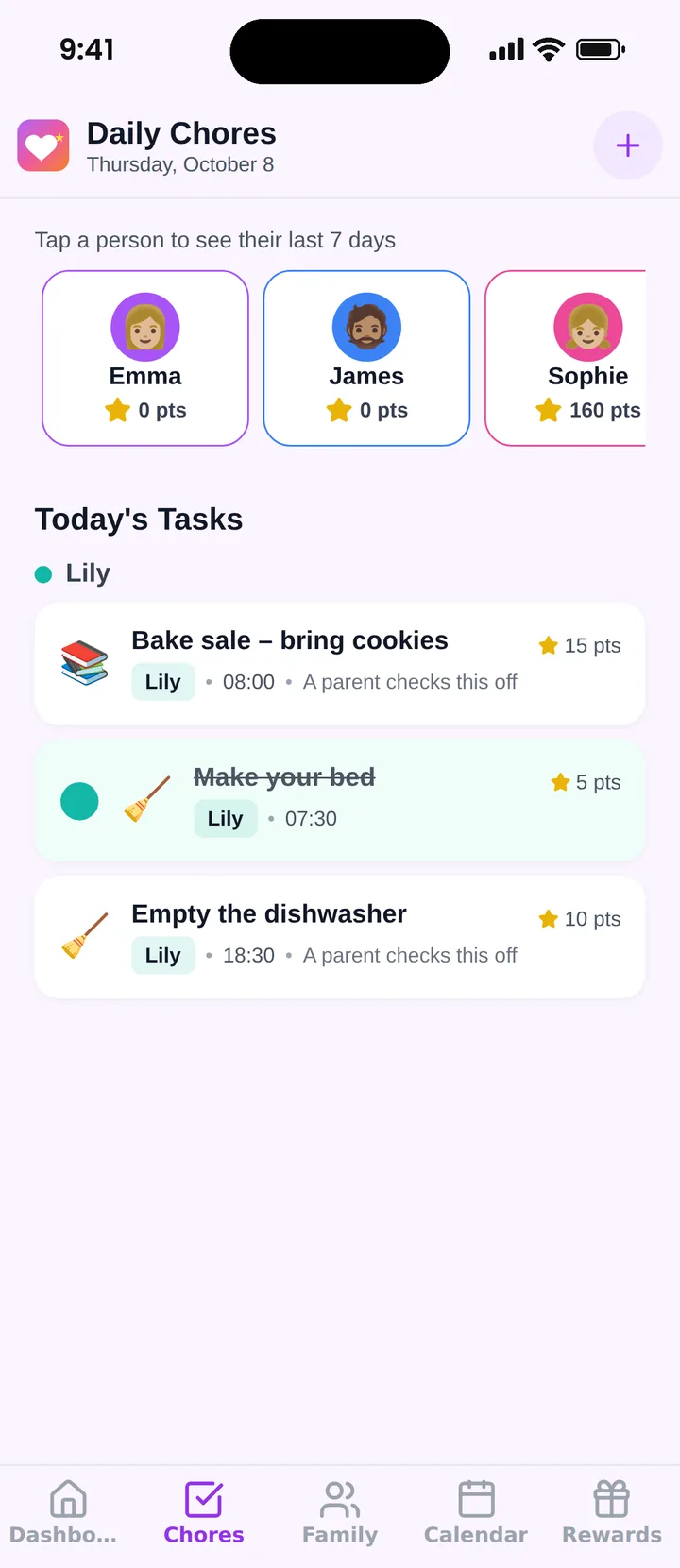
Points can go toward rewards you set up, like extra screen time or a later bedtime on a weekend. If you want to compare options, see our list of the best chore apps for kids.
Pick the one conversation this week. Everything else gets easier once the list is theirs too.
Frequently asked questions
How many chores should a teenager have?
Most teens can handle 3 or 4 small daily jobs and one bigger weekly job, about 30 to 45 minutes a day in total. More than that and homework, sports and sleep start to suffer, and resentment grows fast.
What do I do when my teenager flat-out refuses?
Don't argue in the moment. Say 'We'll talk about it after dinner,' then follow through calmly. The agreed consequence, such as no phone or no ride until the job is done, does the work. Repeating yourself only gives them something to push against.
Should I pay my teen to do chores?
Keep the basics unpaid, because they live there too. Pay for extra jobs beyond the baseline, such as washing the car or mowing the lawn, at roughly $2 to $5 for a big one. Many families tie privileges, not cash, to the daily list.
Is it okay to take away the phone over chores?
Yes, if the rule was agreed ahead of time and you apply it without anger. 'Phone is back when the kitchen is done' is a clear, fair rule. Taking it away for a week on the spot, in a rage, is not.
Try Famiyo With Your Family
Chores with points, a rewards shop for kids and one shared family calendar. Set it up in a couple of minutes.



Free to download • No credit card required • Available on iOS & Android