How to Get Teens to Help Around the House
How to get teens to help around the house: a short family meeting, a fixed job list, point rewards and exact words to use when they say no or ignore you.
By Famiyo Editorial Team5 min read

Your teen walks past the full dishwasher, the laundry on the stairs and you, standing there with the third reminder loaded. Most parents of teenagers know this scene. Here's a plan that cuts the reminders down to about one a day, with the exact words to use, a sample weekly split and what to do when the answer is still no.
Why teens dig in (and why it isn't about the dishes)
A 15-year-old is trying to become an adult and still lives under someone else's rules. Every order feels like a small reminder of that. So the same request, "unload the dishwasher," lands very differently depending on how it arrives. Shouted from the kitchen at the moment they sit down, it's a power struggle. Written on an agreed list with a time next to it, it's just part of the deal.
That's the whole strategy: move the chores out of the moment and into a system. Teens are often better at following rules they helped write than rules they were handed. They're also usually more tired than they look, with early school starts, homework and activities, so the plan has to be small and fair.
If you want the version that covers refusal, mood and attitude in depth, see our guide to how to get teens to do chores. This page is about getting real help in the house, day to day.
Hold one short family meeting
Do it once, on a calm evening, not right after an argument. Ten minutes is enough. Pick a time when nobody is hungry or about to leave.
- Say what you see, without blame: "The house takes about two hours of work a day, and right now most of it lands on me and Dad."
- Ask for their view first: "What feels unfair about how we split it?" Then listen. Teens often have a real point.
- Offer a fixed list of 3 or 4 daily jobs and one weekly job, and let them pick which ones they want first.
- Agree on deadlines in plain times. "By 6 p.m." is better than "when you get a chance."
- Agree on the consequence together, ahead of time. Phone off at 9 p.m. until jobs are done works better than a surprise punishment.
- Write it down. Put it in one place everyone can see, or on their phone.
You can say no to some of their ideas. The point is that they had a say.
What a realistic split looks like
Teens can carry a real share. The facts that matter: a 13-year-old and up can do about 30 to 45 minutes a day without it turning into a second job. Keep the list short and make each job finishable.
| Day | Daily jobs (10 to 15 minutes each) | Weekly job |
|---|---|---|
| Mon | Dishwasher, trash out | Own laundry, start to finish |
| Tue | Cook or help with dinner | |
| Wed | Dishwasher, wipe counters | Sweep or vacuum main floor |
| Thu | Cook or help with dinner | |
| Fri | Dishwasher, trash out | |
| Sat | Bathroom sink and toilet | Mow the lawn or rake |
| Sun | Own room reset, pack bag for Monday |
Adjust it to your house, but notice the pattern. Each day has one or two jobs, not a long list, and a few days are lighter on purpose. Exam week? Swap a dinner job for a dishwasher job. Don't just add or remove them.
What to say, and what to skip
Ask once, at a moment when they can answer, and attach a time. Nagging teaches teens to wait for the third reminder.
- Instead of "You never help," try: "The dishwasher needs unloading before 6. Can you take care of it?"
- Instead of "Why do I have to ask you ten times?" try: "I'll check at 6. If it's done, great."
- When they sigh and say "later," try: "Later is fine if it's before 6."
- When they say "No, it's not fair": "Tell me what feels unfair and we'll look at it on Sunday. For tonight, the job stands."
Skip the lecture about how hard you work. Skip the comparison to their cousin. Skip anything that begins with "When I was your age." Teens tune out all three within a sentence, and you lose the calm tone that makes the rest work.
Rewards, privileges and the word "earn"
Basic jobs aren't a favor to you, so they shouldn't be paid. They're how a household works. What helps is a simple link between finished jobs and the things teens care about: the phone, rides, friends over, a later curfew on weekends. Say it neutrally: "Jobs first, then the phone."
For extra help, a small reward is fair. A day of yard work or washing the car is worth about $2 to $5 for a big one, and a point system works well alongside. In our default suggestion a small job of 2 to 5 minutes is worth 5 points, a 10 to 15 minute job is 10, a big job of 30 minutes or more is 20, and doing it without a reminder adds 2 bonus points. Rewards might be 15 extra minutes of screen time at 30 to 50 points, or a pick of the family movie at 100. For more on picking the right jobs by age, see our list of chores for teenagers.
When they still say no
It will happen on a Wednesday. Don't escalate. Use the consequence you agreed on, once, in a flat voice: "The jobs weren't done, so the phone stays on the counter tonight. You can try again tomorrow." Then stop talking.
Two things make this work. First, the consequence has to be something you'll really do every time, not a threat you drop when it gets inconvenient. Second, tomorrow starts clean. A teen who feels they're permanently in trouble has no reason to cooperate.
If a teen refuses almost everything for weeks, or seems withdrawn or very low, talk to them about more than chores. If it continues, mention it to their pediatrician.
Letting notifications do the nagging
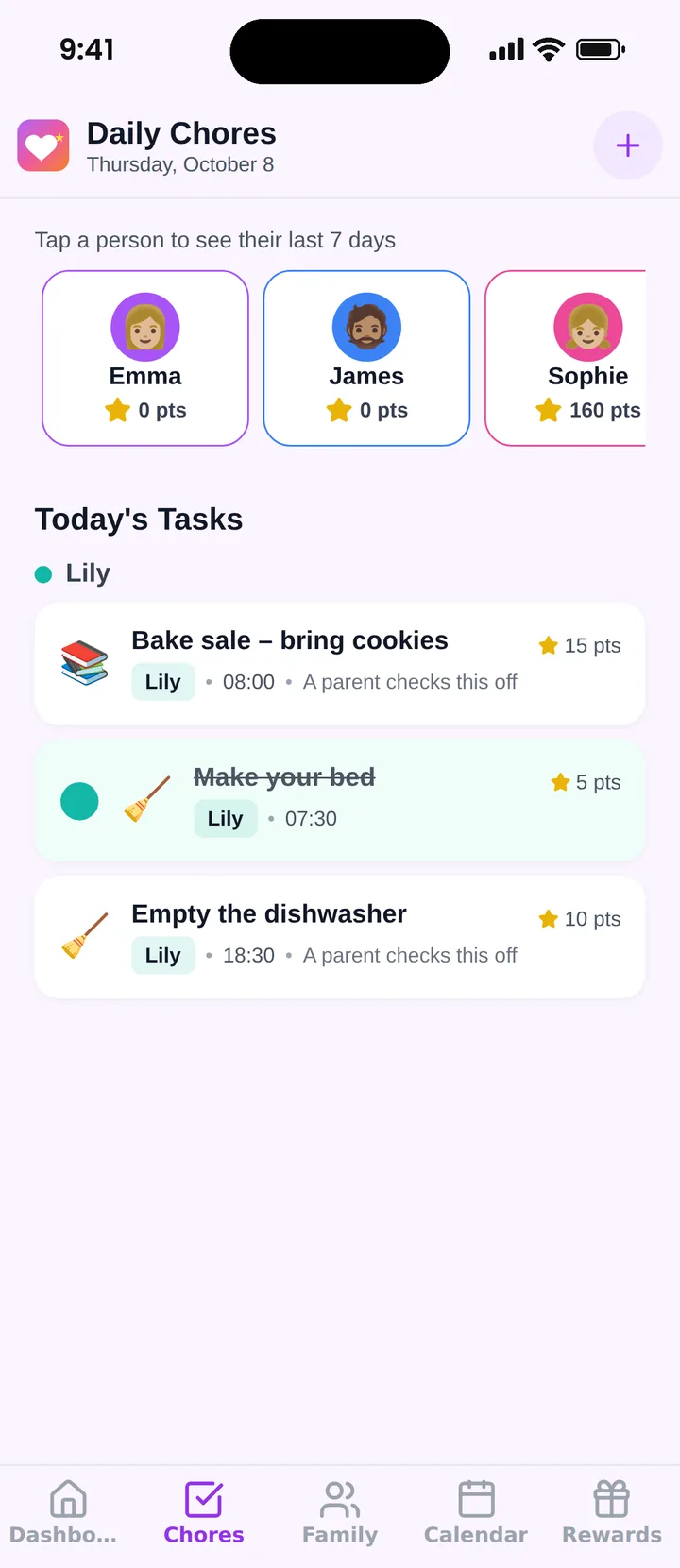
Famiyo is a free family app for iPhone and Android that combines a shared family calendar, chores with points and a rewards shop; kids join with a code, no email needed. For teens, the useful part is that the reminding moves from your mouth to their phone. You add each job once, set it to repeat, pick who does it and the points. The teen gets a push notification about new tasks, checks off their own jobs, and you get a notification when something is done. You choose whether you approve each job or trust the check-off. See our list of the best chore apps for kids for how options compare.
Pick the first job tonight, and ask for a family meeting on Sunday. Ten minutes will do.
Frequently asked questions
Why won't my teenager help around the house?
Usually it is a mix of busy schedules, tiredness, a wish for independence and a sense that the jobs are vague or unfair. Teens push back harder on orders than on agreements. A clear list they helped write, with deadlines and known consequences, removes most of the fight.
How many chores should a teenager have?
Most teens can handle 30 to 45 minutes of household work a day, which is about 3 or 4 jobs, plus one bigger weekly job like mowing the lawn. Go lower during exams or sports seasons, and swap jobs rather than adding them.
Should I pay my teenager to help around the house?
Keep basic family jobs unpaid, since everyone who lives in the house helps run it. Pay or reward extra jobs, like washing the car or yard work, at about $2 to $5 for a big one. That keeps expectations and bonuses separate.
What should I do when my teen says no?
Stay calm and skip the debate. Say, 'That's your call, and the job still has to be done by 7. If it isn't, the phone stays with me tonight.' Then follow through the same way every time. Consistency teaches more than any speech.
Try Famiyo With Your Family
Chores with points, a rewards shop for kids and one shared family calendar. Set it up in a couple of minutes.



Free to download • No credit card required • Available on iOS & Android