Sticker Chart for Kids: How to Use It Well
How to set up a sticker chart for kids: which behavior to pick, how many stickers before a reward by age, when to give them and how to phase the chart out.
By Famiyo Editorial Team6 min read
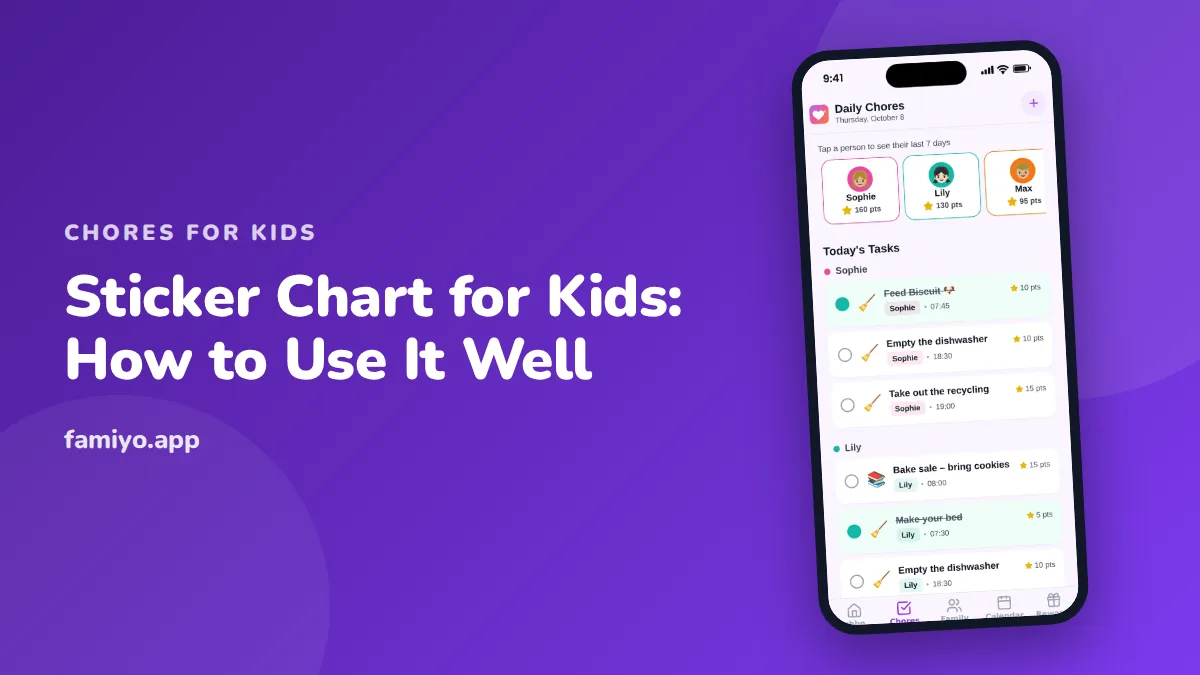
A sticker chart is the simplest reward system there is: a sheet of paper, a pack of stickers and a goal. It also fails a lot, usually in week two, for reasons that are easy to fix. This guide covers who a sticker chart suits, how to set one up step by step, how many stickers to ask for at each age, and how to phase it out once it has done its job.
Who a sticker chart works for
Sticker charts suit kids from about 3 to 7. At this age children love collecting things, they understand "when the row is full, you get a treat," and they can see progress on a wall faster than they can count it.
Under 3, the link between "I put my shoes on" and "I got a dinosaur sticker" is shaky, so a chart tends to be more decoration than motivation. From about 8, many kids prefer points they can add up, because they can save toward something bigger. A sticker chart still works for older kids learning one specific new habit, but keep it low-key.
A sticker chart is a good fit for:
- A new routine step, like getting dressed before breakfast or brushing teeth without a fight
- One or two small chores, like putting shoes on the rack or feeding the fish
- A short-term goal, like staying in bed until the clock turns green
- A visual, predictable system for a child who finds verbal reminders hard to follow
For autistic kids and others who rely on routine, the predictability of a chart can help a lot. Our article on chores for autistic kids has more on visual, step-by-step tasks.
How to set up a sticker chart in 7 steps
- Pick one behavior, two at most. "Be good" is not a behavior. "Put your plate on the counter after dinner" is. If you can't take a photo of it, it's too vague.
- Describe what done looks like. "Teeth brushed for the whole song" or "pajamas on, clothes in the hamper." Say it the same way every time.
- Draw a simple grid. Days of the week across the top, the behavior down the side, with a small picture next to it for kids who can't read yet. A plain sheet of paper is enough; it doesn't need to be pretty.
- Choose the reward with your child. Offer two or three options you are happy to give: a trip to the playground, picking tonight's story, a new pack of stickers. Kids work harder for something they picked.
- Set the target low. The first reward should come within 2 to 4 days. Early success is what hooks them.
- Put the chart at their eye level, where the behavior happens. A bedtime chart goes in the bedroom or bathroom, a dinner chart on the fridge.
- Explain it in one breath. "Every night you get your pajamas on before story time, you get a sticker here. Five stickers and we go for pancakes on Saturday."
If you're juggling stickers for more than one child, keep a separate chart for each kid so nobody counts the other's stickers. And if the chart is part of a bigger family plan, our chore schedule for the family shows where each child's jobs fit.
How many stickers before a reward?
This is where most charts go wrong. Parents set a target that feels reasonable to an adult, like 20 stickers, and a 4-year-old loses interest by day five. Use this as a starting point and adjust to your child.
| Age | Stickers per reward | First reward within | Reward examples |
|---|---|---|---|
| 3 | 3 to 5 | 2 to 3 days | Extra bedtime story, bubbles in the bath, choose the breakfast cereal |
| 4 to 5 | 5 to 7 | 3 to 5 days | Trip to the playground, bake cookies together, pick the music in the car |
| 6 to 7 | 10 to 15 | About a week | Pick the family movie, 15 extra minutes of screen time, a small toy |
Once a child is filling the chart easily for two weeks in a row, you can raise the target by a few stickers or move to a bigger reward that takes two charts to earn. Raise it slowly, and tell them before you change it.
When to give the sticker, and what to say
Timing matters more than the sticker itself. Give it right after the behavior, while your child still remembers doing it. A sticker at bedtime for something they did at breakfast is a much weaker message, especially for 3 and 4-year-olds.
Let them put the sticker on. Peeling and placing is half the fun.
What you say alongside it is the part that lasts after the chart is gone. Name what they did, not how good they are:
- "You put your shoes on the rack as soon as we came in. That's your sticker."
- "Teeth brushed for the whole song. Look, you have four now. One more and it's playground day."
A few rules keep the chart working:
- Never take a sticker away. Once it's on the chart, it's earned. Handle misbehavior separately.
- Don't use the chart as a threat ("No sticker if you keep whining"). That turns it into a punishment board.
- Don't give a sticker for a half-done job just to avoid tears. Say calmly, "Not today. You can try again tomorrow."
- Hand out the reward when it's earned, not "sometime next week."
When the sticker chart stops working
Every chart wobbles. Here are the common problems and what usually helps.
| Problem | What's probably happening | Try this |
|---|---|---|
| Excited for 3 days, then ignores it | Target too far away, or the reward isn't exciting | Lower the target, let them pick a new reward |
| "Do I get a sticker?" for everything | The chart has become the only reason to help | Keep the chart to its one or two behaviors and say, "That one's just because we're a family" |
| Meltdown when no sticker | Too much riding on each sticker | Make the target smaller so one miss doesn't wreck the week, and stay calm |
| Sibling jealousy | Only one child has a chart | Give each child their own chart with their own goal |
| You keep forgetting | The chart is in the wrong place | Move it to where the behavior happens and keep the stickers right next to it |
If your child pushes back on charts in general and you prefer a lower-pressure approach, our piece on gentle parenting and chores covers cooperation without rewards.
How to phase out a sticker chart
A sticker chart is scaffolding. Once the behavior happens on its own most days, it's time to take it down.
Fade it in stages. First raise the target a little. Then give a sticker every other day, or only when they do it without a reminder. After a couple of weeks of that, retire the chart with a small celebration: "You don't need the chart anymore. You just do it now." Keep the old chart somewhere they can see it if they're proud of it.
Then you can start a new chart for the next habit, or, for kids around 6 and up, move to points that add up toward bigger rewards.
When the paper chart becomes Famiyo
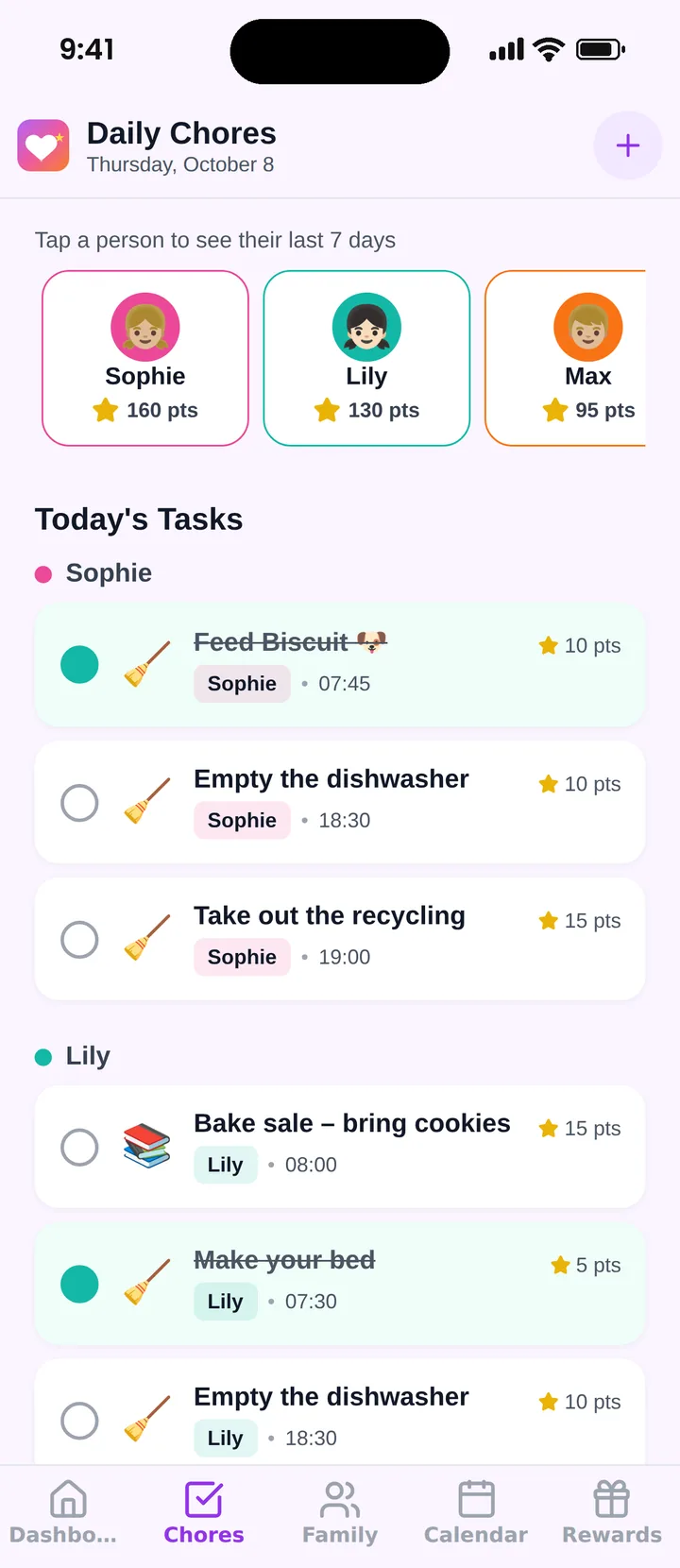
Famiyo is a free family app for iPhone and Android that combines a shared family calendar, chores with points and a rewards shop; kids join with a code, no email needed. It works as a sticker chart that doesn't fall off the fridge. You add each chart behavior as a chore, set it to repeat, and give it points instead of stickers, say 5 points for "shoes on the rack." Kids check it off on their own phone or tablet, or you approve it first. They get a notification when you add a new task, and you get one when a chore is done, so you don't need to be in the room. Every phone syncs live, and rewards go in the rewards shop with a price in points. For other options, see our list of the best chore chart apps.
Pick the one behavior you'd most like to see tomorrow, draw five boxes and buy the stickers tonight.
Frequently asked questions
What age is a sticker chart good for?
Sticker charts work best from about age 3 to 7. Younger toddlers often don't connect the sticker with what they did, and many kids from 8 up find stickers babyish. For older kids, a points system with a running total usually works better than stickers.
How many stickers should a child need for a reward?
Start low so the first reward comes quickly. Three to five stickers is plenty for a 3-year-old, five to seven for a 4 or 5-year-old and ten to fifteen for a 6 or 7-year-old. Once the habit is steady, you can raise the target a little.
Should you take stickers away for bad behavior?
No. Taking stickers away turns the chart into a punishment board and kids quickly stop caring about it. Keep the chart for what went well. Handle misbehavior separately, with the usual calm consequence, so the chart stays a place your child likes to look at.
How long should a sticker chart last?
Give a new chart 2 to 3 weeks of consistent use before judging it. Once the behavior happens most days without prompting, start fading it: raise the target, then switch to a sticker every other day, then retire the chart with a small celebration.
What can I use instead of a printable sticker chart?
Any grid works: a sheet of paper with days across the top, a whiteboard with magnets, a jar of pom-poms or marbles, or an app that awards points. For school-age kids, a points total often works better because they can count toward bigger rewards.
Try Famiyo With Your Family
Chores with points, a rewards shop for kids and one shared family calendar. Set it up in a couple of minutes.



Free to download • No credit card required • Available on iOS & Android