How to Get Toddlers to Clean Up Their Toys
Toddlers can tidy toys if the job is small, visible and done with you. Here is a step-by-step method, the exact words to use and what to do when they melt down.
By Famiyo Editorial Team5 min read
Your toddler can happily empty a whole bin onto the floor in nine seconds. Getting it all back in feels like it should take about the same time, and instead it takes forty minutes and a tantrum. The good news: the problem is usually the setup, not your child. This page covers what a toddler can really do, a method that works for most 18-month to 3-year-olds, and what to say when it goes sideways.
What a toddler can actually do
Be honest about the target. A 2-year-old is not going to survey a room, sort twelve kinds of toys and call it done. The realistic job at this age is dropping toys into a bin while you do the rest, for about 5 to 10 minutes of tidying in a whole day.
| Age | What they can do | What you still do |
|---|---|---|
| 18 to 24 months | Drop a toy in a bin when you hold it open and hand them items | Almost all of it, plus the starting and stopping |
| 2 years | Put toys in a bin, carry a few things across the room | Pick up the small and the odd-shaped pieces, keep them going |
| 3 years | Clear one type of toy, like all the cars, after being told which | Say what comes next, check the corners, finish the last bits |
| 4 years | Tidy a small area with one reminder | Help with big jobs like Lego, give the signal to start |
Notice what is missing: any version where you leave the room and come back to a clean floor. That is a school-age skill.
Set up the room so cleanup is possible
This is where most of the win is, and it costs nothing.
- Put out less. If the whole toy collection lives on the floor, cleanup is a two-hour project. Keep a small selection out and rotate the rest in a closet.
- Use open bins or baskets at toddler height. Lids, drawers and shelves with small compartments are adult storage.
- One bin per category, if you can: blocks, cars, animals, books. Stick a picture of what goes inside on the front.
- Cleanup happens where the toys live. Dragging things down the hall is a second job.
If you do only one thing from this list, make it the first one.
The five-step method
- Pick a fixed moment. Before lunch, before the bath, before the bedtime story. Same trigger every day, so cleanup is "what we do before lunch" and not a surprise.
- Give a warning. Two minutes before: "Two more minutes of trucks, then we tidy up." Toddlers hate abrupt endings, and so do the rest of us.
- Start together. Sit on the floor and begin. Pick up the first toy yourself, say its name, and drop it in the bin.
- Say the exact job. "Blocks in the blue bin." Not "clean up your room", which means nothing to a two-year-old. One instruction at a time.
- End with something concrete. "All done! Now we wash hands and have lunch." The reward is the next fun thing, delivered every time.
Keep the whole thing to 2 to 5 minutes. When their attention goes, finish the rest yourself without a speech about it.
Words that help, and words that backfire
Short, specific and positive beats long and general. A few swaps:
| Instead of | Try |
|---|---|
| "Clean up this mess." | "Cars go in the red bin. Can you drive them there?" |
| "Why can't you ever put things away?" | "Let's see how many blocks we can drop in. Ready?" |
| "If you don't tidy up, I'm throwing it all out." | "The bin is open. I'll take the books, you take the cars." |
| "Good boy!" | "You put every single truck in. Look at that floor." |
Praise that describes what they did teaches more than a general compliment, and it sounds less like a performance. Skip the threats. Nothing gets thrown out, and a toddler will call that bluff in about a week.
Games are allowed and often needed. Race the timer, toss soft toys in like a basketball, make the bin "hungry". Silly voices cost you nothing.
When it all falls apart
It will. Wednesday, a cold, a missed nap, a visitor. Here is what to do in the usual failure modes.
They refuse and go limp. Don't argue. Stay calm, do the first few toys yourself with a cheerful running commentary, and hand them one. If they still won't, finish it quickly yourself and try again tomorrow. One lost round does not undo anything.
They tidy and untidy at the same time. Common. Toddlers see the bin as a toy too. Let it go for the first month, or move the dumping to a separate "dump zone" if you can.
They get overwhelmed. If the floor is covered, break it down: "Just the animals first." Finish one category and stop if you need to.
It only works with you. That is the normal state at this age. Your presence is the system for now. By 4 or 5, you can stand in the doorway instead of on the floor.
For a wider look at how this fits into a day, our guide on how to get toddlers to help with chores covers the other small jobs they like. If your child is closer to 3 and you want a plan built around that age, there is also a page on getting a 3-year-old to clean up toys. And once they are older and the issue is more stubborn than developmental, see how to get kids to pick up their toys.
Where an app can take over the reminding
Most parents are not forgetting to want a tidy house. They are tired of being the only person who remembers and the only one who says it. That is the part an app can handle once your child is old enough to follow a routine.
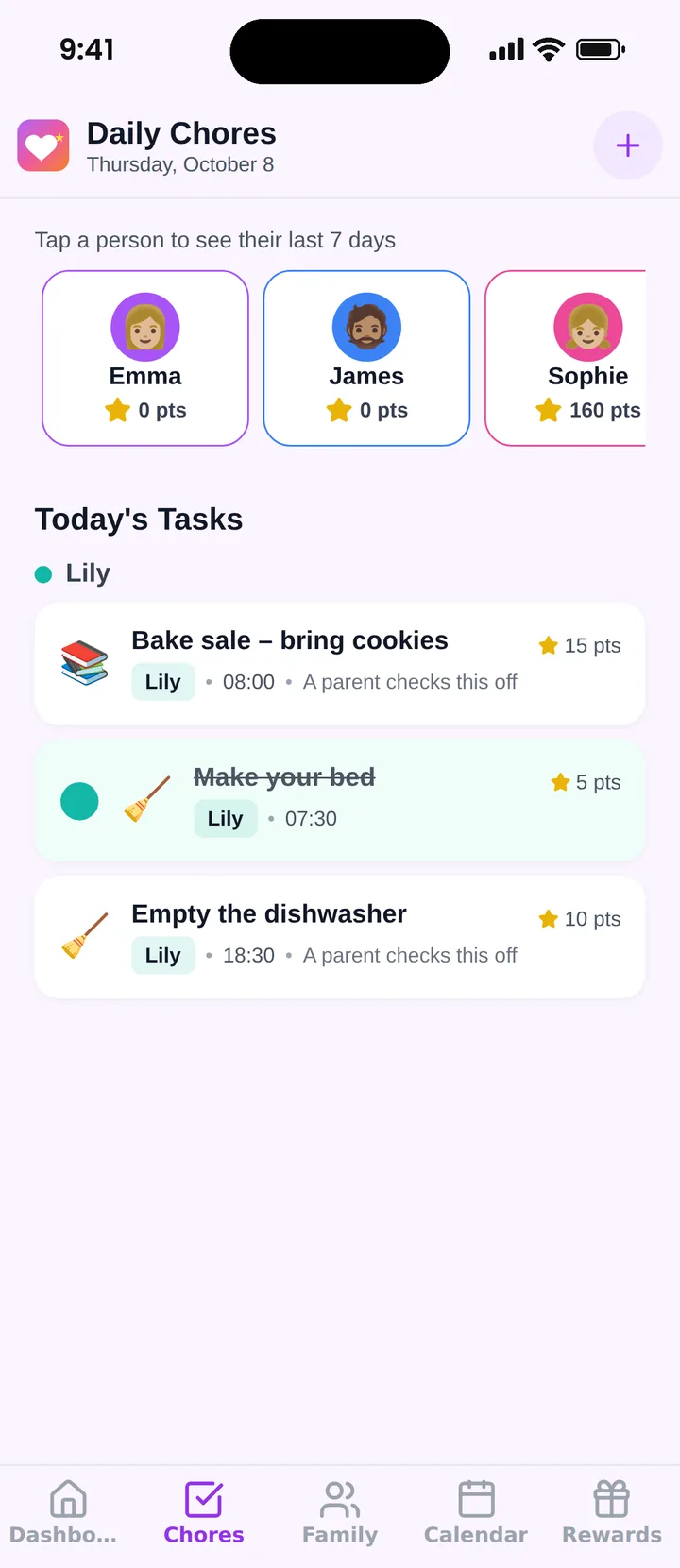
Famiyo is a free family app for iPhone and Android that combines a shared family calendar, chores with points and a rewards shop; kids join with a code, no email needed. You can add "toys in the bins" as a daily repeating chore, worth about 5 points, and it sends a push notification to the child's phone when the task comes up, so the prompt comes from the app and not from you. You get a notification when it is checked off, and you choose whether your child ticks it themselves or you approve it. At 2 or 3 this is mostly for you. From around 4 or 5 it is the child's own list.
Weighing up your options? Our list of the best chore apps for kids compares them.
Tomorrow, try one thing: pick a single time, give a two-minute warning, and tidy for three minutes together. Do that for two weeks before changing anything.
Frequently asked questions
At what age can a toddler start cleaning up toys?
Most children can drop a toy into a bin around 18 months, if you do it with them and make it a game. Real independence at cleanup usually arrives closer to age 3 or 4, and it still needs a nudge.
Why does my toddler fall apart when it is time to clean up?
Stopping play is hard for a small child, and a whole messy room looks impossible. Give a two-minute warning, shrink the task to one type of toy at a time, and stay with them. Tired or hungry makes it worse.
Should I make my toddler clean up alone?
No. Under about age 4, cleanup works as a team job. You do the bulk and your child does a visible part, like dropping in the cars. Sending a toddler off alone usually ends in tears or a half-finished room.
Do toddlers need rewards for tidying up?
Not at first. Praise that names the action ('You found every block') and a predictable next activity, like a snack or a book, are plenty. Points and stickers start to mean something closer to ages 4 and 5.
Try Famiyo With Your Family
Chores with points, a rewards shop for kids and one shared family calendar. Set it up in a couple of minutes.



Free to download • No credit card required • Available on iOS & Android