Extra Chores Kids Can Do for Money (Beyond the Basics)
30 extra chores kids can do to earn money, grouped by size, with minutes, fair pay from $0.25 to $5, and the rules that keep them separate from everyday chores.
By Famiyo Editorial Team5 min read
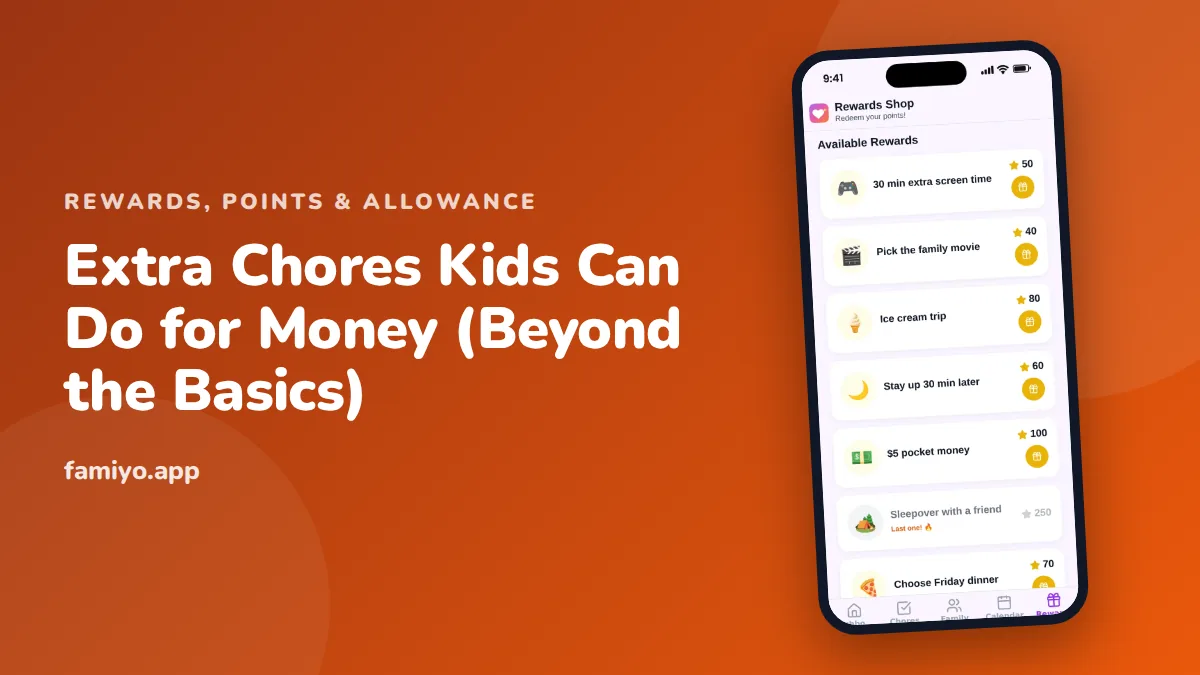
Your 9-year-old already empties the dishwasher and feeds the dog, and now wants $20 for a game. That is the moment extra chores earn their keep. This page gives you a menu of paid jobs sorted by size, a fair price for each, and the few rules that stop extra work from turning into a haggling match.
What counts as an extra chore
Start with the line between basics and extras, because everything else depends on it. Basics are what a person does because they live in the house: making the bed, clearing their plate, putting dirty clothes in the hamper, tidying their own room. These stay unpaid. Nobody pays an adult to wash their own dishes.
Extras are jobs the family would otherwise do itself, skip, or pay someone for. Washing the car, raking the whole yard, clearing out the garage. If you would be willing to hire a neighbor's teenager to do it, it belongs on the paid menu.
Two quick tests help when you are unsure:
- Would this job still need doing if your child did not live here? Then it is probably a basic of the household, and still unpaid.
- Does it take more than the usual 10 to 30 minutes of daily upkeep? Then it is a candidate for an extra.
Small extras: 5 to 20 minutes
Small jobs suit ages 5 to 8 and anyone who wants a quick win. The pay is small, $0.25 to $1, which in points at 100 points to $1 means 25 to 100 points.
| Job | Minutes | Pay | Points |
|---|---|---|---|
| Wipe all the baseboards in one room | 10 | $0.50 | 50 |
| Water the garden or potted plants | 10 | $0.25 | 25 |
| Sort and match the family's odd socks | 10 | $0.25 | 25 |
| Wipe down the front of the fridge and appliances | 10 | $0.50 | 50 |
| Clean the car's interior with a hand vacuum | 15 | $1 | 100 |
| Dust the living room, including shelves | 15 | $0.75 | 75 |
| Pull weeds from one garden bed | 15 | $0.75 | 75 |
| Organize the shoe pile by the door | 10 | $0.50 | 50 |
| Wash the windows on the inside, lower panes | 15 | $0.75 | 75 |
| Bring in and sort the recycling for the week | 10 | $0.50 | 50 |
Medium extras: 20 to 45 minutes
Ages 9 to 12 can handle these, usually with a short demonstration first. Pay $1 to $2.50 or so, which sits between the small and big ends of the usual range.
| Job | Minutes | Pay | Points |
|---|---|---|---|
| Wash the family car outside | 30 | $2 | 200 |
| Rake and bag leaves in a small yard | 40 | $2.50 | 250 |
| Clean out the refrigerator and wipe the shelves | 25 | $1.50 | 150 |
| Vacuum the stairs and the car trunk | 25 | $1.50 | 150 |
| Wash the dog | 30 | $2 | 200 |
| Clean the inside of the microwave and oven door | 20 | $1.25 | 125 |
| Reorganize a closet or a toy shelf | 30 | $2 | 200 |
| Scrub the patio furniture | 30 | $2 | 200 |
| Sweep and rinse the porch or balcony | 25 | $1.50 | 150 |
| Fold and put away a whole family laundry load | 30 | $2 | 200 |
Big extras: an hour or more
These are the $2 to $5 jobs. They fit ages 10 and up, or younger kids working alongside you. A big job should have a clear end point, so the child knows exactly when they are finished and paid.
- Clean out the garage or shed, with you deciding what stays. Pay $5.
- Wash all the windows inside and out. Pay $4.
- Weed and mulch an entire garden area. Pay $4.
- Scrub the bathroom top to bottom beyond the weekly basics, including the tub grout. Pay $3.
- Mow a small lawn, with an adult checking the equipment first. Pay $4 to $5, depending on age and size.
- Help a grandparent or neighbor with a yard day, if you know them and are close by. Pay is theirs to set, usually $3 to $5.
- Deep clean the car, inside and out, mats included. Pay $4.
- Prepare a simple family dinner for the whole family from start to finish, with an adult nearby. Pay $3.
Safety first on anything with a mower, ladder, chemicals or hot surfaces. Your child's age and your own judgment decide what is allowed, not the price list.
Rules that keep it fair
A menu only works if the ground rules are clear. These five cover most trouble:
- Agree on the price and the standard before the work starts. "Clean the car, $2, inside and out, finished by 4 pm."
- Basics come first. No extras until the daily routine is done that day.
- Extras are optional. A child who says no today owes you nothing, and you do not sulk about it.
- Pay when it is done and checked, not later. Delayed pay makes the whole system feel unreal to a child.
- Redo for no pay. If the windows are streaky, the answer is "fix the streaks and the $2 is yours," not a discount.
If you want to go deeper on pricing a whole week of jobs, our chore list for kids to earn money works through a full set of rates. And if your child is around 10 and hungry for bigger opportunities, see how to make money as a 10-year-old.
Setting prices: money or points
A handful of cash is easy to understand, and it works well for a single job. The problem comes when a child does six jobs in a month and you need to track who has earned what. Points solve that by acting like a running balance. At 100 points to $1, a $2 car wash is 200 points, and the child can spend those points on money, 15 extra minutes of screen time or a pick-your-own dinner, whichever they choose.
Points also let you adjust cheaply. If a job turns out to take twice as long as you thought, change the number next week instead of renegotiating with a nine-year-old over a dollar bill. Our guide to a token economy for kids explains the mechanics if you are new to the idea.
Doing it in Famiyo
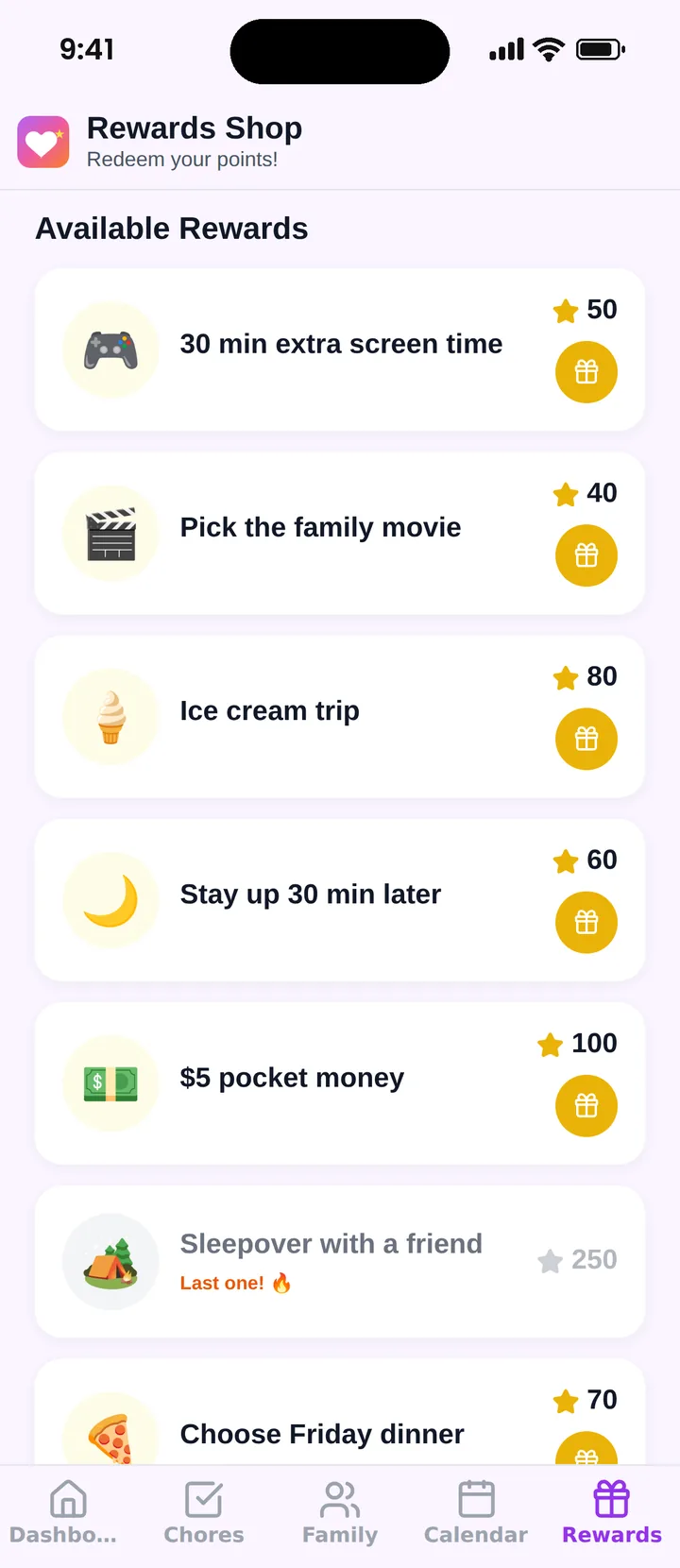
Famiyo is a free family app for iPhone and Android that combines a shared family calendar, chores with points and a rewards shop; kids join with a code, no email needed. To run an extras menu, add each job as a chore with its own point value, and let your child take it on when they want extra to earn. Then build the rewards shop around what they are saving for. Pocket money can be one of the rewards, say $5 for 500 points, though the cash itself changes hands outside the app. Kids see their balance and the price on their own phone, and you get a push notification when a job is checked off. For other options, see our list of the best allowance apps for kids.
A simple way to start this week
Pick five jobs from the tables, write them on a card with prices, and stick it on the fridge. Tell your child the rules once, calmly. Then see which one they choose first.
Frequently asked questions
What counts as an extra chore?
An extra chore is a job that goes beyond what every family member does to keep the home running. Cleaning your own room is a basic. Washing the family car or clearing the gutters is extra, because the family would otherwise do it themselves or hire someone.
How much should I pay for extra chores?
A common range is $0.25 to $1 for a small job and $2 to $5 for a big one. Match the pay to the time and effort, and decide the amount before the child starts so nobody negotiates afterward.
Can a child pick which extra chores to do?
Yes, and it works best that way. Post a short menu with prices and let your child choose. Choice is the point: it makes the work feel like a deal they made, not an order, and it teaches them to weigh effort against pay.
Should extra chores be paid in cash or points?
Either works. Cash is simple for small jobs. Points suit families who already use a rewards system, and at a rate like 100 points to $1 they convert cleanly to money, screen time or a treat when the child is ready to spend.
Try Famiyo With Your Family
Chores with points, a rewards shop for kids and one shared family calendar. Set it up in a couple of minutes.



Free to download • No credit card required • Available on iOS & Android