How Much to Pay Kids for Chores: A Simple Pay Scale
How much to pay kids for chores: $0.25 to $1 for small extra jobs, $2 to $5 for big ones, with a pay scale by task size and tips for paying in a digital world.
By Famiyo Editorial Team6 min read
Somewhere between "chores are free" and "everything costs a dollar" there is a pay scale that works. You just have to decide which jobs are paid, what each one is worth and how the money actually reaches your child's hand. This guide gives you numbers to start with and a way to adjust them.
The short version of the pay scale
Pay for time and effort. Do not pay for age. Here is a table you can copy.
| Job size | Example | Typical pay |
|---|---|---|
| Small extra (5 to 10 minutes) | Wipe the patio table, sort the recycling | $0.25 to $1 |
| Medium extra (15 to 30 minutes) | Wash the dog, vacuum the car | $1 to $2 |
| Big extra (an hour or more) | Wash the car, rake the yard, clean out the garage shelf | $2 to $5 |
Those figures come from the common range of $0.25 to $1 for a small extra job and $2 to $5 for a big one. A family with a tight budget can start at the low end. Nothing is wrong with that. A child learns the connection between work and money at 50 cents just as well as at five dollars.
Which chores should be paid at all?
Split the household work into two piles before you name a single price.
Unpaid family chores. These are the things everyone in a home does because they live there: making the bed, clearing your own plate, putting dirty clothes in the hamper, tidying your own room. Many parents keep these unpaid so a child never says "what will you give me?" before helping. Our article on setting up a chore allowance goes through the argument for and against.
Paid extras. Jobs beyond the basics, the kind you might otherwise hire someone for, or that save you real time. Washing the car, raking leaves, cleaning out the garage, helping a neighbor with a yard. These are the jobs that carry a price tag.
Some families skip money for chores entirely and pay a flat allowance for being part of the family instead. That is a legitimate choice. If you go that way, keep the pay scale for bonus jobs only.
How much by age
The pay is for the job, but the jobs a child can do change with age, so weekly totals rise. These are typical weekly allowance ranges, which you can use to sanity check what a child earns across the week.
| Age | Typical weekly total | Jobs that pay |
|---|---|---|
| 5 to 7 | $3 to $7 | Water plants, help wash the car, sort recycling |
| 8 to 10 | $7 to $10 | Vacuum a room, wash windows low down, walk the dog |
| 11 to 13 | $10 to $15 | Mow a small lawn, deep clean a bathroom, babysitter's helper |
| 14 and up | $15 to $25 | Larger yard jobs, cooking a family dinner, shopping from a list |
The old rule of $1 per week for each year of age is a decent starting point, but it is just that. An 8-year-old who gets $8 a week for doing nothing learns something different from one who earns $8 across a week of real work. Our pages on paid chores for 10-year-olds and teenagers have job lists and rates for those ages.
Pay in points first, then convert
Cash is awkward for small jobs. Nobody wants to hand over a dime every time the dog's bowl gets filled. Points fix that. Give every paid job a point value, let the child collect them during the week, and settle up on payday.
A clean exchange rate is 100 points to $1. At that rate:
- A 5-point job pays 5 cents (too small to bother with cash, so it adds up)
- A 20-point job pays 20 cents
- A 100-point job pays a dollar
Then price your bigger jobs in points too, so everything lives on one scale. A car wash worth $3 is 300 points. If the child does not want cash, the same points can be spent on non-money rewards like a movie pick or an extra 15 minutes of screen time, so the child gets to choose between spending now and saving for something larger.
This also lets you handle the real-world problem of cash that is not around. If your family rarely carries bills, paying in points and settling by bank transfer or a deposit to a kid's account on the weekend is entirely reasonable. Our guide to teaching kids about money explains how to split earnings into spend, save and give. A common split for younger kids is 50%, 40% and 10%.
A sample month
Here is a realistic month for a 9-year-old who does the unpaid basics and picks up a few extras.
| Week | Paid extras | Points | Cash value |
|---|---|---|---|
| 1 | Vacuum car (100), sort recycling (30) | 130 | $1.30 |
| 2 | Wash windows (150), walk dog x3 (90) | 240 | $2.40 |
| 3 | Rake leaves (300) | 300 | $3.00 |
| 4 | Water plants x5 (50), wash dog (200) | 250 | $2.50 |
Total for the month: $9.20, paid for work above and beyond the basics. That is a healthy first lesson in earning. The allowance, if you give one, sits on top and has its own rules.
What to do when the money runs out of your budget
A pay scale only works if you can afford it. If three kids each pick up five paid jobs a week, the totals add up quickly. Put a weekly cap on paid extras, such as $5 per child, and tell them in advance. When the cap is reached, the extras are still available for points toward non-money rewards. This also protects you from the child who discovers they can fund a game purchase by volunteering for every task in the house.
You can also rotate the paid jobs. Offer two or three extras per week and let kids choose first, oldest to youngest one week, youngest to oldest the next. It keeps the market fair between siblings and avoids the sense that one child is hoarding the good jobs.
Rules that keep it fair
- Write the list and the prices where everyone can see them. No surprise negotiations.
- Define done. "Clean the car" means vacuum inside, wipe the dash, rinse the outside. Pay when the job meets that standard.
- Pay on the same day each week. A late payday teaches your child that your word is soft.
- Let them say no. A paid job is optional. If your child skips the extras, that is fine. They just do not earn.
- Do not pay for grades or for basic behavior. Those tend to turn into hostage situations.
- Raise prices when the jobs get harder, not on birthdays.
If your child starts negotiating every job ("how much for taking out the trash?"), the line between paid and unpaid has blurred. Redraw it and say it plainly: "Trash is a family job. Washing the car is a paid job."
Tracking paid jobs in Famiyo
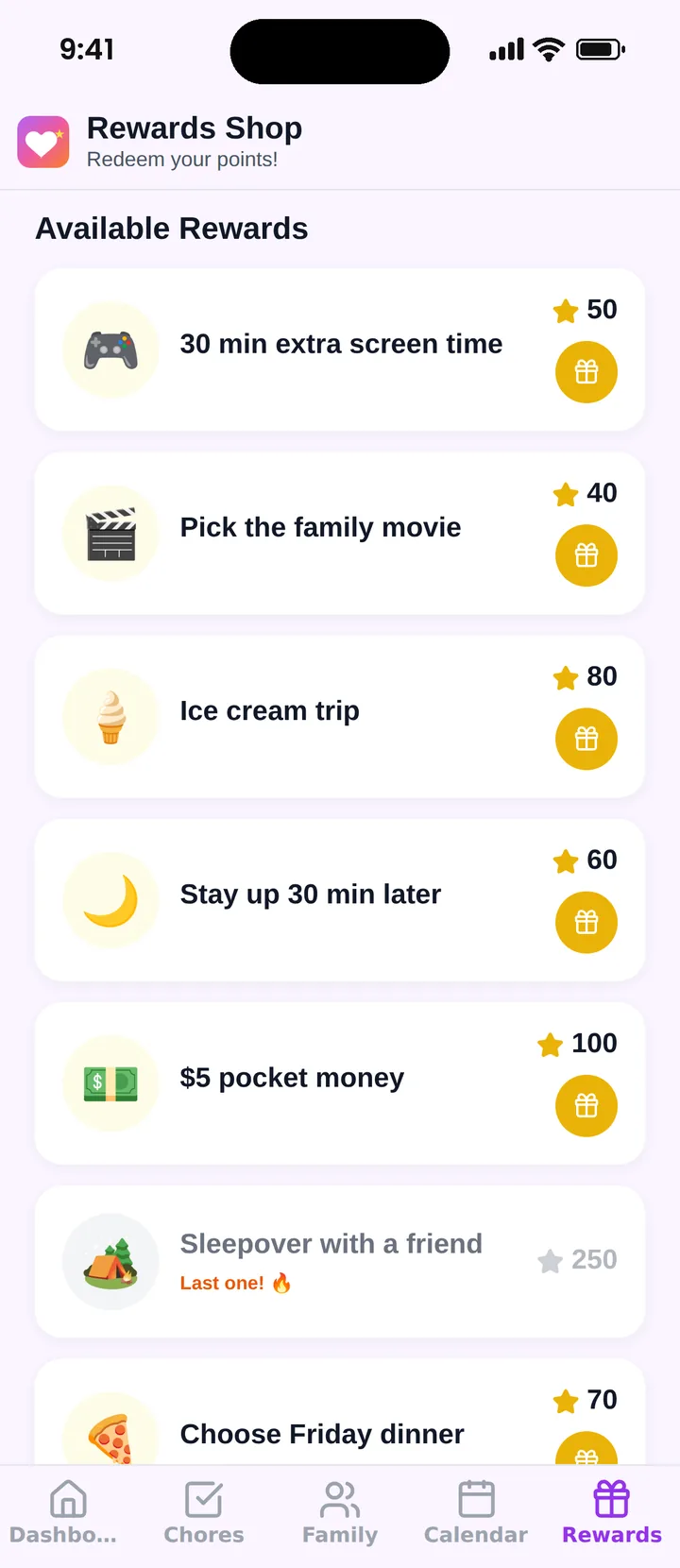
Famiyo is a free family app for iPhone and Android that combines a shared family calendar, chores with points and a rewards shop; kids join with a code, no email needed. Give each job a point value, let kids check them off on their own phone, and set up the rewards shop with prices in points. Pocket money can be one of the rewards: you set the price, say 100 points for $1, and the child redeems from their phone. The money itself changes hands outside the app, so you stay in charge of the cash.
You can compare options in our list of the best allowance apps for kids.
Start with one job
Pick one extra job this weekend, name the price before the child starts and pay as soon as it is done. Once the first payment lands, the rest of the system explains itself.
Frequently asked questions
How much should a 10-year-old get paid for chores?
For extra jobs beyond daily basics, $0.50 to $1 for a small task and $2 to $5 for a big one, like washing the car. A total of $7 to $10 a week is a typical allowance range for ages 8 to 10, though your own budget decides.
Should I pay kids for every chore?
Most parents don't. Everyday chores like making the bed or clearing plates are part of living in a family and stay unpaid. Pay only for extra jobs that go beyond the basics, so kids learn the difference between helping and earning.
Should chore pay depend on age or on the job?
The job. Pay for time and effort so a 7-year-old and a 12-year-old get the same for the same task. Older kids earn more because they take on bigger jobs like mowing the lawn, not because their birthday has passed.
How often should I pay kids for chores?
Weekly works for most families, on the same day each week. Young kids need quicker payback, so use points or stickers during the week and settle up in cash on payday. Consistency matters more than the day you pick.
What if my child does a job badly?
Decide what done looks like before they start, and pay only for finished work. If it falls short, let them fix it and then pay. Docking a little in the moment teaches less than a calm redo.
Try Famiyo With Your Family
Chores with points, a rewards shop for kids and one shared family calendar. Set it up in a couple of minutes.



Free to download • No credit card required • Available on iOS & Android