How to Motivate a Teenager to Study: What Works
Teens study when they see a reason, feel some control and have a workable routine. Here is how to build all three, with scripts, a weekly plan and rewards that last.
By Famiyo Editorial Team4 min read
Your teen says "I'll do it later" at 4 pm and is still on the couch at 9. You have tried reminders, bribes and a firm speech, and the cycle is the same. This page explains why teens avoid studying, what tends to shift it and how to set up a routine, with the exact words to use.
Why teens avoid studying
Before you try tactics, work out which problem you have. The fix differs.
- Too tired. Teens need 8 to 10 hours of sleep a night, according to the American Academy of Pediatrics and the AASM. A teen on 6 hours is not lazy, they are running low.
- The phone is closer than the book. Notifications beat a chemistry chapter every time.
- The task is too big. "Study for the exam" has no first step. It feels impossible, so they avoid it.
- They think effort will not help. After a few bad grades some teens decide they are "just bad at it" and stop trying.
- No reason that feels theirs. If studying is only for you, they have little reason to do it.
One conversation will usually tell you which one it is. Ask, without judgment: "When you sit down to study, what's the hardest part?"
What drives motivation in teens
Researchers who study motivation, in a framework called self-determination theory, describe three needs: autonomy (some control), competence (feeling able) and relatedness (feeling supported). Teens motivate best when all three are met.
In practice this means giving them choices inside a structure. You decide that school nights have a study block. They decide when it starts, where they do it and what they tackle first. You show that you believe they can do it, and you stay available without hovering.
Motivation also follows action more often than it leads it. A teen who starts a 10-minute task usually keeps going. The first push is the hard part, so make starting easy.
Set up a study routine in five steps
- Pick a fixed block together, say 4:30 to 5:30 on school nights, with a 10-minute break in the middle. Let them choose the time within limits.
- Choose the place. A desk or kitchen table, with phone in another room or a charging spot, beats a bed.
- Start with the smallest next step. "Open the math sheet and do problem 1."
- Use a written list of the week's work, with due dates. One place, not scattered.
- Review it briefly on Sunday: "What's due this week? What needs the most time?"
Give the routine two to three weeks before you judge it. It usually fails in week one because it is new, not because it is wrong.
What to say, and what not to say
The words matter. Compare these.
| Instead of | Try |
|---|---|
| "You never study." | "What would make it easier to start tonight?" |
| "You'll end up with no future." | "What do you want your next year to look like?" |
| "Why can't you be like your sister?" | "What worked last time you got a good result?" |
| "Put the phone away or I'll take it." | "Phones go in the basket during study time, mine too." |
| "Did you do your homework?" | "What's on your list for tonight?" |
Questions put the teen in charge of the answer. Orders put you in charge of the problem, and they will let you keep it.
Rewards that help and rewards that backfire
Rewards can help with the first weeks of a habit. They can also teach teens that studying only matters when there is a prize. Some rules of thumb:
- Reward effort and routine, not grades. "Started on time four nights this week" is within their control. A grade is partly out of their hands.
- Keep rewards small and quick. Extra gaming time, picking dinner or a later weekend curfew work better than a big prize months away.
- Let them help choose the rewards, since a reward they do not want has no pull.
- Fade it. As study becomes normal, stretch the gap between rewards and shift to praise for specific effort.
For grade-based rewards, read our guide on how to reward kids for good grades before you decide. If studying trouble goes with a general loss of interest in school, our article on how to motivate a teenager who hates school goes into that. And if attention is the hurdle, see how to motivate a teenager with ADHD.
When to get extra help
If a teen is studying for hours with no results, avoids school entirely or seems anxious or low for weeks, it is no longer a motivation problem to solve with a routine. Talk to their teacher or school counselor, and to their pediatrician if you are worried about stress, mood or attention. Do not wait for a report card to make that call.
Using a rewards shop for study routines
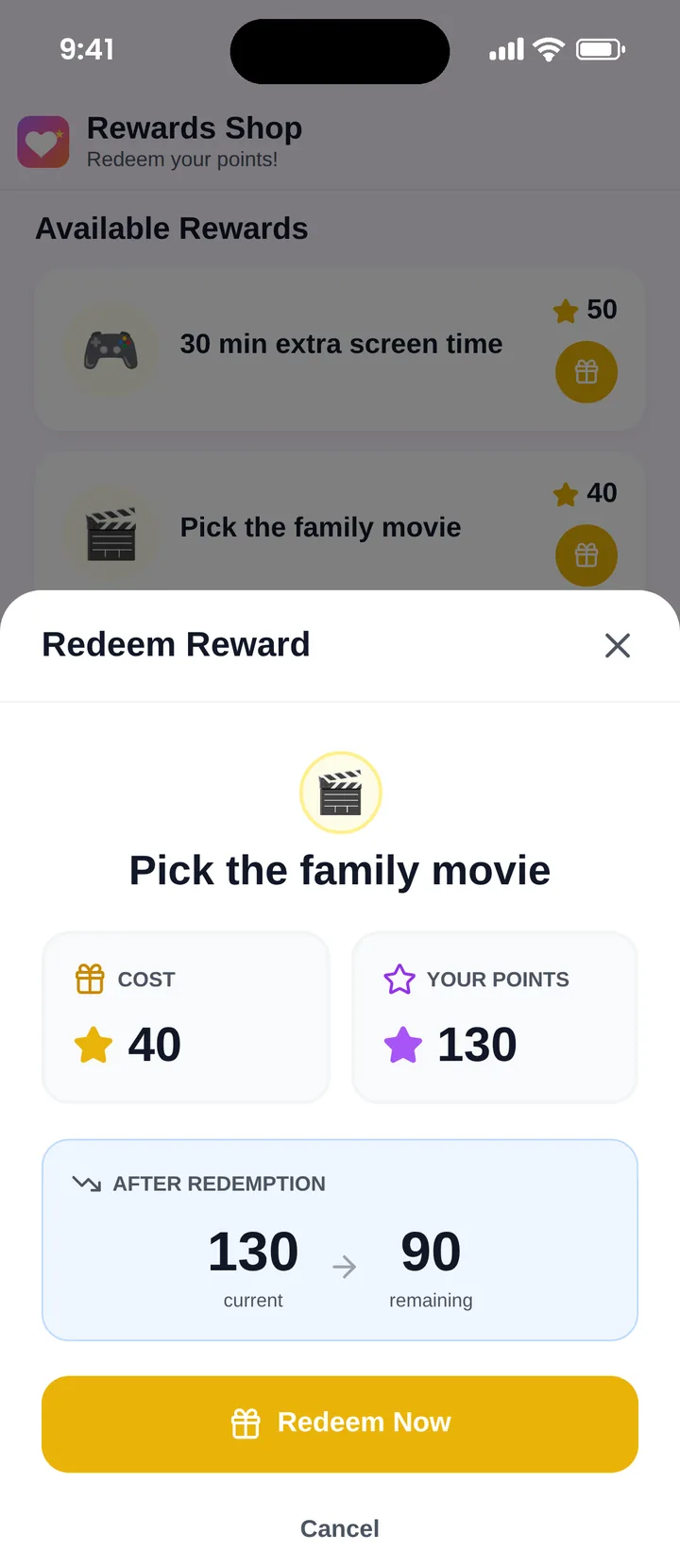
Famiyo is a free family app for iPhone and Android that combines a shared family calendar, chores with points and a rewards shop; kids join with a code, no email needed. You can make a study block a repeating task worth points, for example 10 points for starting within 10 minutes of the agreed time, and let your teen add it to their own routine. In the rewards shop you set prices in points, how many are available and when, and your teen redeems from their own phone, seeing how many points they will have left.
Our list of the best reward chart apps for kids compares your options.
A first step for tonight
Ask one question, "What's the hardest part of getting started?", and then write down whatever they say. Pick the smallest fix and try it for a week.
Frequently asked questions
Why won't my teenager study?
Common causes are tiredness, a phone within reach, work that feels too big to start, or a belief that effort will not change the result. Ask which of these fits, then fix that one before adding rules.
Should I punish my teen for not studying?
Punishment tends to harden resistance. Natural consequences, such as a lower grade or a missed activity that depends on grades, teach more than extra restrictions. Pair them with a calm conversation about what went wrong and what to try next.
How many hours should a teenager study?
It depends on grade level, courses and the school's homework policy, so there is no single number. Many teens do well with a regular block of 1 to 2 hours on school nights. Ask the teacher if the load seems far off.
Do rewards for studying work?
Short term, yes. Long term, they can backfire if the reward is the only reason to study. Reward effort and routine, such as starting on time, not a grade, and fade them as the habit forms.
How do I help a teen who is overwhelmed by schoolwork?
Break each assignment into a first step of 10 to 15 minutes, write the week's work down in one place and talk to the school if the load stays heavy. If stress is severe or lasts, speak with their pediatrician or a counselor.
Try Famiyo With Your Family
Chores with points, a rewards shop for kids and one shared family calendar. Set it up in a couple of minutes.



Free to download • No credit card required • Available on iOS & Android