Life Skills for Teenagers Checklist (Before They Leave Home)
A practical life skills for teenagers checklist covering food, laundry, money, health, home and people skills, with a plan to teach each one before 18.
By Famiyo Editorial Team6 min read
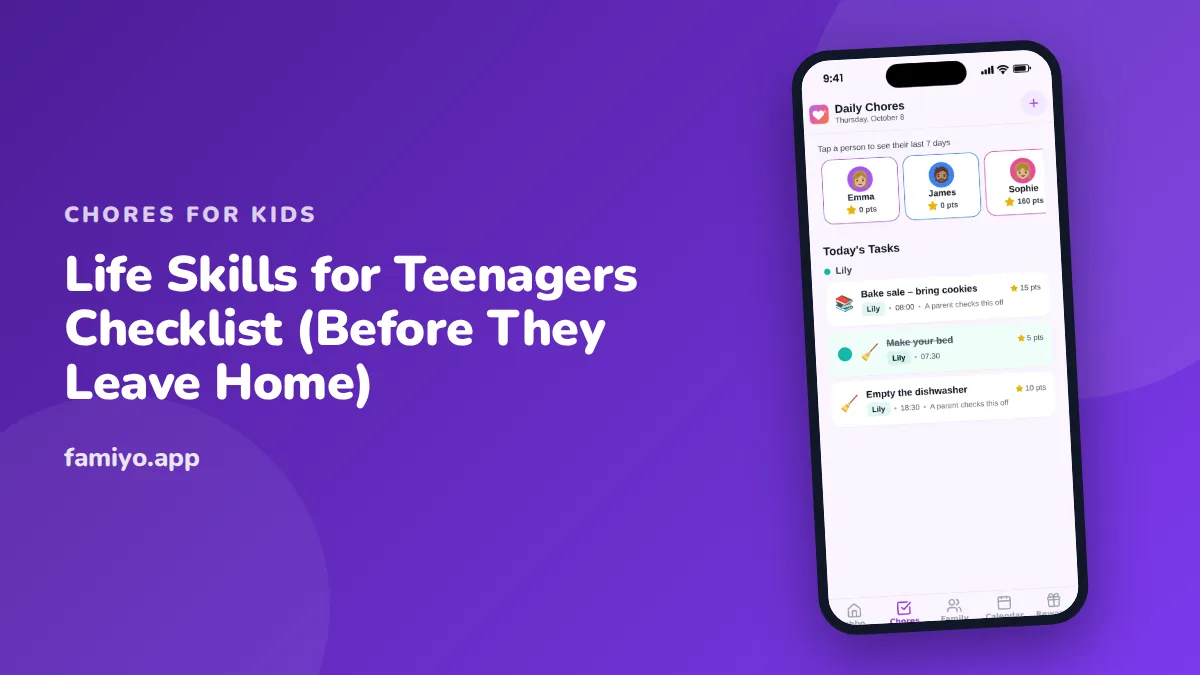
Most parents picture the day their teenager moves out and then realize, a little late, that their kid has never booked a dentist appointment or cooked a meal that did not come from a box. The good news is that you have years, and nothing on this list is hard. This checklist breaks adult independence into six areas, gives you a realistic standard for each, and ends with a plan for fitting it into ordinary weeks.
What life skills does a teenager need before leaving home?
Think in six areas: food, clothes and home, money, health, getting around, and people. For each one there is a bar that most 18-year-olds can reach if they have practiced, and the table below states it plainly. Use it as a self-assessment: sit down with your teen, go through the rows, and mark each as "can do alone", "can do with help" or "never done".
| Area | The standard by 18 | Starting age |
|---|---|---|
| Food | Cook 10 simple meals, plan a week of dinners, shop from a list, store leftovers safely | 12 to 13 |
| Clothes and home | Do laundry start to finish, change sheets, clean a bathroom and kitchen, use basic tools | 11 to 13 |
| Money | Keep a budget, save toward a goal, understand a pay stub, avoid impulse subscriptions | 13 to 14 |
| Health | Book and attend appointments, refill a prescription, treat a minor injury, know when to call a doctor | 14 to 16 |
| Getting around | Read a map and a transit schedule, plan a trip, drive if they are ready | 14 to 16 |
| People | Ask for help, disagree politely, email an adult, handle a roommate conflict | 13 and up |
The starting ages are when a teen can begin practicing, not when they should have mastered it. Mastery usually takes two or three years of repeating the thing.
Food: the skills that matter most
If you only have time for one area, pick this one. A teenager who can feed themselves cheaply and safely avoids a lot of trouble.
Ten meals is a real number. Aim for a breakfast (eggs, oatmeal), a sandwich or wrap, a pasta with sauce, a stir fry, a sheet pan dinner, a soup, rice and beans, tacos, a basic salad with protein, and one meal they are proud of. Our guide on when a child should learn to cook covers the earlier steps if your teen is starting from nothing.
Also teach the unglamorous parts:
- Read a recipe all the way through before starting.
- Use a knife safely, and know what to do with a grease fire (cover it, never water).
- Plan three dinners, write the list, and shop for them with a budget.
- Check dates, store leftovers in the fridge within two hours, and reheat until hot.
- Clean as they cook, so the kitchen is done when the food is.
A good first assignment: one dinner a week, entirely theirs, from picking the recipe to loading the dishwasher.
Clothes, home and basic repairs
Laundry is the quickest win. A teen can learn it in an afternoon, and there is no reason a 14-year-old should still hand you a hamper. Show sorting, reading care labels, the right amount of detergent, drying versus hanging, and folding. Then step away. Our guide to laundry chores by age shows how it builds from age 5 up.
Cleaning is mostly knowing a sequence. Bathroom: spray, wait, scrub the toilet, sink and tub, then floor last. Kitchen: dishes, counters, stove, sink, floor. Room: trash, laundry, surfaces, vacuum. A teen who has a sequence cleans in 20 minutes. One who does not stares at the mess.
Add a short list of fix-it basics: unclog a drain, reset a breaker, change a light bulb and a smoke detector battery, hang a shelf with a stud, patch a nail hole. None of them takes more than a few minutes to show.
Money skills a teenager can really practice
Money is the area where teens most often hit a wall in their first year away. The fix is practice with real numbers while the stakes are small.
- Give a regular allowance or paid-chore income in the typical range for 14 and up, which is $15 to $25 a week, and make it theirs to manage.
- Have them track what comes in and goes out for four weeks, on paper or a notes app.
- Split it: spending, saving toward one named goal, and a small amount to give.
- Show a pay stub (yours is fine with the details covered) and explain gross versus take-home.
- Let them cancel a subscription they forgot about. It stings, and they remember it.
Do not rescue them from a bad purchase. A $30 mistake at 15 is cheaper than a $300 one at 19.
Health, safety and getting around
A teenager should know their own basics: allergies, medications, blood type if known, and the name of the clinic. Have them book their own next dental cleaning with you in the room, then without you. Teach them to describe a symptom in two sentences, and to ask "what should I watch for?" before leaving the office.
First aid for a teen means cleaning and bandaging a cut, treating a burn with cool running water, knowing when a head injury or high fever needs urgent care, and the number for poison control (1-800-222-1222 in the US). A community first aid or CPR class is a good weekend project.
For getting around, practice a bus or train trip together, then let them do the return alone. Teach them to share their trip plan with someone and keep their phone charged. If they are learning to drive, add basics like checking tire pressure, adding wiper fluid and what to do after a minor collision.
People skills that make the rest easier
These are the quietest skills on the list and the ones adults wish they had learned sooner. Practice them out loud:
- "Hi, I'm calling to schedule an appointment." Have them make the next call to a restaurant, a coach or a store.
- "I'd like to talk about my grade." Let them email a teacher themselves, without you drafting it.
- "That doesn't work for me, but this does." The sentence for a roommate, a boss, a friend.
- "I made a mistake, and here's how I'll fix it." Worth more than any apology paragraph.
You will be tempted to jump in when it gets awkward. Count to ten first. The pause is where they learn.
Turning the checklist into weekly habits
A checklist alone gets a teenager's eyes rolling. What works is picking one skill a month and turning it into a repeating job with a clear finish line. March might be laundry every Sunday. April might be dinner on Tuesdays. May might be a monthly budget check.
Rotate who holds the clipboard: some months you teach, some months they teach you. Keep a record of what they have mastered so the list shrinks and the progress is visible. For more ideas on keeping a system alive, see our rules for chore charts that actually work, and for teens who push back, how to get kids to help around the house has scripts that avoid a power struggle.
Making each skill a repeating chore in Famiyo
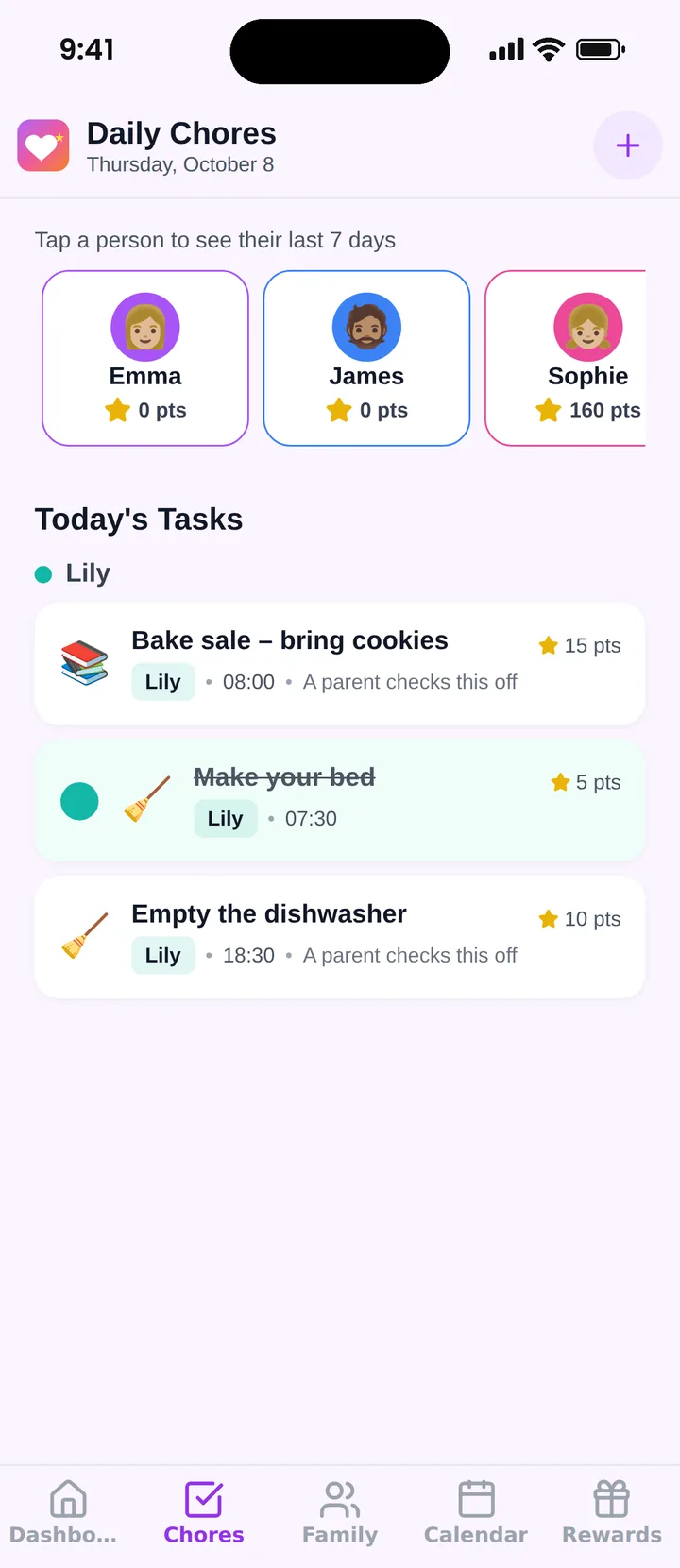
Famiyo is a free family app for iPhone and Android that combines a shared family calendar, chores with points and a rewards shop; kids join with a code, no email needed. For this checklist, you can add each skill as a repeating chore, such as "Cook Tuesday dinner" weekly or "Wash and fold own laundry" every few days, and give it points that match the effort. Your teen sees their own list on their own phone, checks tasks off, or waits for you to approve, and earns the points toward rewards you set.
If you want to see how this compares with other tools, our list of the best chore apps for kids is a good place to start.
Pick the three skills your teen is furthest from, write them at the top of the list, and give each one a day of the week this month.
Frequently asked questions
What life skills should a teenager have before leaving home?
Cooking basic meals, laundry, cleaning, budgeting, managing a phone plan and subscriptions, booking appointments, basic first aid, getting around without a parent, and speaking up for themselves. Skill in each area matters more than perfection, so aim for competent.
At what age should I start teaching teens life skills?
Earlier than feels natural. Most of this list can start at 13 or 14, when a teen can do a job from start to finish. The skills that carry risk, like driving or cooking with hot oil, come later and with you nearby.
How do I teach life skills to a teenager who resists?
Give them ownership of one real job and a clear finish line, then step back. Teens push against being managed, not against being trusted. Pair the new skill with something they want, such as a phone upgrade or a later curfew.
Should life skills be taught through chores?
Mostly yes. A chore is just a life skill that repeats. Cooking dinner every Tuesday teaches planning, shopping and timing far better than one lesson does. Repetition is what turns knowing how into doing it without thinking.
What if my teen is about to leave and has gaps?
Pick the three that would hurt most, usually laundry, cooking and money, and teach those now. Everything else can be learned by doing, and a phone call home is a fine teacher. Do not try to cram the whole list into one summer.
Try Famiyo With Your Family
Chores with points, a rewards shop for kids and one shared family calendar. Set it up in a couple of minutes.



Free to download • No credit card required • Available on iOS & Android