Prizes for Kids That Aren't Junk: 35 Ideas Worth Giving
Skip the plastic trinkets. Here are 35 prizes for kids that aren't junk, from time with you to small real tools, sorted by cost with a point price for each.
By Famiyo Editorial Team5 min read
Everyone knows the prize drawer. A rubber ball that bounces once, a ring that turns a finger green, a tiny eraser shaped like a taco. Kids love them for about nine minutes and then they end up in the vacuum.
If you want a prize that still feels like a reward tomorrow, the good news is that the best ones are usually cheaper. The ideas below are sorted by cost, with a suggested price in points if you run a point system, using the common scale from our other guides: small rewards at 30 to 50 points, medium at 100, big at 300 to 500.
Why experiences beat trinkets
Researchers who study motivation have long noted that rewards work best when they feel like a recognition of effort rather than a payment, and when the child has a say in what they are. A prize the child chose, with your time attached, tends to say "I noticed what you did." A random object from a bin says very little.
The American Academy of Pediatrics also encourages parents to praise specific effort and to spend regular, unhurried time with their children. A reward built around that time delivers both at once. It is a guideline for how to frame prizes, not a promise that any single prize will change behavior, and children differ. Some kids prefer a small object they can hold. Offer a mix and watch what they pick.
A few rules make any prize better:
- Let the child help write the list.
- Tie the prize to something specific they did.
- Keep it proportional: small effort, small prize.
- Never take back a prize that was earned.
Free and nearly free prizes (30 to 50 points)
These take a few minutes of your time and cost nothing.
- Choose what is for dinner (within reason).
- Pick the music in the car for a whole trip.
- 15 extra minutes of screen time, used on their schedule.
- Stay up 15 minutes later.
- Choose the bedtime story or read two instead of one.
- Pick the weekend breakfast.
- A turn in the front seat, if age and local rules allow.
- A skip card for one small chore.
- Pillow fort night in the living room.
- Pick a family game after dinner.
Prizes built on time with you (100 points)
For many kids this is the category that works hardest.
- A one-on-one walk or bike ride, no phones.
- Bake something together and keep half.
- A trip to the library with permission to borrow five books.
- Choose the family movie and the snacks.
- Pancakes in the shape of their choice.
- Playground trip with a friend.
- Stay up 30 minutes later on a weekend.
- A short drive to a place they pick, such as the duck pond.
- Help with a real project: a birdhouse, a pot of herbs, a simple craft.
- A video call with a grandparent, just for a chat.
Small real things (100 to 300 points)
When a child wants an object, make it one that gets used and costs a few dollars.
- A good notebook and a nice pen.
- A packet of seeds and a pot.
- A deck of cards.
- A set of colored pencils or markers.
- A used book from their favorite series.
- A magnifying glass or a flashlight.
- A sticker sheet for a hobby they care about.
- A new set of sidewalk chalk.
Bigger goals (300 to 500 points)
These suit the savings-for-something-special approach, a prize that takes a few weeks to reach. It also teaches patience.
- A day out: zoo, trampoline park, a hike with a picnic.
- A friend sleepover.
- A toy or game around $20, chosen after a few weeks of thinking about it.
- A class or a lesson they have been asking about, such as a rock climbing session.
- Choose a new family tradition, such as Friday pizza night.
- Plant a tree or a garden bed with you.
- Rearrange their bedroom a bit, within agreed limits.
Prizes for older kids
Tweens and teens usually do not want a taco eraser. They want autonomy and a little status. Ideas that tend to land:
- Choose the family movie or the weekend outing.
- A later curfew on one night.
- A ride to a friend's place, no questions.
- A skipped chore voucher.
- Money toward something they are saving for. See our guide to rewards for 13-year-olds for more.
What to avoid
Not every non-junk prize is a good one. Be careful with these:
- Food as a routine reward. Occasional treats are fine, but using candy for every success teaches kids to pair eating with achievement.
- Prizes that depend on someone else's schedule. If the trip to the zoo can only happen in a month, the link to the effort is lost.
- Surprise prizes at random. Kids need to know what they are working toward.
Where to find more ideas
We have a bigger list in rewards for kids, and a separate guide to what to give for everyday jobs in rewards for kids doing chores. For a low-tech way to display prizes, look at our reward jar ideas for kids.
Setting prices and running the shop in Famiyo
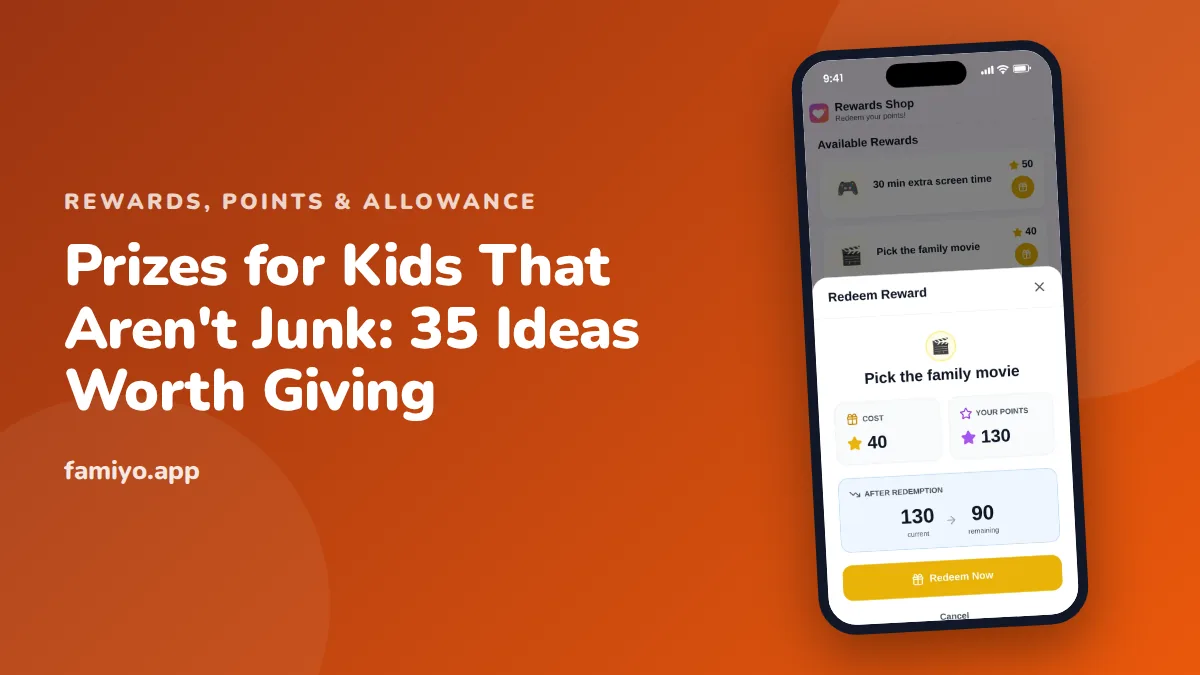
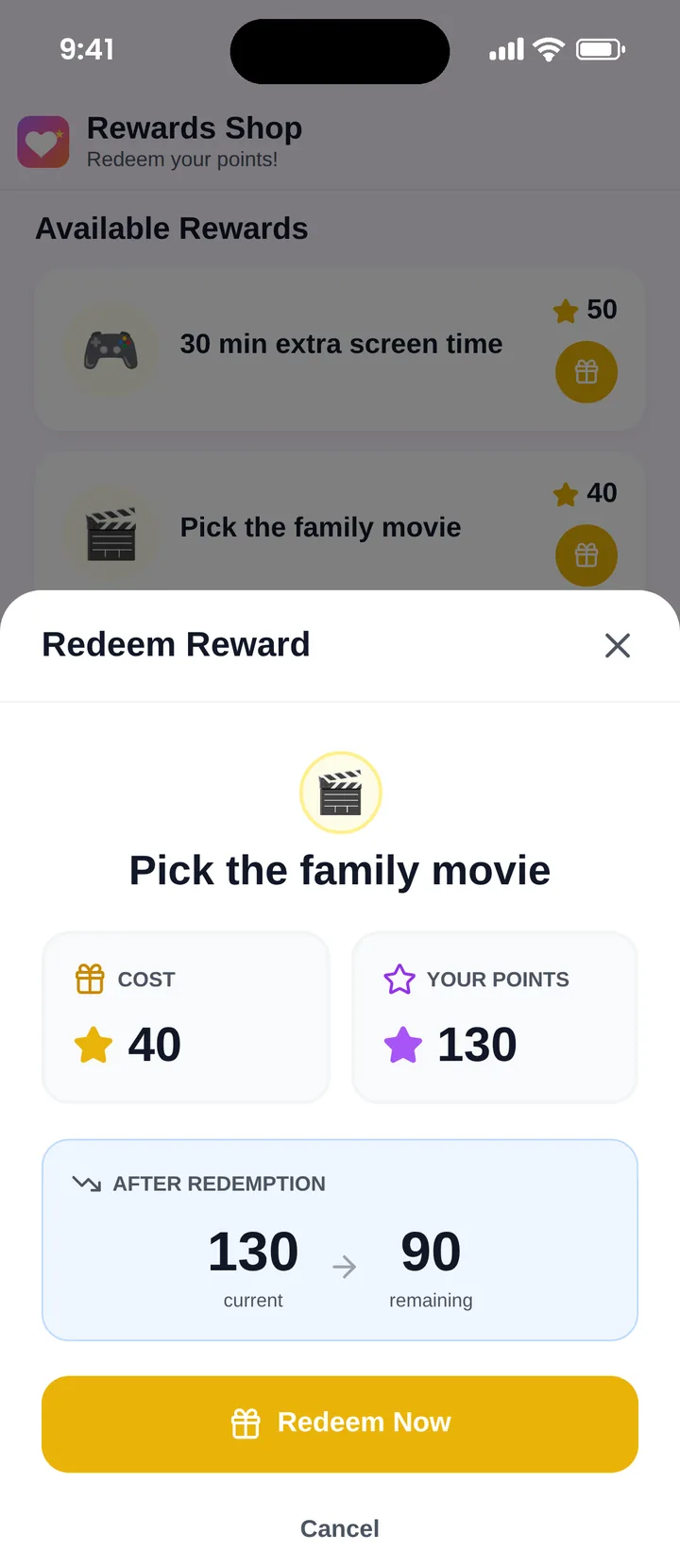
Famiyo is a free family app for iPhone and Android that combines a shared family calendar, chores with points and a rewards shop; kids join with a code, no email needed. In the rewards shop you add each prize with a price in points, how many are available and when. For example, "Pick the family movie, 100 points, one per week." Kids open the shop on their own phone, redeem a reward and see how many points they will have left. You get a notification when they redeem, so nothing is a surprise.
For a comparison of tools, see our list of the best reward chart apps for kids.
Try this: sit down with your child this week and have them write five prizes of their own. You will probably be surprised by what is on it.
Frequently asked questions
What can I give kids as prizes instead of candy or toys?
Give experiences and choices: picking the dinner, a bike ride with a parent, extra reading time, a trip to the playground, or a small useful item such as a sketchbook. These cost little and are remembered longer than a trinket.
Are non-material prizes enough to motivate kids?
For most children, yes, especially when the prize is something they chose and it comes with your attention. Time with a parent often outranks objects. Ask your child to write their own list and you will see what they value.
How much should a prize cost?
Most prizes can cost nothing or a few dollars. Keep the biggest ones, such as a day out or a toy around $20, for goals that take several weeks, and let small rewards be quick and free.
Should prizes be given for chores?
Prizes work for extra effort and new habits. Everyday family jobs are part of belonging to the household, so it helps to keep the prize for streaks, bigger jobs or a goal the child has been working toward.
Try Famiyo With Your Family
Chores with points, a rewards shop for kids and one shared family calendar. Set it up in a couple of minutes.



Free to download • No credit card required • Available on iOS & Android