Chores for Teenagers to Earn Money: Fair Rates and Bigger Jobs
Paid chores for teens: which jobs to pay for, fair rates of $0.25 to $5 a job, how to price bigger projects and how to handle payday without arguments.
By Famiyo Editorial Team6 min read

Your 15-year-old wants headphones, concert tickets or gas money, and you'd like them to earn at least some of it. Paid chores at home are the easiest first job a teen will ever have, as long as the rules are clear before anyone picks up a sponge. This guide covers what to pay for, a rate card for teen-sized jobs, a simple way to price bigger projects, and how to run payday so it doesn't turn into a weekly negotiation.
Which chores should be paid and which shouldn't
Start by separating two kinds of work. Base chores are what every person in the house does because they live there. For a teenager that usually means their own laundry start to finish, keeping their room livable, cleaning up after themselves in the kitchen and a share of the daily family jobs, about 30 to 45 minutes a day in total. These stay unpaid. If you pay for them, you'll eventually hear "I don't need the money this week, so I'm skipping the dishes."
Paid chores are extra. A quick test helps decide which side a job falls on:
- Is it beyond their normal share? Washing their own cereal bowl is not. Washing the car is.
- Would you otherwise do it yourself on a weekend or pay someone for it? Mowing, window washing and garage clean-outs usually pass.
- Does it have a clear finished state? "Help out more" can't be paid fairly. "Weed the front bed" can.
If a job passes all three, it can go on the paid list. For how paid work fits with a regular allowance, see our guide to how much allowance kids should get by age, which covers typical weekly amounts for teens.
A rate card for paid teen chores
The common range for paid chores is $0.25 to $1 for a small extra job and $2 to $5 for a big one. Teens are faster and more careful than younger kids, so most of their paid work should sit at the big-job end. Here's a starting rate card:
| Job | Typical time | Size | Suggested pay |
|---|---|---|---|
| Bring in and put away a big grocery order | 10 minutes | Small | $0.50 to $1 |
| Wipe down the fridge, microwave and oven fronts | 10 minutes | Small | $0.50 to $1 |
| Water the garden or all the house plants | 10 minutes | Small | $0.50 to $1 |
| Clean out and wipe the fridge before grocery day | 30 minutes | Big | $2 to $3 |
| Weed one flower bed | 30 to 45 minutes | Big | $2 to $4 |
| Deep-clean a bathroom: tub, tile, mirror, floor | 45 minutes | Big | $3 to $5 |
| Wash and vacuum the car inside and out | 45 to 60 minutes | Big | $4 to $5 |
| Mow the lawn (after training) | 45 to 60 minutes | Big | $4 to $5 |
| Wash all the windows on one floor | 60 minutes | Big | $4 to $5 |
| Cook an extra family dinner, beyond their usual turn | 60 minutes | Big | $3 to $5 |
| Watch a younger sibling for an hour while you work from home | 60 minutes | Big | $3 to $5 |
| Clean out the garage | 3 hours | Project | Priced in blocks, see below |
| Rake and bag the whole yard in fall | 2 hours | Project | Priced in blocks |
| Paint a fence or a bedroom wall with you | 3 to 4 hours | Project | Priced in blocks |
Adjust for where you live and what your budget can carry. The point of a rate card is that it's written down, so the price of mowing doesn't depend on your mood or their bargaining skills that day.
How to price bigger projects
Projects are where teens can earn real money and where most arguments start. A simple fix is the block method: treat every 30 minutes of honest work as one big job and pay your big-job rate for each block.
- Walk through the job together and list its parts. For a garage: empty one wall, sweep, sort into keep, donate and trash, put back on shelves, take the donate pile to the car.
- Estimate the 30-minute blocks for each part and add them up. Say it comes to six.
- Multiply by your big-job rate. At $4 a block, six blocks is $24.
- Add a block for jobs that are messy or unpleasant, like cleaning a gutter or a pet area.
- Write down the scope, the standard and the deadline, then agree on the total before work starts.
- Pay the agreed price, even if they finish faster. Working efficiently is a skill, and you want to reward it.
That last step matters more than it looks. If you pay by the hour for projects, a teen learns to stretch the job. A fixed price teaches what a quote is.
Write the job like a real work order
Teens respond well to being treated like someone you hired. A short work order, in a note on their phone or on paper, removes most of the "but you didn't say" debates. A good one answers four questions:
- What exactly is the job? "Wash and vacuum the minivan, including the floor mats and the third row."
- What does done look like? "No crumbs in the seat tracks, windows streak-free on the inside."
- When is it due? "Saturday by 4 p.m."
- What does it pay? "$5, paid Sunday."
Then inspect together. Have them walk you through the finished job instead of checking behind their back. If something is missed, give one chance to fix it before payday. Partial work earns partial pay only if you said so in advance; otherwise the job is either done or not done yet.
Paying teenagers in a digital world
Most teens rarely touch cash, so think about how the money will actually move. A teen bank account, a debit card linked to your account or a payment app all make sense at this age, and they let a teenager watch a balance grow toward something specific.
A few rules keep the money side clean:
- Pick one payday, such as Sunday evening, and pay everything owed that week in one transfer. Instant payment for every small job teaches less about waiting.
- Keep a running list of finished jobs that you can both see, so there's no memory contest on payday.
- Suggest a savings split before the money lands. For younger kids the classic split is spend, save and give, for example 50%, 40% and 10%. A teen can set their own version.
- Don't advance pay for jobs not yet done. If they need money early, that's a conversation about borrowing, which is its own lesson.
Money works well for extra work like this. It's a poor fit for things a teen already enjoys, such as practicing an instrument they chose. Our guide to intrinsic motivation in kids explains why paying for those can backfire.
When paid chores go wrong
The most common problem is a teen who happily does paid jobs and lets the base chores slide. The fix is a simple rule: paid jobs open only after the week's base chores are done. Say it once, calmly, and then let the rule do the work.
Haggling is the second. If every job turns into a negotiation, freeze the rate card and agree to review it once a month, not job by job. A teen who thinks a rate is unfair can make the case at the review, with reasons, which is good practice for asking for a raise someday.
Third, busy seasons. A teen with practice four nights a week and a heavy homework load doesn't need a paid job on Tuesday. Move paid work to weekends and school breaks, and drop it entirely during exam weeks if that's what it takes.
Last, sloppy work. Don't redo it yourself and pay anyway. Point to the work order, show what's missing, and hold the payment until it's fixed.
Tracking paid jobs with Famiyo
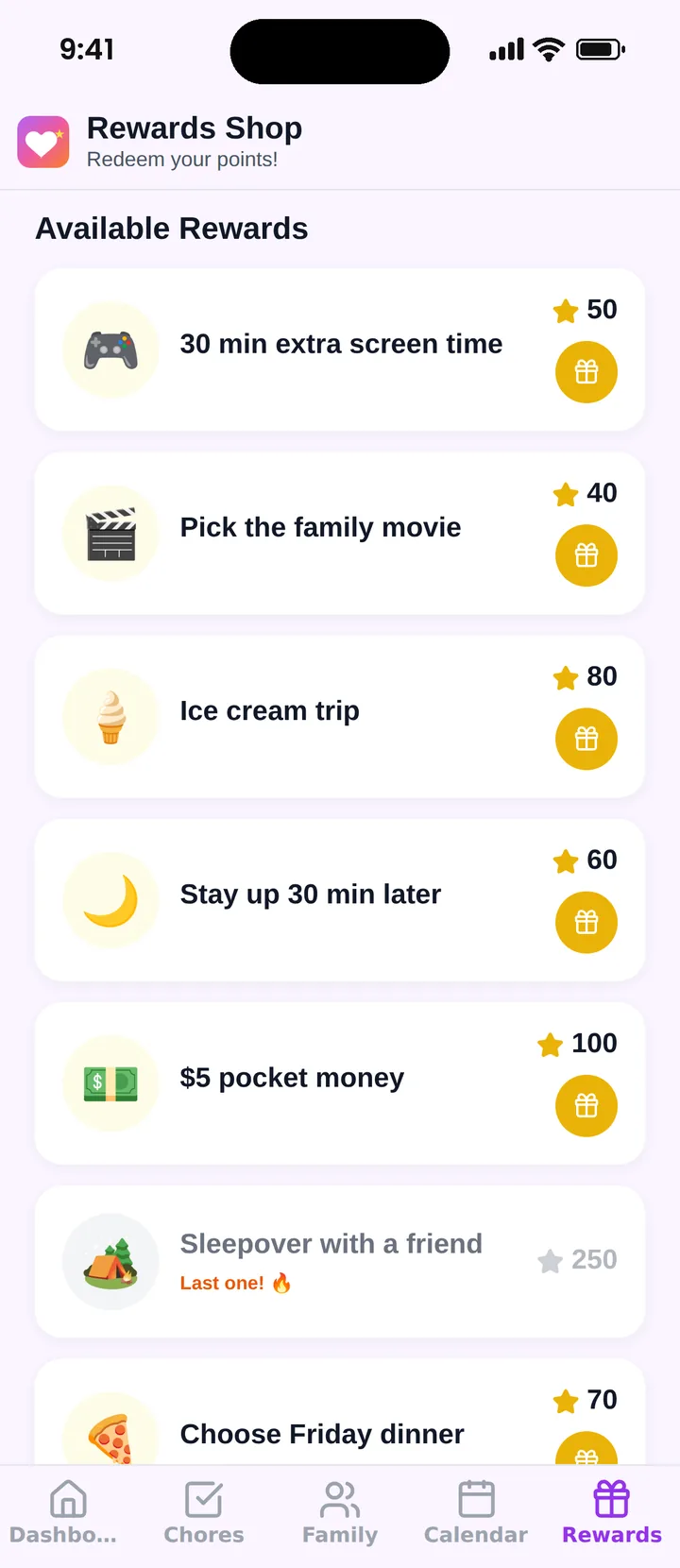
Famiyo is a free family app for iPhone and Android that combines a shared family calendar, chores with points and a rewards shop; kids join with a code, no email needed. For paid jobs, use a simple conversion of 100 points = $1, so a $4 car wash is a 400-point chore. A younger sibling who helps can get fewer points for the same task. Switch on parent approval so points land only after you've inspected the job. Then add "$10 cash" to the rewards shop at 1,000 points, with a limit on how many are available each month. Your teen redeems it from their phone, you get a notification, and you pay outside the app, since it doesn't hold or move money. For other options, see our list of the best allowance apps for kids.
Before you offer the first paid job, write the rate card and the work order format down. Ten minutes of setup saves a lot of Saturday arguments.
Frequently asked questions
How much should I pay my teenager for chores?
Nothing for the basic chores every family member does, like their own laundry and room. For extra work, $0.25 to $1 per small job and $2 to $5 per big job is a common range. For projects that take an afternoon, count the big-job blocks inside it and agree on one price in advance.
Should teenagers get paid for chores at all?
Many families split it. Everyday chores are unpaid because they come with living in the house, while extra jobs a parent would otherwise do or hire out are paid. That keeps contributing separate from earning and gives teens a fair way to make their own spending money.
What chores can a 13-year-old do for money?
A 13-year-old can wash and vacuum the car, mow the lawn after training, deep-clean a bathroom, clean out the fridge, weed a flower bed or sort a garage shelf. Start with jobs that have an obvious finished state, so there's no debate about whether the work is done.
Should I pay my teen in cash or digitally?
Either works. Many families pay into a teen bank account or through a payment app, which makes saving easier and looks more like how a real job pays. Whatever you choose, pay on the same day every week so the money arrives on schedule and nobody has to chase it.
Try Famiyo With Your Family
Chores with points, a rewards shop for kids and one shared family calendar. Set it up in a couple of minutes.



Free to download • No credit card required • Available on iOS & Android