Reward Jar Ideas for Kids: 12 Setups That Work
Twelve reward jar ideas for kids, from marble jars to coupon jars, with what to put in, how to fill it and what to do when the jar is full.
By Famiyo Editorial Team5 min read

A reward jar is about as low-tech as a reward system gets. A jar, something to put in it and a line near the top. There is not much to break, and kids tend to understand it within a minute.
The details matter, though. A jar that fills in a day teaches nothing, and one that takes six weeks gets abandoned. Here are twelve ways to set one up, plus what to choose as the payoff.
Why a jar can work
Evidence on reward systems suggests a few things hold up across many families. Rewards are most effective when the target behavior is specific, the payoff comes soon, and the child understands the rule. A jar delivers all three because progress is visible. A child can see it and touch it, which helps younger children who cannot yet picture "20 days from now".
The same research also warns that rewards can lose their effect or backfire when they are too big, too frequent or used to bribe. If you want the broader picture, read our guide to rewards for kids doing chores. It depends on the child; some are motivated by a jar, others shrug.
12 reward jar ideas
1. The classic marble jar
One marble in the jar for each specific good choice, such as getting dressed without reminders. Mark a line at 20. A full jar earns a reward from your list.
2. Pom-pom jar
Same as above, but quieter and unbreakable. Good for toddlers and for homes with wooden floors.
3. Coin jar
Use real coins, such as a quarter for each completed task. The jar doubles as a savings jar. Read our guide on how much to pay kids for chores before you pick amounts.
4. Coupon jar
Write rewards on popsicle sticks or paper slips and put them in a jar. After the child earns a prize, they draw one. Surprise is part of the fun, but include only rewards you are happy to give.
5. Two-jar system
One jar for earning, one for the reward. Move each marble across as the task is done. Kids like watching one empty while the other fills.
6. Clear jar with a drawn finish line
Mark the level with tape or a marker. For small children, draw a picture of the prize on the jar.
7. Jar per child
For siblings, give each child their own jar with their own color of marble. It keeps comparing to a minimum.
8. Family jar
Everyone contributes to a single jar for a shared prize, such as a movie night. Good for teaching cooperation, but use it alongside individual jars, because one child can end up carrying the rest.
9. Kindness jar
Add something when a child is caught being kind. Keep it for positive observations only. See our positive reinforcement phrases for kids for words that go with it.
10. Chore-day jar
A small jar tied to a short list of daily jobs. The child adds a bead for each finished job. At the end of the week, count them.
11. Savings goal jar
Pair coins with a picture of something they want. This turns a reward jar into an early lesson in saving.
12. Jar with levels
Tape three lines on one jar. Hitting the first line earns a small reward, the middle a medium one, the top a big one. Great for kids who need a quick win.
What to put in and when
Keep the "currency" simple and cheap. Marbles, pom-poms, buttons, beads, craft sticks or coins all work. A few ground rules:
- Say exactly what earns an item. "Putting shoes by the door" is clear. "Being good" is not.
- Put it in right away, in front of the child. Delay weakens the link.
- Never remove items.
- Check the target after a couple of weeks. If it is too easy or too hard, adjust it once and explain why.
Reward ideas for a full jar
| Jar fills in | Reward size | Examples |
|---|---|---|
| A few days | Small | Choose dessert, 15 extra minutes of screen time |
| One to two weeks | Medium | Family movie pick, stay up 30 minutes later |
| Several weeks | Big | A day out, a toy around $20 |
For more ideas that are not plastic, see our list of prizes for kids that aren't junk.
Matching the jar to the child
A three-year-old needs the payoff within a day or two, so use a small jar with a low line and a reward that takes no planning, such as choosing a song. A six-year-old can wait a week and enjoys counting the marbles aloud with you. By eight or nine, many children want a say in the target itself, so let them propose the behavior and the finish line and agree on it together. A child who helped design the rules is much more likely to follow them.
It also helps to keep the jar in a spot where the child sees it daily but cannot reach it alone, such as a shelf at your eye level. That way the contents stay accurate and the jar stays a shared ritual rather than a toy.
When a jar stops working
Most jars lose steam after a few weeks. Common signs and fixes:
- The child stops caring. The reward is probably wrong. Ask them what they would like.
- They want to cash in constantly. Make the full line clearer or lower the cost of small rewards.
- Siblings fight over fairness. Give each their own jar with a goal that suits their age.
- You forget. Keep the jar and the marbles in one spot you walk past every day.
When the child is ready for more than a jar, usually around age 8 to 10, consider moving to points with a rewards list.
When a jar becomes an app
Famiyo is a free family app for iPhone and Android that combines a shared family calendar, chores with points and a rewards shop; kids join with a code, no email needed. It works like a jar that cannot get lost. Chores and tasks earn points, and you create rewards in the shop with a price, a limit and a date. Kids open the shop on their own phone, redeem a reward and see how many points they will have left, and you get a notification when they do.
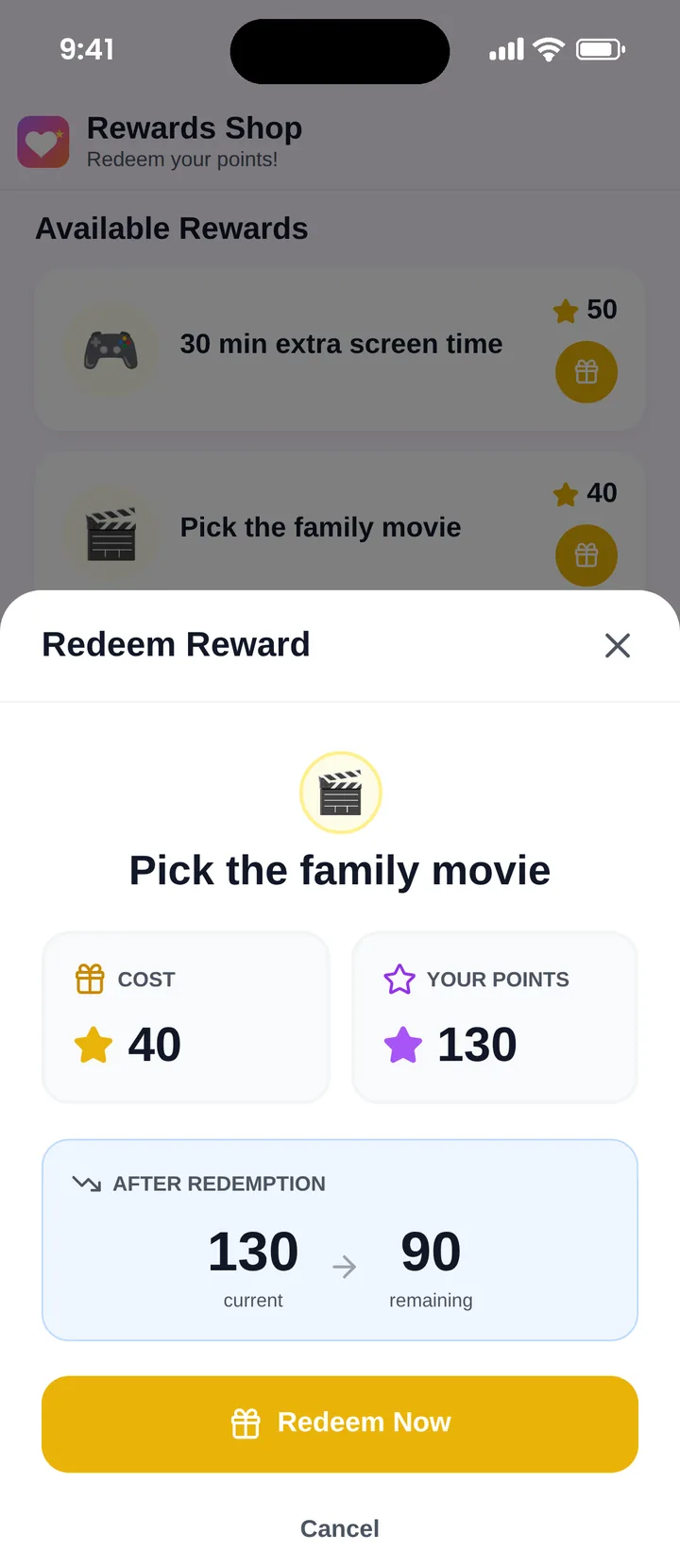
Many families keep a physical jar for the youngest child and use the app for older ones. We compare options in our list of the best reward chart apps for kids.
Pick one jar, one behavior and one reward this week. Keep it small and see whether your child cares before building anything bigger.
Frequently asked questions
How does a reward jar work?
The child earns a small object, such as a marble, each time they do a target behavior. When the jar reaches an agreed line, they choose a reward from a list. Seeing the jar fill is what keeps them going.
How many marbles should fill a reward jar?
Pick a number a child can reach in one to two weeks, often 15 to 30 for younger kids. If the jar takes a month to fill, most children lose interest before the end.
Should you take marbles out as a punishment?
Most guidance on rewards recommends against it. Removing earned items feels unfair and can make children stop trying. Let the jar only fill, and handle misbehavior with calm, consistent consequences instead.
What age is a reward jar best for?
Roughly ages 3 to 9. Younger children enjoy the physical objects, and school-age kids like the visible progress. Older kids usually prefer a points system with choices.
Try Famiyo With Your Family
Chores with points, a rewards shop for kids and one shared family calendar. Set it up in a couple of minutes.



Free to download • No credit card required • Available on iOS & Android