Positive Reinforcement Phrases for Kids: 40 Things to Say
40 positive reinforcement phrases for kids, grouped by effort, kindness, mistakes and age, with swaps for 'good job' and why specific words work better.
By Famiyo Editorial Team5 min read
"Good job!" is the most common thing parents say, and probably the least useful. It's pleasant, but it doesn't tell a child what they did right or what to do again. Positive reinforcement works best when the words carry information. This page gives you 40 phrases grouped by what you want to encourage, a table of swaps for the usual lines, and notes on tone by age.
Why the exact words matter
Positive reinforcement means following a behavior with something your child values so the behavior becomes more likely. Attention is one of the strongest reinforcers there is, and words are the cheapest way to deliver it. The American Academy of Pediatrics' guidance on positive discipline advises noticing and praising what children do well, not just correcting what they do wrong.
Three things make a phrase work. It's specific (it names the action), it's immediate (it comes right after the behavior), and it's honest (the child can tell you mean it). Children, especially older ones, notice when praise is automatic.
Research on praise, widely summarized, points the same way: praising effort and strategy encourages kids to keep going when things are hard, while praising fixed traits ("you're a natural") can make them cautious. Findings depend on the child, so treat this as a good default rather than a rule.
Swap "good job" for something specific
| Instead of | Try |
|---|---|
| "Good job!" | "You put every block back in the bin." |
| "You're so smart." | "You tried three ways before it worked." |
| "You're such a good girl/boy." | "You waited for your turn, even though it was hard." |
| "Perfect!" | "I can see how carefully you did the corners." |
| "Great drawing!" | "You used so many colors here. Tell me about this part." |
| "Thanks, I guess." | "Thank you for feeding the dog. She was hungry." |
The pattern is simple: say what you saw, then, if it helps, say what it did for someone else.
Phrases for effort and persistence
- "You kept trying even though it was tricky."
- "That took patience, and you stuck with it."
- "I saw you practice that. It's getting smoother."
- "You didn't give up when it went wrong the first time."
- "You asked for help when you needed it. That's smart."
- "Look how much further you got than yesterday."
- "That was hard work, and it shows."
- "You found a different way to solve it."
Phrases for kindness and cooperation
- "You shared your snack without me asking."
- "I noticed you let your sister go first."
- "You said sorry and meant it. That takes courage."
- "You helped him up. That was kind."
- "You listened to what she wanted to play. Thank you."
- "That was a gentle way to ask."
- "You included the new kid. I bet that felt good for him."
- "Thank you for waiting while I finished my call."
Phrases for chores and responsibility
- "You packed your bag before I reminded you."
- "Your room is picked up. That makes the whole house feel better."
- "You did that chore start to finish on your own."
- "I didn't have to ask. You remembered."
- "Thanks for being on time. It made our morning easier."
- "You finished before the timer. Nice pace."
- "You noticed the trash was full and took it out."
- "That's the third day in a row you did it yourself."
For chores that repeat daily, pair the words with a visible tally. Our guide to point system rewards for kids covers how to set one up so the words and the points back each other up.
Phrases for mistakes and hard moments
Reinforcement isn't only for wins. How you respond to a mistake teaches a child whether it's safe to try again.
- "Mistakes help your brain grow. What will you try next?"
- "You were upset, and you took a breath. I saw that."
- "It's okay to be frustrated. You handled it well."
- "You told me the truth, even though it was hard. Thank you."
- "That didn't go the way you wanted. Want to try again together?"
- "I'm proud of how you kept going."
- "You calmed down faster than last time."
- "Thanks for owning up to it. Let's fix it."
By age: how to adjust
Toddlers (2 to 3) need short, energetic words right away: "You did it!" with a clap. Preschoolers (4 to 5) like to hear the exact action and love hearing you tell someone else. School-age kids (6 to 12) can take a bit more detail, such as "You've remembered your homework folder all week." Teens often prefer it quiet and private.
- Toddler: "You picked up the ball! Thank you!"
- Preschooler: "You buttoned your coat all by yourself."
- Age 7: "You read that whole page without help."
- Age 9: "You planned your project and finished it on time."
- Age 11: "You handled that disagreement without yelling."
- Age 13: "I noticed you did that without being asked."
- Age 15: "That was a mature call. I appreciate it."
- Age 17: "You handled that responsibly. Thank you."
For ideas on matching rewards to a 13-year-old, see our list of rewards for 13-year-olds. More examples beyond words are in positive reinforcement for kids examples.
When words need a reward behind them
Words are the foundation, but for tough habits a small reward can help. Used together, praise says why it mattered and a reward makes the next attempt more appealing. Keep the reward modest, agree on it beforehand, and keep the praise coming after the novelty fades.
Pairing phrases with Famiyo
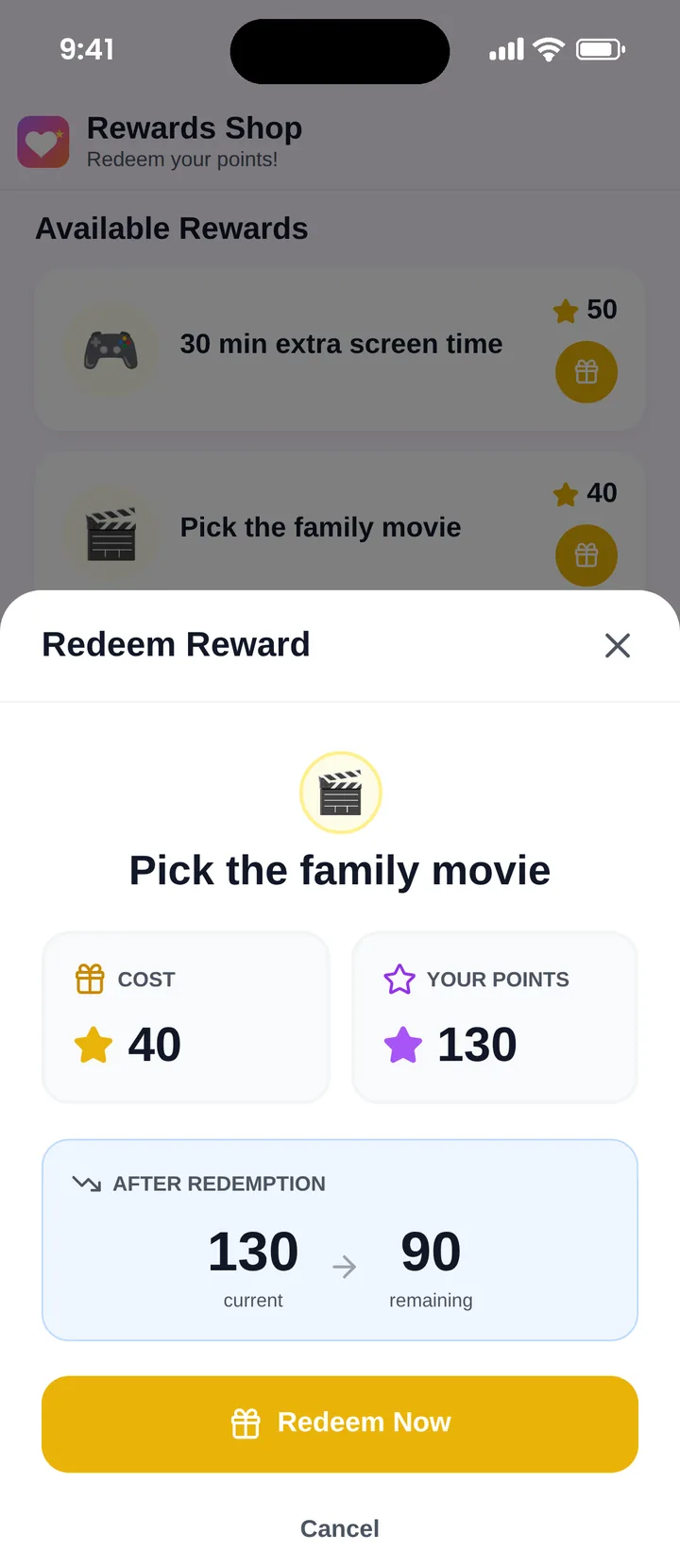
Famiyo is a free family app for iPhone and Android that combines a shared family calendar, chores with points and a rewards shop; kids join with a code, no email needed. When a child finishes a chore, you get a push notification, which is a handy cue to say something specific in person. Points add up, and your child spends them in the rewards shop, where you set the price, the number available and the dates. They redeem on their own phone and see how many points they'll have left. Our list of the best reward chart apps for kids compares other tools.
Choose three phrases from this list and use them today, right after the behavior you want to see.
Frequently asked questions
What can I say instead of 'good job'?
Describe what you saw: 'You carried your plate to the sink by yourself.' Add the effect when it fits: 'That helps me a lot.' Naming the action tells your child exactly what to repeat, which 'good job' never does.
Is it bad to tell kids they are smart?
Praising ability ('you're so smart') can make children avoid hard tasks for fear of losing the label. Praising effort and strategy ('you tried three different ways') tends to encourage persistence. An occasional 'you're smart' won't harm them, but make effort your default.
How often should I use positive reinforcement phrases?
Often at first, then less. When you're building a habit, praise it every time. Once it happens reliably, notice it now and then. Praise that comes too constantly or is not genuine loses its effect, so keep it honest.
Do teenagers like praise?
Many do, but they often prefer it low-key and private: a quiet 'I noticed you did that without being asked' rather than a public announcement. Keep it brief, skip the gushing, and be specific so it doesn't sound like you're managing them.
Try Famiyo With Your Family
Chores with points, a rewards shop for kids and one shared family calendar. Set it up in a couple of minutes.



Free to download • No credit card required • Available on iOS & Android