Positive Reinforcement for Kids With ODD: What Works
Positive reinforcement for kids with ODD works best when it is immediate, specific and kept free of power struggles. Scripts, examples and a simple chart plan.
By Famiyo Editorial Team5 min read
When a child says "no" to almost everything, the days start to run on corrections: stop that, put that down, I said now. Positive reinforcement flips the ratio. This guide explains how it works for a child with oppositional defiant disorder (ODD), what to say, how to build a simple chart, and what to avoid so that the rewards don't become a new thing to fight about.
A note before the details. ODD is a diagnosis made by a clinician, and this isn't treatment advice. The CDC describes parent training in behavior management as a main treatment for children with ODD, and a therapist can tailor the approach to your child. What follows is practical material for home that fits alongside that support.
Why positive reinforcement helps with defiance
Children with ODD often get a lot of negative attention. Parents are worn out, and most of the conversation is about what went wrong. For a child who is already sensitive to being told what to do, a steady stream of commands tends to raise the stakes and feed the argument.
Reinforcement changes what gets attention. When cooperation brings warmth, a small reward or a privilege and defiance brings neither, the child has a reason to try the first one. Parent training programs generally teach the same core moves: notice the behavior you want, say exactly what you saw, reward it quickly, and give clear, calm instructions.
It won't remove the defiance overnight. The aim is to make cooperation worth the effort and reduce the number of fights over everyday things.
Catch the small good moments
Start by noticing what's going right, even when it's tiny. A child who comes to the table when called, uses a regular voice or puts one shoe on is doing something you want to see again.
Praise it while it happens, and be specific. "Nice job" is easy to wave away. A statement of what you saw is harder to argue with and shows you were paying attention.
| What you saw | What to say | What to skip |
|---|---|---|
| Came to dinner when called | "You came the first time I called. Thank you." | "Finally!" |
| Put the shoes by the door | "Shoes are by the door. That makes mornings easier." | "See? That wasn't hard." |
| Stayed calm when told no to a game | "You were disappointed and you kept your voice calm." | "Why can't you do that every time?" |
| Did homework without a fight | "You got started on your own. I noticed." | "Maybe now you'll stop complaining." |
Keep praise matter-of-fact and brief. Some children with ODD push back against big, gushing praise or suspect it's a trick. A calm tone and a quick pat or smile often goes over better.
Give choices and use when-then
Commands invite a "no." Choices leave the child in charge of something small, which is what a defiant child often wants. Offer two options you can live with: "Do you want to start your homework at the kitchen table or on your bed?" Either answer is a yes to homework.
A when-then statement sets up a reward as a plain fact of life instead of a threat: "When your room is picked up, then you can have your tablet." Say it once in a calm tone, then stop talking and walk away. If you repeat it three times, it becomes an argument.
- State the expectation clearly and in positive terms, such as "Shoes on," rather than "Stop dawdling."
- Give a choice if there is one, or a when-then if there's a reward attached.
- Say it once, then wait a few seconds in silence.
- If your child does it, name the behavior and let the reward happen right away.
- If your child doesn't, say nothing more. The reward just hasn't been earned yet. No lecture, no threat.
Build a simple chart
A chart works for a child with ODD when it's small, specific and part of a larger pattern of positive attention. Pick two or three goals, written as things to do. Starting with something your child already does most days gives an early win.
| Goal | What counts | Points |
|---|---|---|
| Get ready on time | Dressed and shoes on by the time the timer rings | 5 |
| Start homework | Sits down with materials within 10 minutes of being asked | 10 |
| Calm voice with a sibling | Used words instead of yelling or hitting during a disagreement | 5 |
| Bonus | Did it without a reminder | +2 |
For rewards, use a menu your child helps write. Small rewards at 30 to 50 points, such as choosing dessert or 15 extra minutes of screen time, mean something can be earned every 2 to 3 days. A medium reward is 100 points, and a bigger one such as a day out is 300 to 500. Our article on the point system for kids' behavior explains how to set the numbers.
Two firm rules. Never take points away for misbehavior, because taking back something earned feels like a betrayal and fuels the opposition. Handle problem behavior separately with a calm, predictable consequence that doesn't touch the chart. And give the child control over the process: let them put the stickers on, pick the reward, or move the marker.
What can go wrong
Rewards offered during a blow-up teach the wrong lesson. If you say "I'll give you a treat if you stop," the child learns that escalating gets a payoff. Offer the reward ahead of time as a plan, and give it after the behavior.
Rewards can also feel like another demand. If your child refuses the chart outright, don't fight about it. Go back to catching good moments with specific praise for a few weeks, then try again with a smaller chart.
Another common trap is expecting too much too soon. A child who spends most of the day resisting won't turn into a different child in a week. Give a new plan 2 to 3 weeks of consistent use before judging it, and pick goals your child can reach today.
If defiance is intense, happens at school as well as home, or involves aggression or safety worries, don't wait for a chart to fix it. Talk to your child's pediatrician or a mental health professional, who can check for other conditions and guide treatment. Many children with ODD also have ADHD or anxiety, and the approach shifts accordingly. Our guides to positive reinforcement for kids with ADHD and positive reinforcement for kids cover related ground.
Rewards your child picks in Famiyo
Famiyo is a free family app for iPhone and Android that combines a shared family calendar, chores with points and a rewards shop; kids join with a code, no email needed. Because kids redeem from their own phone, your child gets some control: they look at the rewards you've set up, each with a price in points, a number available and when it can be used, and choose what to save toward. The screen shows how many points they'll have left.
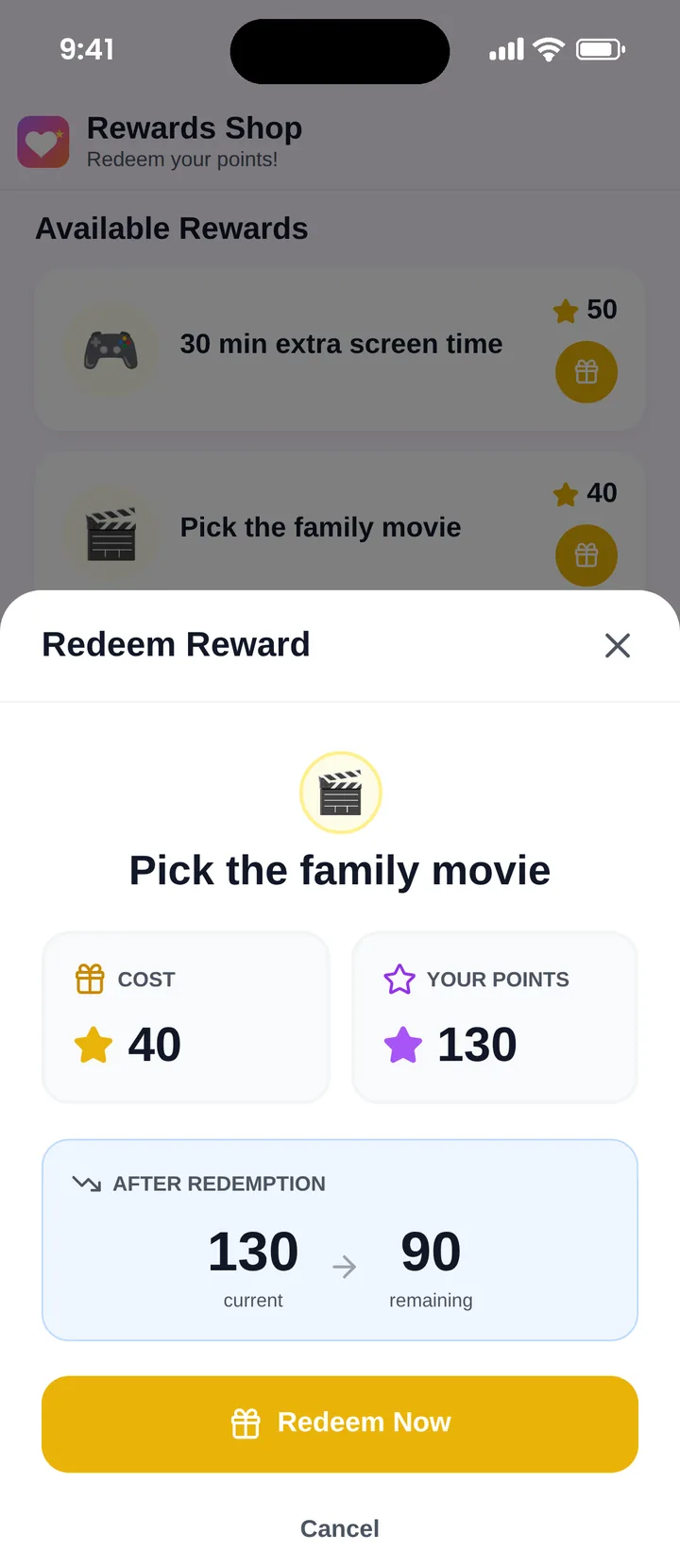
You can have a parent approve each task so points follow only what you've seen, and you get a notification when a reward is redeemed. See our list of the best reward chart apps for kids for more tools.
A first step this week
Tonight, find three small things your child did that you'd like to see again and name each of them out loud, calmly and briefly. Do that for a week before you introduce a chart.
Frequently asked questions
Does positive reinforcement work for oppositional defiant disorder?
It's a core part of what's recommended. Parent training programs for ODD teach caregivers to notice and reward cooperation, use clear expectations and stay calm, and the CDC lists them among the main treatments. It works best as a steady pattern at home, with a clinician guiding the details.
What is the difference between a reward and a bribe?
A reward is planned in advance and follows the behavior: 'When your homework is done, you can pick the music.' A bribe is offered in the middle of a conflict to stop it: 'If you stop screaming, I'll give you candy.' The first teaches skills. The second teaches that escalating pays.
Should I take away rewards when my child misbehaves?
Try not to. Removing something already earned feels unfair and often triggers more defiance. Handle the misbehavior with a calm, predictable consequence that is separate from the reward chart, and let the chart only count what went right.
What should I do when my child refuses the reward or the task?
Stay calm, repeat the when-then once, and walk away without arguing. If the child still doesn't act, the reward simply isn't earned yet, with no lecture. Try a smaller first step later, and check that the reward is something your child truly wants.
Try Famiyo With Your Family
Chores with points, a rewards shop for kids and one shared family calendar. Set it up in a couple of minutes.



Free to download • No credit card required • Available on iOS & Android