Reward Chart for Toddlers: What to Put on It and How It Works
A reward chart for toddlers works when it is tiny: three goals, a sticker right away, a small prize at five. Sample chart, reward ideas and a free printable.
By Famiyo Editorial Team4 min read
Free printable
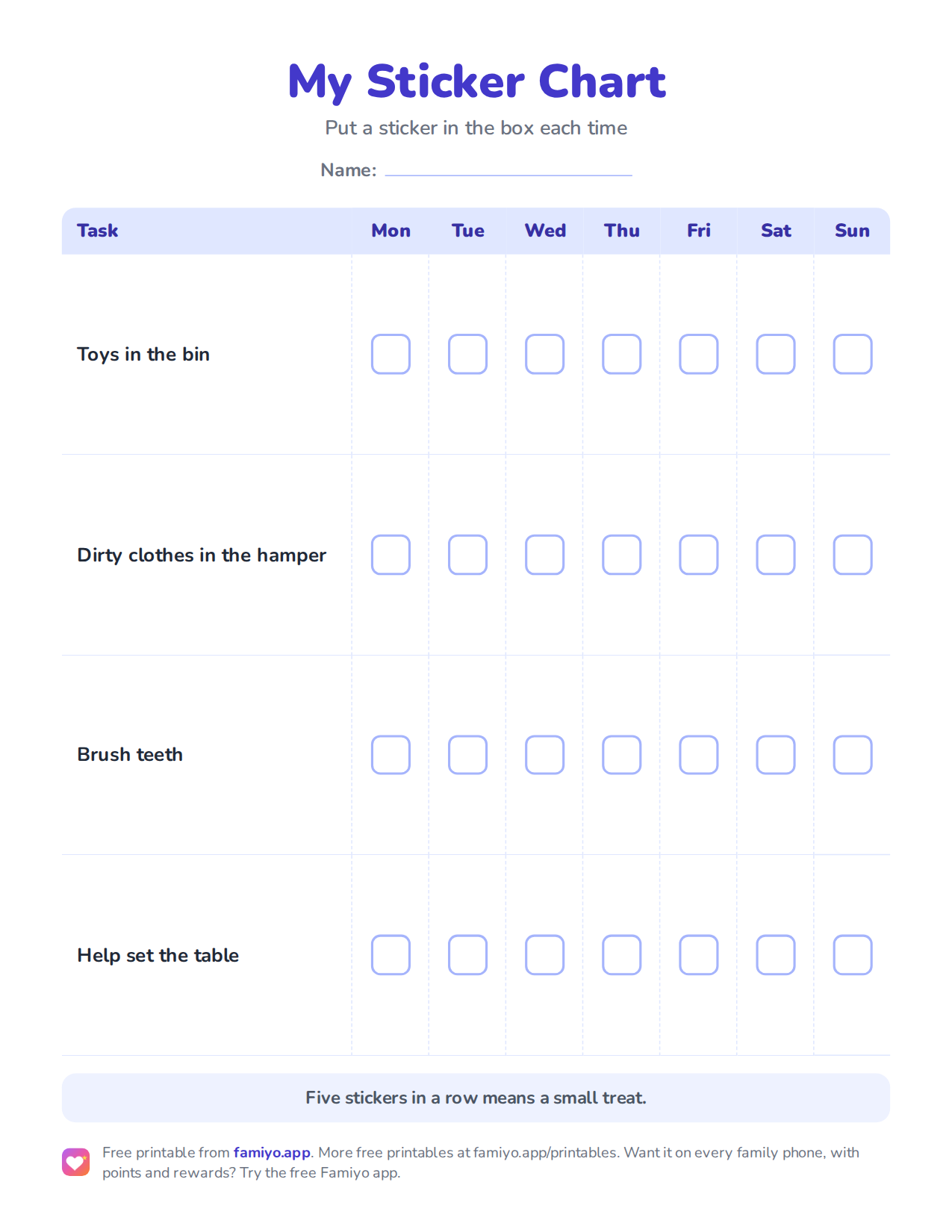
My Sticker Chart
A weekly chart on one US Letter page. Download the PDF to print it, or save the image to use it on a tablet or in a document.
Free for home, classroom and nonprofit use, see the license. More free printables.
Your 2-year-old is excited about a chart on the fridge for exactly three days. Then the stickers sit unused, the chart gets a juice stain, and you wonder if toddlers are too young for this. They aren't, but the chart has to be built for how they actually think. This guide gives you a tiny setup, a sample week and a printable.
Why toddler reward charts are different
An older child can hold a goal in mind for a week. A toddler mostly lives in the next few minutes. So the usual rules for charts get shrunk down.
Rewards have to be quick, ideally a sticker in the same minute the task is done. Goals have to be concrete things the child can see and touch, not "be good" or "be kind." And the chart itself should be a few big squares, not a grid of tiny boxes.
You're also not really teaching earning at this age. You're giving a small, happy ending to a routine step, so that the step becomes familiar.
What goes on a toddler chart
Pick from the chores that suit ages 2 to 3: putting toys in a bin, putting clothes in the hamper, wiping up spills, helping feed a pet. Add routine steps if you like, such as brushing teeth.
Start with one goal. When it's going smoothly, add a second, then a third. Three is the ceiling.
| Goal | How a toddler does it | What counts |
|---|---|---|
| Toys in the bin | Drops toys in a basket after play | Most toys in, any way |
| Clothes in the hamper | Carries dirty socks to the hamper | Item reaches the hamper |
| Wipe the spill | Dabs a spill with a small cloth | Any effort with the cloth |
| Help with the pet | Tips scooped food into the bowl with you | Taking part |
Notice the last column. For toddlers, "counts" means trying. A bin with six toys next to it still earns the sticker, because the habit is the goal.
A five-day plan for the first week
- Day 1: Show the chart. Pick the sticker together. Do the single goal with your child once, with lots of cheering, and add the sticker straight away.
- Day 2 and 3: Same goal, same time. Say the same words each time: "Toys in the bin, then sticker."
- Day 4: Point out the row. "Look, three stickers!"
- Day 5: Reach five, celebrate, give the small prize.
If a day gets missed, just skip it. Don't fill it in later, and don't comment on the empty box.
Rewards that work for a toddler
Keep prizes small and close. A good rule is one prize for a short row of five stickers.
- An extra bedtime story
- Choosing the song in the car
- A bubble bath with extra bubbles
- A trip to the playground
- A turn on the "special" cup or plate at dinner
- Ten minutes of one-on-one play with you
Sweets can drift into being the main motivation fast, and they're hard to dial back. Time with you works better and costs nothing.
If you're also working on potty training, a separate chart makes more sense, and we've covered it in our reward chart for potty training guide.
What to say while you hand out the sticker
Words matter as much as the sticker. Keep them short, specific and warm.
- "You put the toys in the bin. Sticker!"
- "You carried your socks all the way to the hamper."
- "Three stickers. Two more and we pick a bubble bath."
Name the action, not the child. "You did it" beats "good girl" or "good boy," because it tells your toddler what earned the cheer. If they refuse the task, stay neutral: "Okay, maybe next time," and move on. There's no sticker, no lecture and no argument.
When to stop, change or grow the chart
Toddlers get bored. If your child stops caring after two or three weeks, that usually means the habit has taken hold, so you can retire the chart or swap the goal. If they never cared, try a different sticker, a bigger chart or a new goal.
Never take stickers away. And never withhold a bath, a meal or a hug because the chart is empty.
Once your child is around 4 or 5, the chart can grow up. Our chore chart for a 5-year-old shows what the next step looks like, and the printable chore chart for kids page has more layouts.
Doing the chart in Famiyo
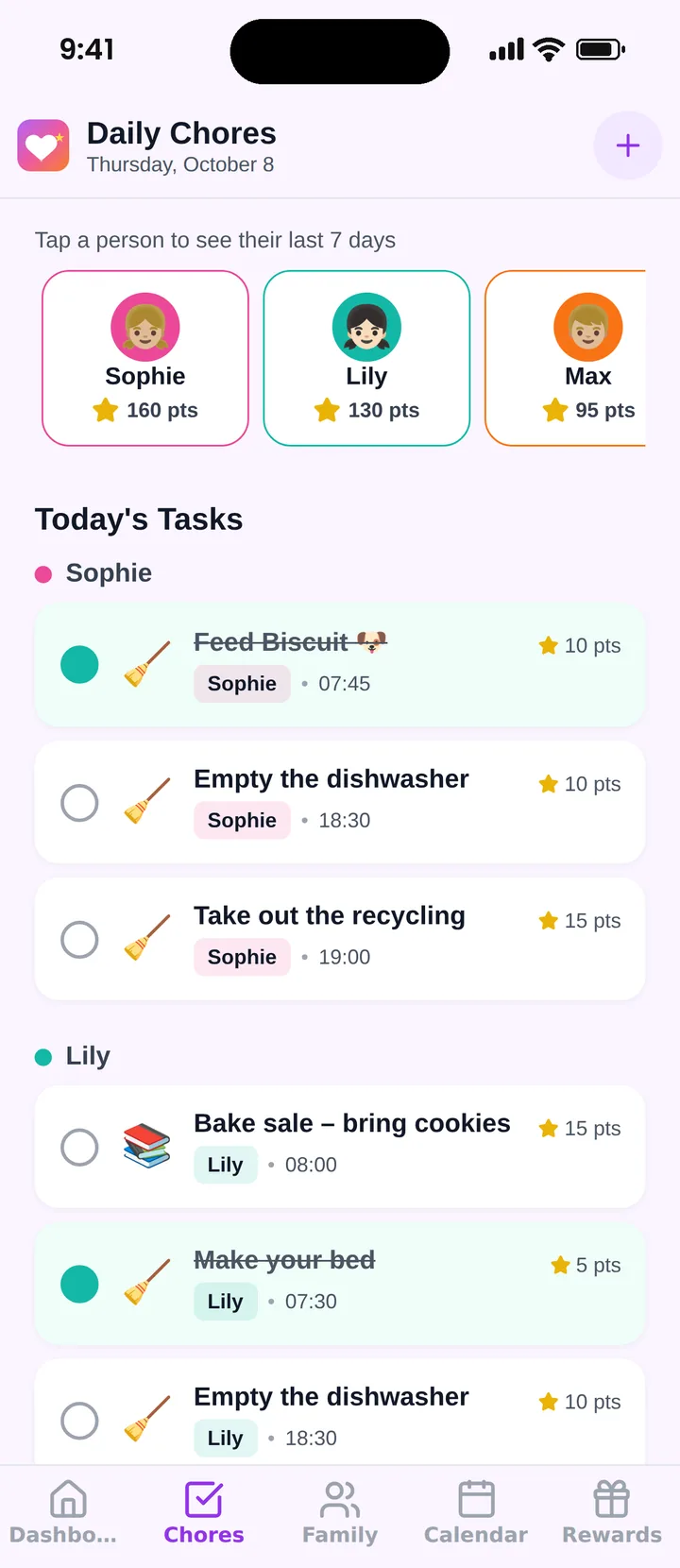
Famiyo is a free family app for iPhone and Android that combines a shared family calendar, chores with points and a rewards shop; kids join with a code, no email needed. For a toddler, you hold the phone. Add the chore, make it repeat daily and give it a few points, then tap it done in the moment, with your child watching the number go up. Notifications remind you at the right time, and if two parents are involved, the phones stay in sync, so nobody gives a second sticker by mistake. When the points reach the price of a small reward you've set, you can hand it over. Our list of the best chore chart apps compares the options.
One thing to try tonight
Choose a single goal, find a sticker your child loves, and give the first one at bedtime tonight.
Frequently asked questions
At what age can a toddler use a reward chart?
Many children respond to a simple sticker chart from around age 2 or 3. Under that, the connection between a task and a reward is hard to hold onto. Start with one goal and give the sticker immediately.
How many goals should a toddler chart have?
Two or three at most. Toddlers can't keep a long list in mind, and a crowded chart means fewer stickers and less feeling of success. Start with one if your child is new to charts, then add a second after a week or two.
What are good rewards for a toddler chart?
Short, small and immediate work best: an extra bedtime story, a bubble bath, choosing the song in the car, or a trip to the playground. Skip sweets as prizes, and avoid big rewards that take weeks to reach.
Should I take stickers away when my toddler misbehaves?
No. Toddlers don't understand removal the way older children do, and it tends to end in tears and a lost interest in the chart. Let the chart show only successes, and handle behavior separately and calmly.
Try Famiyo With Your Family
Chores with points, a rewards shop for kids and one shared family calendar. Set it up in a couple of minutes.



Free to download • No credit card required • Available on iOS & Android