Printable Chore Chart for Kids (Free Weekly PDF)
A free printable chore chart for kids with real chores, points and a weekly grid. Learn how to pick tasks by age, set it up and keep it going past week two.
By Famiyo Editorial Team4 min read
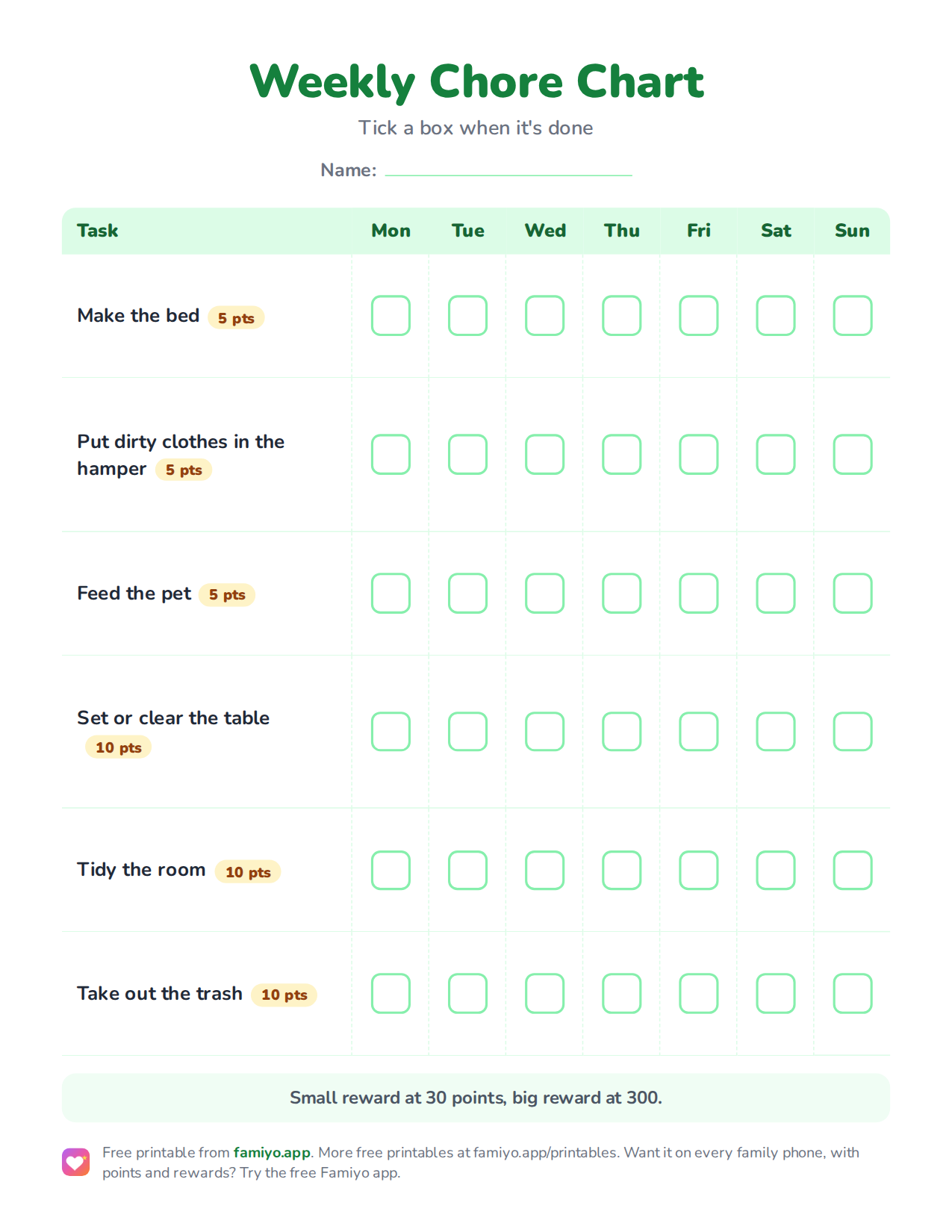
Free printable
Weekly Chore Chart
A weekly chart on one US Letter page. Download the PDF to print it, or save the image to use it on a tablet or in a document.
Free for home, classroom and nonprofit use, see the license. More free printables.
Most printable chore charts end up in the same place: stuck on the fridge for a week, ignored for a week, then recycled. The ones that last are simple, fit the child's age and sit where kids walk by. This page gives you a free weekly chart, a way to choose the chores and a few tweaks for keeping it going.
What goes on a printable chore chart
The layout is the easy part. A column of tasks on the left, the days of the week across the top, and a box for each day. The hard part is picking the tasks, so start from a short list of jobs your child can do without your help.
Use these ages as a starting point:
| Age | Good chart tasks | Time per day |
|---|---|---|
| 4-5 | Make the bed (roughly), clear their own plate, match socks, water plants, feed a pet | 10 to 15 minutes |
| 6-7 | Sort laundry by color, empty unbreakable dishes, sweep, pack the school bag, tidy the room | 15 to 20 minutes |
| 8-9 | Load the dishwasher, fold laundry, vacuum one room, take out the trash | 20 to 30 minutes |
| 10-12 | Clean the bathroom sink, cook a simple meal with an adult, change bed sheets | 30 minutes |
For a longer menu of ideas, see our responsibility chart for kids, or the family chore chart if one sheet should cover everyone.
How many chores to put on it
Fewer than you think. Two or three daily tasks for preschoolers, three to four for school-age kids, and one bigger weekly job from age 8. If you put six items on every day for a 6-year-old, you will see the chart abandoned by midweek.
The printable below has six rows because it covers a full week of different jobs. You can cross out rows you do not need, or write your own in the blank spaces. Some tasks can happen on certain days only, such as trash night on Tuesday.
Setting it up in 15 minutes
- Print the chart. Standard letter paper is fine, and a plastic sleeve lets you reuse it with a dry-erase marker.
- Choose 3 to 5 tasks and write them on the chart with your child. Let them pick the order.
- Add points if you use them: 5 for a small task, 10 for a medium one, 20 for a big one. Put a bonus of +2 for doing it without a reminder.
- Hang it at your child's eye level near where they start their day.
- Show them how to tick a box. Younger kids love a bright marker or a sticker.
- Do the first week together, then let them run it on their own.
If you want a picture-based version for little ones, our free printable chore chart with pictures works better under age 6.
Rewards and points on the chart
A chart without any payoff is a to-do list, which is fine for some kids. For others, points give the boxes a purpose. A simple version: every box earns its points, and the weekly total goes toward a reward.
| Reward size | Examples | Price |
|---|---|---|
| Small | 15 extra minutes of screen time, choose dessert | 30 to 50 points |
| Medium | Pick the family movie, stay up 30 minutes later | 100 points |
| Big | A day out, a toy around $20 | 300 to 500 points |
Aim for a child to afford a small reward every 2 to 3 days and a big one every 3 to 4 weeks. Too many easy rewards and the chart loses its meaning. Too few and the kids give up.
What to do when the chart stops working
Charts often fall apart in week three. Before you change the whole system, check these:
- Too many tasks. Cut back to the three that matter most.
- The chart is out of sight. Move it.
- The tasks are not clear. "Tidy room" is vague, so define it: floor clear, bed made, clothes in the hamper.
- You stopped looking. A 30-second check each evening keeps it alive.
- The child has outgrown it. Time for new tasks or a different format, such as a shared list on a phone.
If the real problem is morale, how to get kids to do chores without yelling goes into what to say.
Using the printable
The chart below suits ages 5 to 12 and has six sample chores with points. Print one per child, ticks go in the boxes and the points total at the bottom. For older teens, a more mature version works better, so see our guide to weekly chores for teenagers.
Replacing the paper chart with Famiyo
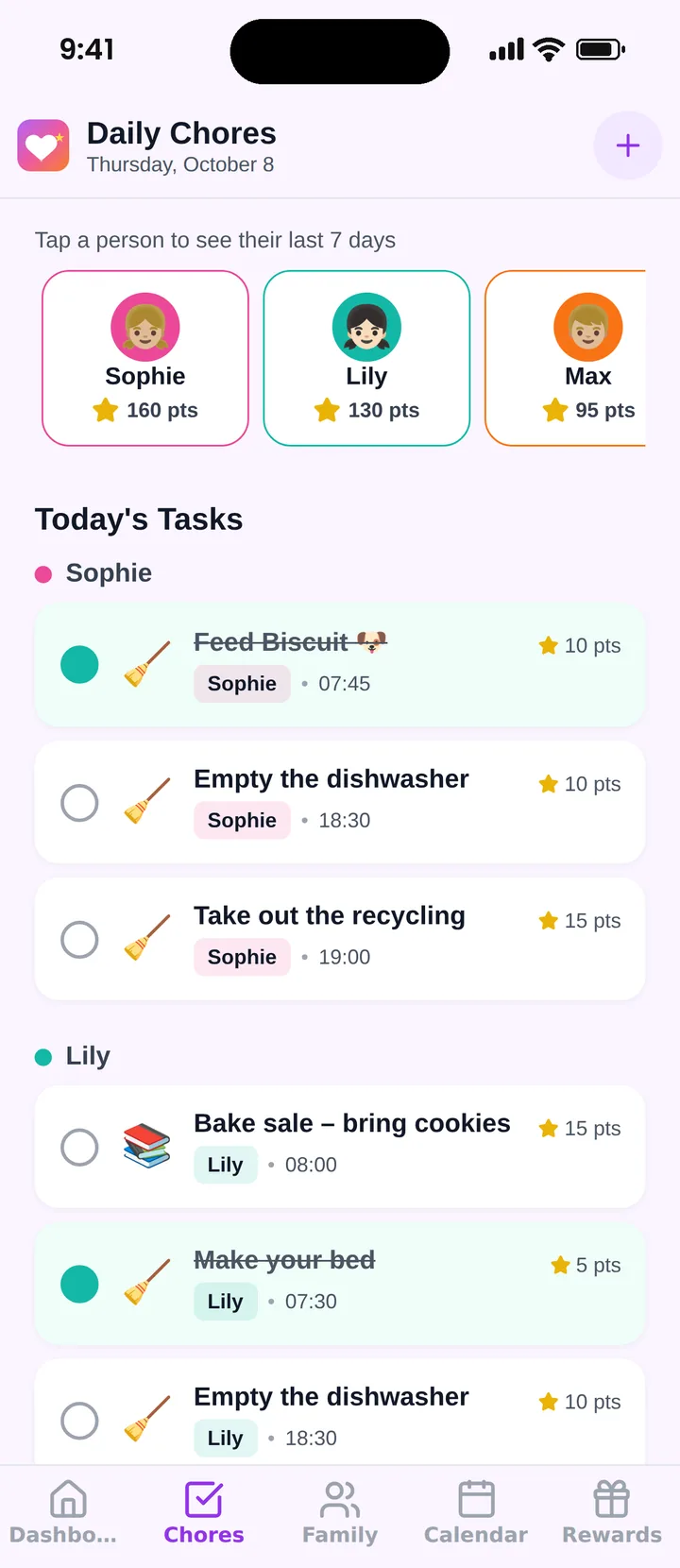
Famiyo is a free family app for iPhone and Android that combines a shared family calendar, chores with points and a rewards shop; kids join with a code, no email needed.
If the paper keeps getting lost, the same chart can live on the phones. You add each chore once, pick who does it and how many points it is worth, and set it to repeat daily or weekly. Kids get a notification about new tasks and check them off themselves, or you approve them. The chart updates on every phone, and the free plan includes one repeating task. For a comparison of tools, see our best chore chart apps.
Print it this weekend
Choose three tasks, print the chart and put it up before Monday. Then leave it alone for two weeks before you change anything.
Frequently asked questions
How many chores should be on a kids' chore chart?
Two or three daily tasks for preschoolers and three to four for school-age kids, plus one bigger weekly job from age 8. Fewer is better to start. A chart with ten rows loses most children by Wednesday, so add tasks only after the first ones stick.
What age is a printable chore chart for?
Most children can use a chart from about age 4, with pictures for younger ones. A weekly grid like the one below suits ages 5 to 12. Teens usually do better with a shared list on their phone than with paper on the wall.
Where should I put a printed chore chart?
Somewhere the child passes several times a day at their eye level: the kitchen, the hallway by the bags, or the back of their bedroom door. A chart in a drawer or on a high fridge shelf stops being used within days.
Should a chore chart include rewards?
It can. A small points total with a reward at a few weeks works for many families, and a sticker or tick is enough for others. Reward the habit of finishing the list, and keep basic chores from turning into negotiations over payment.
Try Famiyo With Your Family
Chores with points, a rewards shop for kids and one shared family calendar. Set it up in a couple of minutes.



Free to download • No credit card required • Available on iOS & Android