Responsibility Chart for Teens: Free Template and Setup
A responsibility chart for teens that treats them like near-adults: what to put on it, a sample week, a free printable and how to set it up without a fight.
By Famiyo Editorial Team4 min read
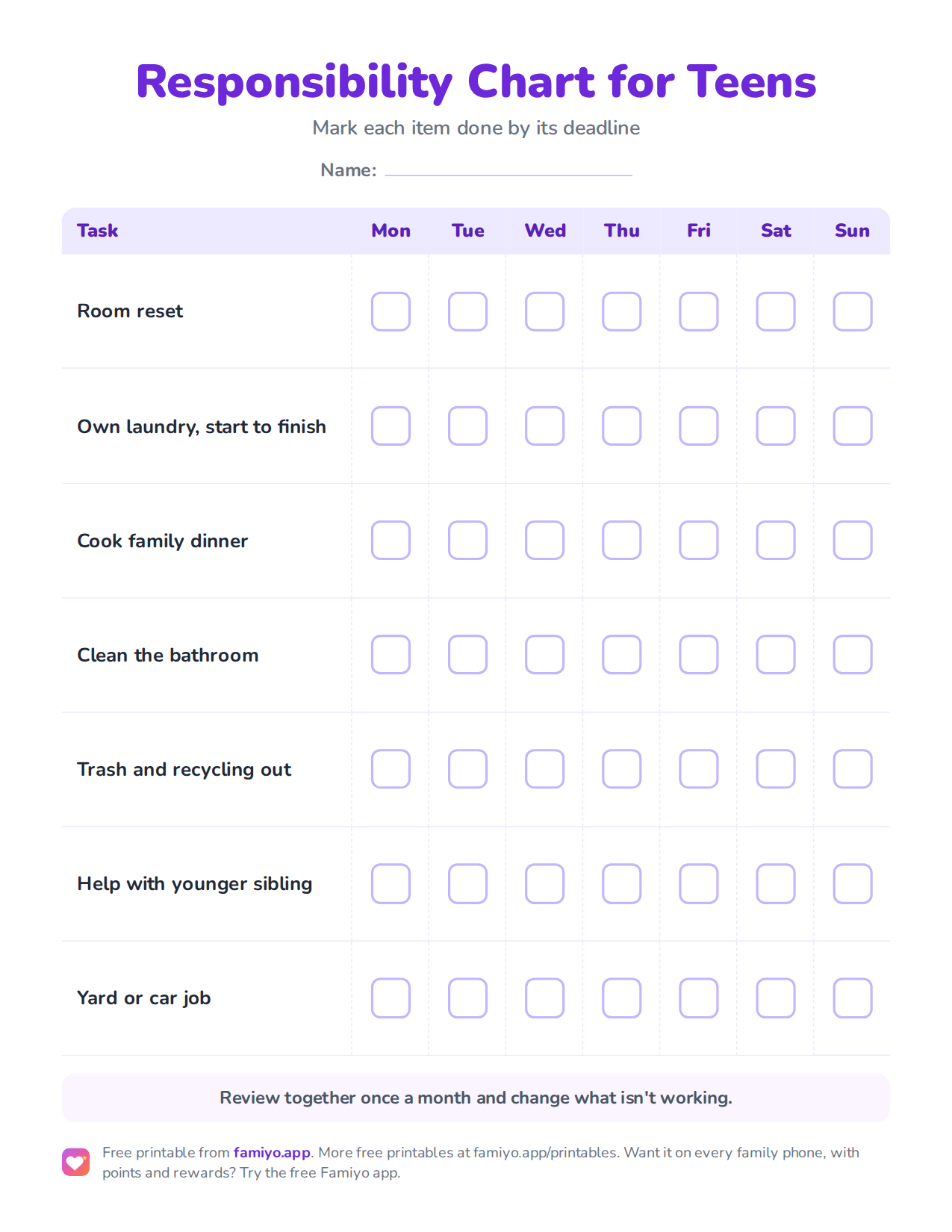
Free printable
Responsibility Chart for Teens
A weekly chart on one US Letter page. Download the PDF to print it, or save the image to use it on a tablet or in a document.
Free for home, classroom and nonprofit use, see the license. More free printables.
A 14-year-old doesn't need a sticker chart, and a chart that looks like one will get ignored by Thursday. What works is something closer to a work agreement: a short list of things they own, a clear deadline for each, and no daily nagging. This page gives you a sample week, the reasoning behind the layout, and a free printable you can adjust at the kitchen table.
What a teen chart needs that a kid chart doesn't
Younger children need frequent, visible wins. Teens need respect and control. That changes the design in four ways.
First, the list is short. Five to eight items for the week, not a daily grid of twelve. Second, each item has a finish line ("laundry done and put away by Sunday 6 pm") instead of "do laundry". Third, the teen helps write it. Fourth, there's a stated consequence that comes from the situation, not from your mood.
Typical time for this age is 30 to 45 minutes a day of household and personal jobs, which fits alongside school, sports and a job if they have one. If the chart adds up to more than that, cut something before you start.
The three kinds of responsibility to include
A good teen chart balances three groups. Mixing them keeps it from becoming a cleaning list.
| Type | What it covers | Examples |
|---|---|---|
| Self-care | Things that are about their own life | Own laundry start to finish, room reset, packing for practice, bedtime set by 10:30 |
| Household | Shared work the family needs done | Cook one family dinner, take out trash and recycling, clean the bathroom, mow the lawn |
| Family contribution | Something that helps other people | Pick up a younger sibling, help a grandparent, a grocery run from a list |
If you need more ideas by age, our guide to chores for 12-year-olds shows the jobs that should already be solid before the teen years, so you're not starting from zero.
A sample week
Here is a chart for a 15-year-old who has school, a sport and about 40 minutes a day for home. Weekly deadlines replace daily check-ins.
| Responsibility | Done by | Time needed |
|---|---|---|
| Room reset (floor clear, bed made, dishes out) | Every Saturday noon | 20 minutes |
| Own laundry, washed, folded and put away | Sunday 6 pm | 15 minutes of work spread over the day |
| Cook dinner for the family | Wednesday, ready at 6:30 | 45 minutes |
| Bathroom clean (sink, toilet, mirror) | Friday | 20 minutes |
| Trash and recycling out | Sunday and Wednesday night | 5 minutes each |
| Help with younger sibling (homework or pickup) | Tuesday and Thursday | 30 minutes |
| Yard or car job | One per month, picked by the teen | 30 to 60 minutes |
Notice there is no "be respectful" or "have a good attitude" line. A responsibility chart works when every item can be checked as done or not done.
How to set it up in one conversation
- Pick a calm moment, not right after an argument. Say what you want it for: "I'd like us to agree on what you own at home so I can stop reminding you."
- Hand them the blank printable and let them list what they already do without being asked.
- Add your must-haves from the three groups above. Keep the total under eight.
- Let them choose deadlines, within reason. If they pick Sunday for laundry and it works, great.
- Agree on what happens when something is missed. Good consequences are direct: the laundry isn't done, so no clean uniform; the dinner night was skipped, so the next day they cook and clean up.
- Decide on privileges. Many families tie phone or gaming time to a week with no missed items, not to each individual task.
- Set a review date four weeks out and put it on the calendar.
The first two weeks are always wobbly. Judge the chart after three weeks of steady use, not after the first missed Saturday.
What to say when a responsibility gets missed
Skip the lecture. A short script works better than a long one: "The bathroom wasn't done by Friday. When can you do it today?" Then stop talking. If the same item is missed three weeks in a row, treat it as a design problem and ask what's in the way: too much on Fridays, a deadline that clashes with practice, or a job they find unclear.
Our responsibility chart for kids covers the younger version if you have a mix of ages, and the job chart for kids works well for a rotating family-wide setup.
The printable
The printable below has a weekly grid with seven of the items above, ready to print and adjust. It suits teens aged 13 to 17. Cross out or rewrite any line that doesn't fit your family, and give the teen a pen to add their own.
Replacing paper with an app
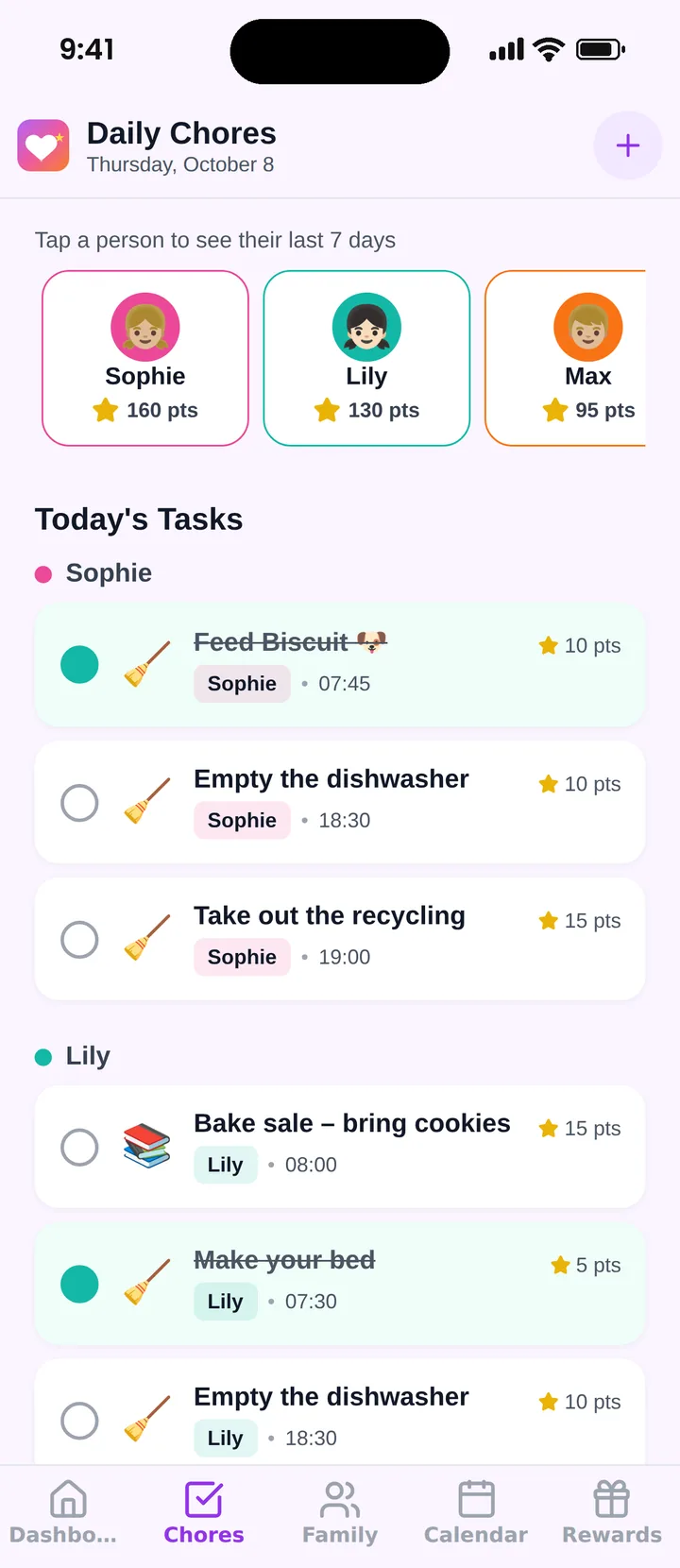
Paper charts tend to vanish under a pile of school forms. Famiyo is a free family app for iPhone and Android that combines a shared family calendar, chores with points and a rewards shop; kids join with a code, no email needed. For a teen, that means the chart lives on their own phone: they see their tasks for today, check them off themselves (or you approve them, your choice) and get a push notification when something new is assigned. You hear when a chore is done, and every phone stays in sync. You can repeat a chore on a schedule, and the free plan includes one repeating task.
If you're comparing options, see our list of the best chore chart apps.
Review it monthly
Once a month, spend ten minutes with the chart. Remove what's now automatic, add one new responsibility, and talk about whether the deadlines still fit their schedule. A teen who has handled the chart well for three months can take over more of the planning themselves.
Frequently asked questions
What should be on a responsibility chart for a teenager?
Mix three types: personal care (room, own laundry, sleep and homework routine), household jobs (a dinner night, trash, bathroom) and one family contribution such as helping a younger sibling or yard work. Five to eight items is plenty. Teens need a short list they can actually keep up with.
Should a teen get rewards for meeting responsibilities?
Basic responsibilities like their room and laundry are part of living in the family and usually stay unpaid. Many parents attach privileges, such as phone time or a later curfew, to a week of finished items, and pay separately for bigger extra jobs. Agree on this before you start, not mid-argument.
How do I get my teenager to actually use the chart?
Build it with them. Let them pick which jobs they own, choose the deadlines and suggest what happens if one is missed. Teens resist lists handed down from above but usually keep agreements they helped write. Review it for ten minutes once a month and change whatever isn't working.
How is a chart for teens different from one for younger kids?
It has fewer items, fewer reminders and more ownership. Instead of daily stickers, a teen gets a weekly deadline and checks in themselves. Jobs are bigger and more complete (do the laundry start to finish) and the consequences are natural, like no clean jersey if the wash wasn't done.
Try Famiyo With Your Family
Chores with points, a rewards shop for kids and one shared family calendar. Set it up in a couple of minutes.



Free to download • No credit card required • Available on iOS & Android