A Weekly Family Planning System in 15 Minutes
A weekly family planning system you can run in 15 minutes: a Sunday meeting agenda, a two-minute daily glance and a Friday reset that keeps the week on track.
By Famiyo Editorial TeamUpdated 4 min read
Plenty of families plan nothing, then spend the week reacting. Others try an elaborate Sunday ritual with color-coded binders and give up by the third week. This system sits in between. It takes about 15 minutes once a week, adds two tiny daily habits, and gets its value from asking the same few questions every time. You can run it with a paper calendar or an app, with a partner or alone.
What does a weekly family planning system include?
Three layers, each short:
- Plan (15 minutes, once a week): look ahead, decide, assign.
- Glance (2 minutes, each morning): check today, fix what changed.
- Reset (5 minutes, end of week): clear the decks and note what broke.
Most plans fail because they only have the first layer. The glance is what keeps Monday's plan alive on Thursday, and the reset gives you a clean start. Together they take under 40 minutes a week.
The 15-minute planning session, step by step
Pick a regular time. Sunday after dinner is common. Sit with your partner (and the calendar open), and then bring kids in for the last few minutes.
| Minutes | What to do | Question to ask |
|---|---|---|
| 0-3 | Read the next seven days on the calendar, out loud | What is already booked? |
| 3-6 | Mark the one or two heavy days | Which days are tight? |
| 6-9 | Assign drivers, pickups and who is home | Who is where, and when? |
| 9-11 | Pick dinners for the heavy days, note anything to buy | What is easy that night? |
| 11-13 | List what must be packed, signed or returned | What will we forget? |
| 13-15 | Kids join: tell them the week, ask what they need | What is the best part of the week? |
Don't try to plan every meal or every hour. The point is to find the pressure points while you can still do something about them.
Find the heavy days first
Every week has one or two days that will go badly if nothing is done. Look for a day with three or more commitments, a day when both parents work late, or one where a child has an early start and a late finish. Name them out loud: "Tuesday and Thursday are the hard ones."
Then do something small for each. Move dinner to the slow cooker or pick a freezer meal. Ask a carpool family. Get the bags packed the night before. For meal ideas that fit the busy nights, see our simple family meal planning system, and the weekly planner for families gives you a printable grid for the week if you like to write things down.
What the plan can look like
Say you have two kids, 6 and 11, and both parents work. After the session, your plan for the week might fit on a sticky note:
- Monday: free evening, laundry night.
- Tuesday (heavy): swim at 4:30, piano at 5:00. Mom drives swim, the Parks take the 11-year-old to piano. Slow cooker dinner.
- Wednesday: school project due Thursday, 20 minutes after dinner.
- Thursday (heavy): soccer at 5:30, Dad's work dinner. Mom covers soccer. Freezer meal for the kids.
- Friday: pizza and a movie, picked by the 6-year-old.
- Weekend: Saturday game at 9:00, birthday party at 1:00. Buy a gift Friday.
That is six lines, and it answers most of the questions you would otherwise be asked at 4:15 on Tuesday.
Assign every driving and pickup slot
An unassigned pickup is the most common reason a plan breaks. Walk through each child and each day. Say a name for every slot. If the answer is "I don't know yet," write it down as the thing to settle on Monday morning, not as something that will somehow resolve itself. Put the answer in the calendar event, so no one has to remember a conversation.
Add a two-minute daily glance
Each morning, look at today only. Which events moved? Is anyone out late? Anything to bring? That takes two minutes and prevents most surprises. If something has changed, tell the person involved right then. This is also a good moment to look at color: if the calendar uses one per person, you can see in a second whose day is heavy. Our guide to color-coding a family calendar explains a scheme that holds up.
End the week with a five-minute reset
Friday evening or Sunday morning, before the next plan. Clear the counters, empty the backpacks, put forms where they belong. Then ask two questions: what went wrong this week, and what one change would prevent it? Write the answer on the calendar for next week. The week that goes wrong in the same way three times needs a different system, not more effort. For a longer reset, our Sunday planning for the week covers the house as well.
Where the plan lives: Famiyo
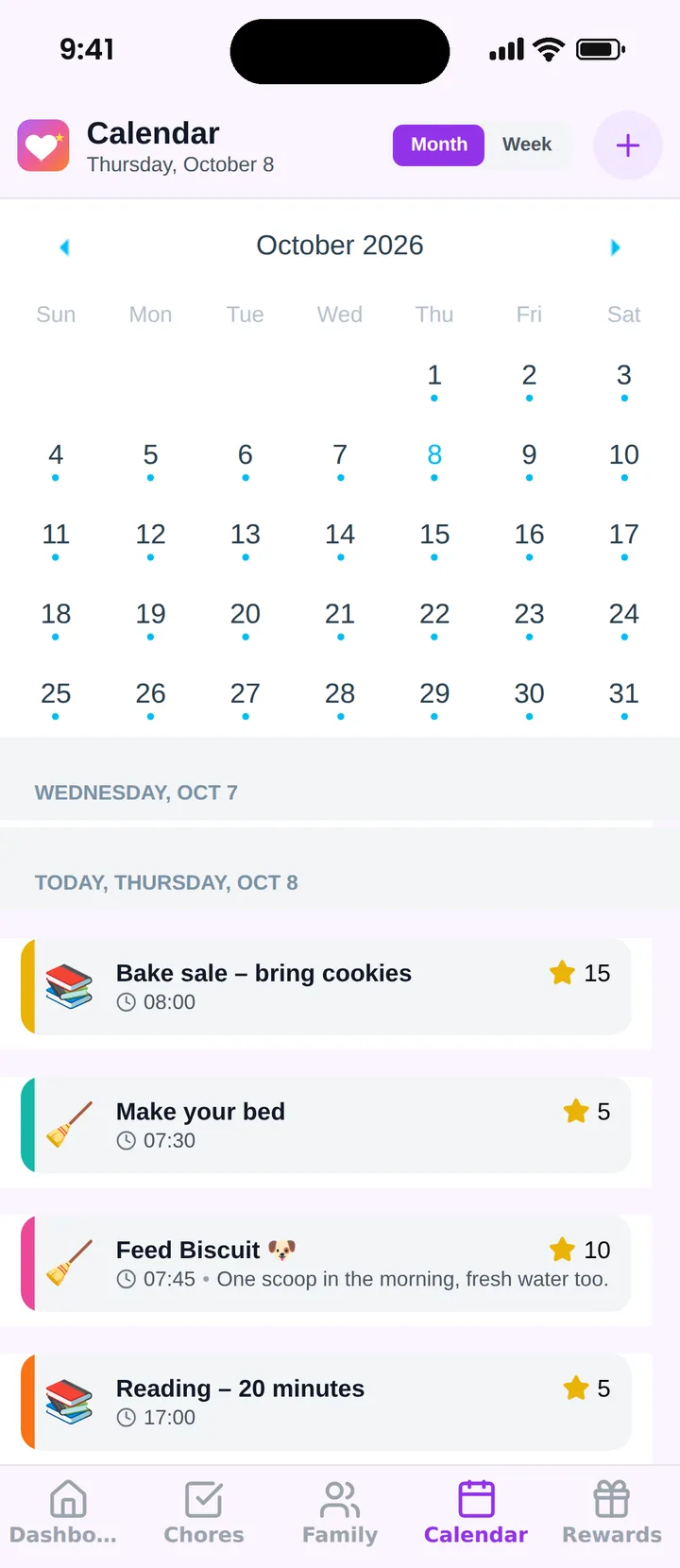
Famiyo is a free family app for iPhone and Android that combines a shared family calendar, chores with points and a rewards shop; kids join with a code, no email needed. For weekly planning, the month and week views show the heavy days at a glance, each person has a color, and repeating events cover the fixed parts of the week. Chores can sit on the same calendar, with points for the kids. Both parents can edit, and changes sync live. Our list of the best family calendar apps compares the options.
Start with one session
Don't build the whole system at once. Run the 15-minute session this Sunday, skip the other two layers, and add the morning glance next week. By the third week you will know how much planning your family needs.
Frequently asked questions
How long should a weekly family planning session take?
Fifteen minutes is enough for most families, and ten works once you have a rhythm. Longer meetings get skipped. If you regularly need more, move some of the work to a short daily check or a separate Friday reset.
What day is best for weekly family planning?
Sunday afternoon or evening works for most families because the week is about to start, but Friday or Saturday morning work too. Pick a time that is already calm, such as after dinner, and keep it the same each week so it becomes automatic.
Should kids be part of the weekly planning?
Yes, for the last few minutes. Children from about 5 can hear what is happening each day and pick one thing to look forward to. Older kids can add their own events and say which day looks hard. Parents do the logistics beforehand.
What if our plan falls apart by Tuesday?
That is normal. Treat the plan as a first draft. Spend two minutes each morning adjusting, and use the Friday reset to note what broke. If the same thing breaks three weeks in a row, change the system, not the people.
What should be in a weekly family plan?
The calendar for the next seven days, who drives, what is for dinner on the busy nights, anything to buy or pack, and one task or goal each person owns. Skip long to-do lists. A plan you can read in one minute is the one you will use.
Try Famiyo With Your Family
Chores with points, a rewards shop for kids and one shared family calendar. Set it up in a couple of minutes.



Free to download • No credit card required • Available on iOS & Android