Why Families Need a Shared Calendar (And What Changes)
Why families need a shared calendar: fewer missed pickups, no more 'I didn't know', a lighter mental load and kids who check their own schedule.
By Famiyo Editorial TeamUpdated 4 min read
Ask a family without a shared calendar how their week works and you will usually hear a version of "I think Dad has it." Ask one with a calendar, and they will open a phone. The difference is not technology for its own sake. It is whether the plan lives in one place everyone can read, or in five people's heads. Here are the questions parents ask most about why that matters.
What problem does a shared family calendar solve?
The core problem is that family schedules have grown. Two working adults, two or three children with school, sports and lessons, extended family, medical visits, social plans: that is dozens of dated commitments a month, spread across emails, texts, flyers and conversations. No person remembers all of it reliably.
A shared calendar turns scattered information into one visible plan. Everyone who needs a date can find it without asking, and changes appear for everyone at the same time. It is a small thing that removes a large number of small friction points: "What time is it again?" "Did you tell me that?" "Who is picking up?"
Why does it stop the "I didn't know" argument?
Because the information is either on the calendar or it isn't. When a plan is entered, both parents have the same facts. When it isn't, there is no ambiguity about whose job it was to enter it, and you can agree on a simple rule going forward: if it is not on the calendar, it is not committed.
This changes the tone of conversations. "You never told me" becomes "I put it in on Tuesday." Disagreements about the schedule shrink to disagreements about priorities, which are much easier to have.
How does it help with the mental load?
The mental load is the work of remembering, anticipating and coordinating, and in many households one parent carries most of it. A shared calendar doesn't remove the work, but it makes the work visible, which is the first step toward sharing it.
When the dentist appointment is on the calendar, the other adult can see it and take it. When both parents can edit, either can add the pickup swap. The remembering shifts from "ask me" to "look". Our guide to household management for busy families goes further into dividing the rest.
What do kids get out of it?
Independence, mostly. A child who can see their own color learns when practice is, what to pack and which days are busy. Younger children can look at the week with you on Sunday, and by 8 or 9 they can check it themselves. That means fewer reminders from you and fewer "I forgot" moments from them.
Teenagers are a separate case. They tend to resist anything that looks like surveillance, and the calendar works better when it is theirs to use as well as yours to read. Our piece on getting teens to use the shared calendar covers that.
Is a digital calendar better than a wall calendar?
Not better, different. A wall calendar is good at one thing: being seen by everyone at home. It can't tell you what changed at noon or what is on tonight while you are at the grocery store. A digital calendar does both, though it is only visible when someone opens it.
| Need | Wall calendar | Shared digital calendar |
|---|---|---|
| Seen at a glance at home | Yes | Only if on a screen |
| Updated from anywhere | No | Yes |
| Changes reach everyone | Only at home | Yes, on every phone |
| Repeating events | Copy by hand | Set once |
| Works for older kids and partners away | Poorly | Well |
Plenty of families keep both, with the digital calendar as the source of truth and a printed week on the fridge. Our comparison of a digital and a wall family calendar walks through the choice.
What can go wrong?
A shared calendar fails when it is only half used. If one parent enters things and the other doesn't look, or events go in with no details, people lose trust and go back to asking. Fix that with a few shared habits: enter things when you learn about them, put the time, place and who is driving in the event, and look at it before saying yes to plans. Our short guide to shared calendar etiquette lists the rules that families find most useful.
How Famiyo works as a shared family calendar
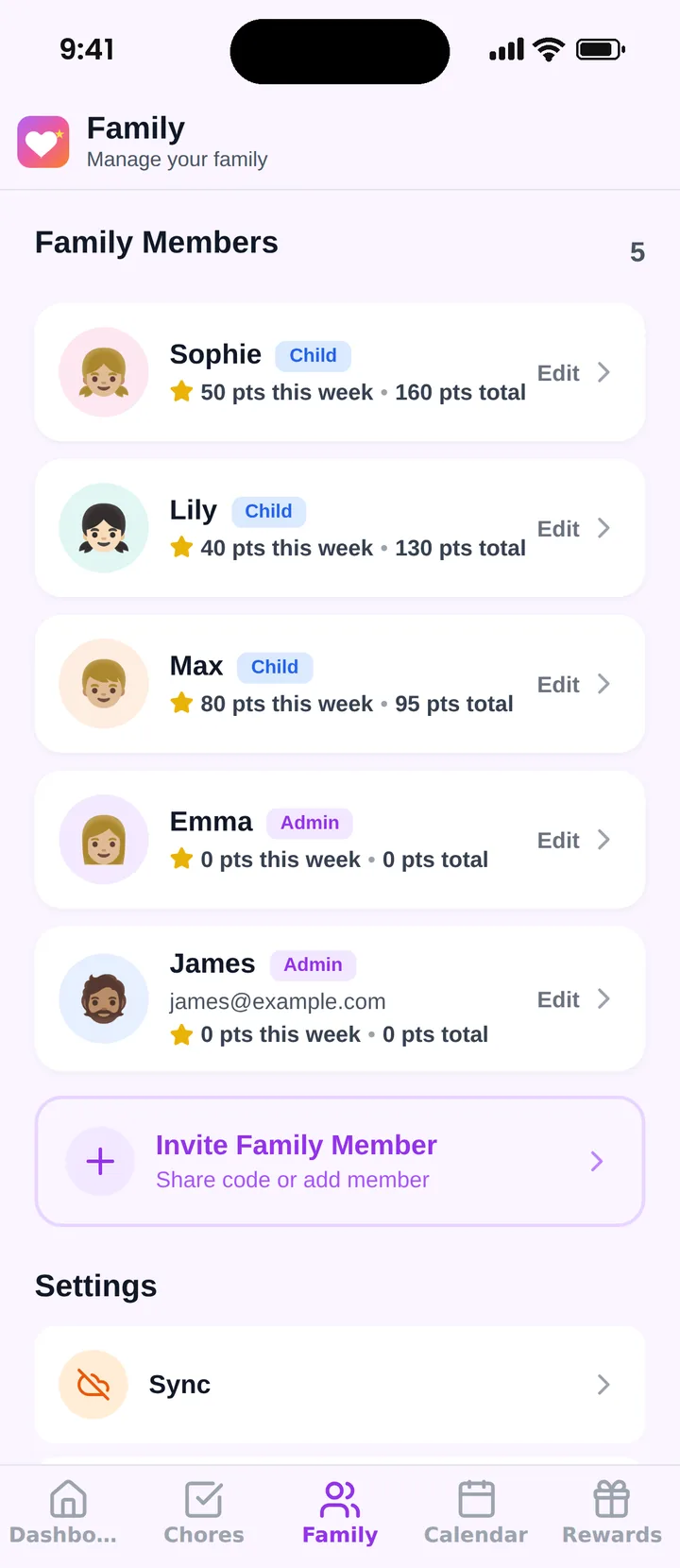
Famiyo is a free family app for iPhone and Android that combines a shared family calendar, chores with points and a rewards shop; kids join with a code, no email needed. Every family member has a color, and events can include several participants, so each person sees what concerns them. Both parents can be administrators, and kids see their own events on their own phones. The free plan covers up to 3 family members. For a wider comparison, see our list of the best shared family calendar apps.
Start by putting next week on the calendar tonight, and ask everyone who lives with you to look at it once tomorrow.
Frequently asked questions
Do we really need a shared calendar if we only have one or two kids?
Probably yes, once both parents work or the kids have regular activities. A shared calendar pays off when more than one adult is making plans. With one child and no activities you can manage without, but the habit helps before things get busy.
Is a shared calendar better than a paper wall calendar?
They do different jobs. A wall calendar is easy to see at home but can't update when you're out. A shared digital calendar goes with you and syncs across phones. Many families use both, with the digital one as the source of truth.
How does a shared calendar reduce mental load?
It moves the remembering out of one person's head into a place everyone can read. Another adult can see the dentist appointment and act on it without being asked. The planning still takes effort, but the carrying is shared.
At what age should kids see the family calendar?
Young children can look at it with you in a weekly check-in. From about 8 or 9 they can check their own color and pack their gear. Teenagers should have their own access and add their own events.
What are the downsides of a shared family calendar?
It only works if people enter events and look at it. A calendar that is half full is worse than none, because nobody can trust it. It also surfaces how busy you are, which can be uncomfortable but useful.
Try Famiyo With Your Family
Chores with points, a rewards shop for kids and one shared family calendar. Set it up in a couple of minutes.



Free to download • No credit card required • Available on iOS & Android