What to Put on a Chore Chart: Tasks, Columns and Rewards
What belongs on a chore chart: the parts every chart needs, tasks by age, how many to list, what to leave off and a sample week you can copy tonight.
By Famiyo Editorial Team6 min read
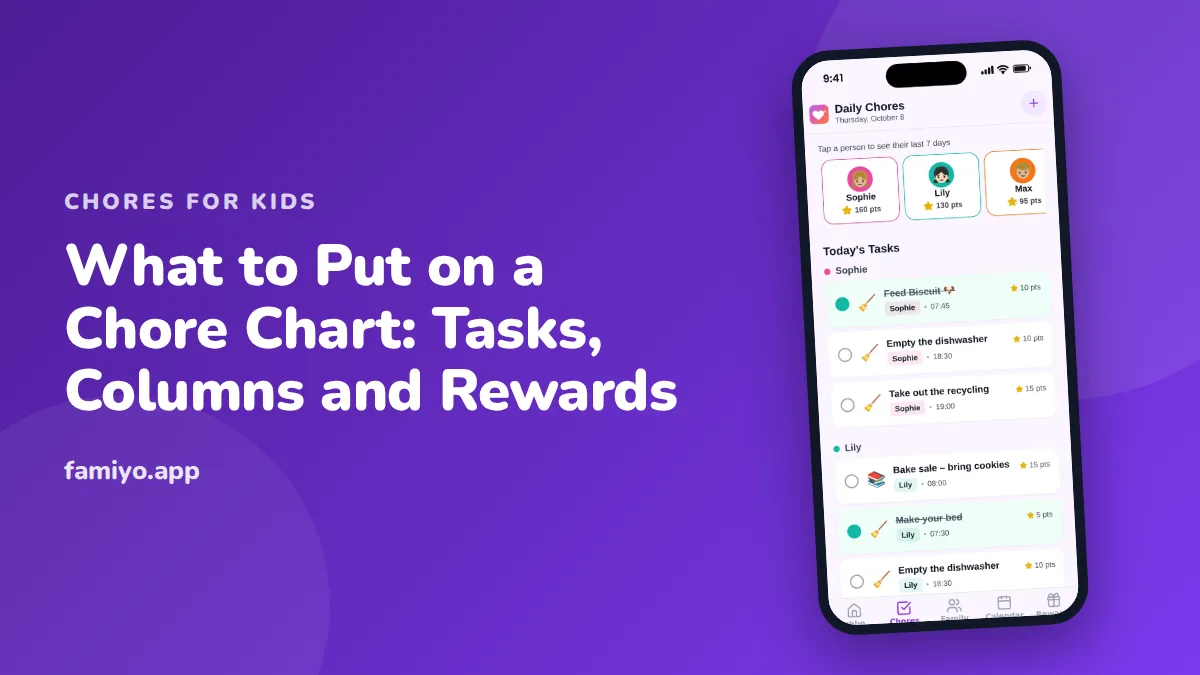
Most chore charts fail before the first sticker, and the reason is usually on the chart itself. The tasks are vague, there are too many of them, or nobody can tell what counts as done. This guide goes through what to put on a chart, what to leave off, and how it should look once it is filled in, with a sample week at the end.
The five parts every chore chart needs
Strip away the cartoon borders and a chart is five pieces of information. If one is missing, the chart gets ignored by about day four.
- Who. The child's name, or a color or picture they recognize. One person, one row.
- What. A short list of specific tasks. "Feed Biscuit" is a task. "Help out" is not.
- When. Which days, and ideally which moment: after breakfast, before dinner, Saturday morning.
- Done. A box to check, a sticker, a toggle. Something the child does themselves, and that you can see.
- Payoff. Points, stars or a streak that lead to something the child wants.
Everything else is decoration. A chart with only those five parts, written in a size a child can read, beats a beautifully designed one with fifteen tasks.
Which chores to put on it, by age
Choose from what a child can really do alone or with light help. The ranges below follow the usual pattern of 10 to 15 minutes a day for ages 4 to 5, 15 to 20 for ages 6 to 7, 20 to 30 for ages 8 to 9, and 30 minutes or more from 10 up.
| Age | Good chart items | Daily tasks to list |
|---|---|---|
| 2 to 3 | Toys in the bin, dirty clothes in the hamper, wipe a spill, help feed the pet | 1 to 2 |
| 4 to 5 | Make the bed (roughly), set and clear their own place, match socks, water plants, feed a pet | 2 to 3 |
| 6 to 7 | Sort laundry by color, empty unbreakable dishes, sweep, pack the school bag, tidy their room | 3 to 4 |
| 8 to 9 | Load the dishwasher, fold and put away laundry, vacuum one room, simple snack, take out trash | 3 to 4 daily, 1 weekly big job |
| 10 to 12 | Clean the bathroom sink and toilet, cook a simple meal with an adult nearby, change bed sheets | 3 to 4 daily, 1 to 2 weekly big jobs |
| 13 and up | Own laundry start to finish, cook a family meal, shop from a list, mow the lawn | Daily basics plus ownership of a few jobs |
If you want a more detailed list for one age, our chores for 4-year-olds page gives 18 jobs with minutes and points.
Writing each task so a child can follow it
The wording on the chart matters more than the layout. Three habits make every task clearer.
Start with a verb and name the object. "Put dirty clothes in the hamper." "Clear your plate to the counter." "Fill the dog bowl."
Say what done looks like. For tasks with a fuzzy edge, add three or four words: "Tidy room: floor clear, toys in bins." If a child cannot tell when they are finished, they will stop when they get bored.
Keep it under about six words where you can. Young children need pictures as well. A small drawing or photo next to each task lets a 4-year-old run the chart without reading.
How many tasks is too many
Fewer than you think. The pattern most families settle on is 2 to 3 daily tasks for a preschooler, 3 to 4 for a school-age child, and one weekly "big" job from age 8. A seven-day chart with ten boxes in each row is not a chore chart, it is a second job.
A useful test: could your child finish everything on today's column before dinner without help from you? If not, cut one.
When a chart is working, add one thing at a time and wait two to three weeks before the next, which is long enough for a new routine to settle.
What to leave off
Some items look right on paper and cause trouble in real life.
- Tasks you will redo. If you plan to remake the bed after school, take it off. Kids notice.
- Anything under a minute that happens anyway. Putting a coat on a hook is a habit, not a chart item, unless you are really working on it.
- Vague character goals. "Be kind" and "listen well" belong on a behavior chart, not here. Our guide to a sticker chart for kids explains where that kind of tracking fits.
- Things that need an adult's full attention. Stoves, sharp knives, chemicals.
- Both too-easy and too-hard items. A job a child finds boring or one that defeats them will empty the chart within a week.
Daily, weekly and rotating jobs
Sort the tasks into three types so the chart does not overflow.
Daily. Things that happen every day and take a few minutes: bed, dirty clothes, clearing a plate, pet food.
Weekly. Bigger jobs that happen once: vacuum a room, change sheets, clean a bathroom sink, wash the car. These get a fixed day.
Rotating. Jobs that move between children, such as taking out the trash or setting the table. Our guide to a chore wheel generator covers fair ways to rotate them.
Put daily jobs in a fixed order tied to the day's rhythm. Weekly jobs go on one day only, so the chart does not look crowded every day.
A sample week for two kids
Here is what a filled-in chart can look like. Maya is 5 and Theo is 8. Points are in brackets, using 5 for a small job, 10 for a medium one and 20 for a big one.
| Task | Mon | Tue | Wed | Thu | Fri | Sat | Sun |
|---|---|---|---|---|---|---|---|
| Maya: make the bed (5) | x | x | x | x | x | x | x |
| Maya: clear her plate (5) | x | x | x | x | x | x | x |
| Maya: feed the cat (5) | x | x | x | x | x | x | x |
| Theo: make the bed (5) | x | x | x | x | x | x | x |
| Theo: set the table (5) | x | x | x | x | x | - | - |
| Theo: pack the school bag (5) | x | x | x | x | - | - | x |
| Theo: empty the dishwasher (10) | - | x | - | x | - | x | - |
| Theo: vacuum his room (20) | - | - | - | - | - | x | - |
Maya can earn up to 105 points in a week, enough for one medium reward and a few small ones. Theo has a bit more. Add +2 for any job done without a reminder if you want to reward independence.
Making the chart work after week two
A good chart is checked by the child, seen by the whole family and tied to something that happens every day. If you use a paper one, hang it where kids pass it, at their eye level, and keep a pen on a string. The how-to pages cover layout in detail, starting with how to make a chore chart in six steps.
Skipping the paper
Famiyo is a free family app for iPhone and Android that combines a shared family calendar, chores with points and a rewards shop; kids join with a code, no email needed. It replaces the paper chart: you add each chore once, choose who does it, set it to repeat and give it points. Each child sees their own list on their own phone and checks it off, or you approve it.
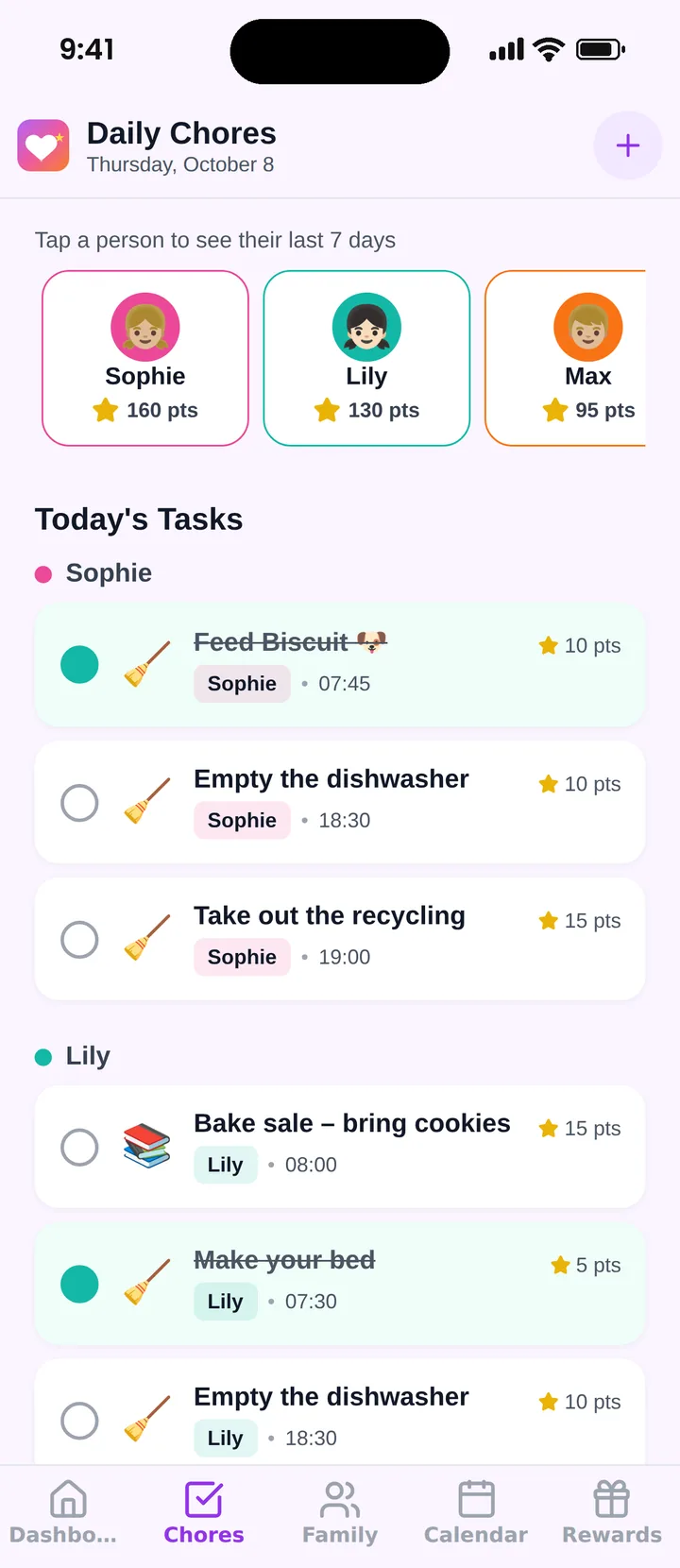
Kids get a notification about a new task, you get one when it is done, and every phone updates live. The free plan covers up to 3 family members and 1 repeating task. If you are comparing options, see our list of the best chore chart apps.
Start with three lines
Write three tasks for one child, with a name, a day and a box. Run it for two weeks before you change anything.
Frequently asked questions
How many chores should go on a chore chart?
Two to three daily tasks for preschoolers, three to four for school-age kids, plus one bigger weekly job from about age 8. More than that and the chart turns into a list nobody finishes. Add one task at a time once the current ones are routine.
Should a chore chart include things like brushing teeth?
For young kids learning a routine, yes, it can help for a few weeks. Once it is automatic, take it off so the chart stays short. Many families keep hygiene on a separate morning and bedtime checklist and use the chore chart for household jobs.
Should I put points or rewards on a chore chart?
A payoff helps, especially for younger kids. Points are simple: 5 for a small job, 10 for a medium one, 20 for a big one, spent on rewards the child chooses. Keep the reward small and quick so the link between job and prize is clear.
Do I need a separate chart for each child?
One shared chart is fine if each child has their own row or color. Separate charts make sense when the children are far apart in age, because the tasks and rewards differ. Either way, each child should see only their own list clearly.
Try Famiyo With Your Family
Chores with points, a rewards shop for kids and one shared family calendar. Set it up in a couple of minutes.



Free to download • No credit card required • Available on iOS & Android