Allowance for Teenagers: How Much, How Often and What It Should Cover
Allowance for teenagers explained: typical weekly amounts by age, weekly vs monthly payouts, what a teen allowance should cover and rules for digital spending.
By Famiyo Editorial Team6 min read
Somewhere around 13, money questions change. They stop being about candy at the checkout and start being about food with friends, game currency, a streaming account "everyone else has" and a hoodie that costs more than you think a hoodie should. This guide covers how much allowance teenagers typically get, how often to pay it, what it should cover at each stage, and how to set rules that still work when most of the spending happens on a phone.
How much allowance should a teenager get?
The common rule of thumb is $1 a week for each year of age, so a 15-year-old gets $15 a week. It's a starting point, not a standard. Typical weekly ranges look like this:
| Age | Typical weekly allowance | $1 per year rule | Roughly per month |
|---|---|---|---|
| 13 | $10 to $15 | $13 | $43 to $65 |
| 14 | $15 to $25 | $14 | $65 to $108 |
| 15 | $15 to $25 | $15 | $65 to $108 |
| 16 | $15 to $25 | $16 | $65 to $108 |
| 17 | $15 to $25 | $17 | $65 to $108 |
(Monthly figures are weekly amounts times 52, divided by 12, rounded.)
Notice that the range barely moves after 14. What should change with age is what the money covers. A 14-year-old on $15 a week who only buys snacks and games is in a very different spot from a 17-year-old on $25 a week who also pays for gas and some clothes.
Three things should set your number: what the allowance is expected to cover, what things actually cost where you live, and what your family budget can handle every week without resentment. If you're starting from scratch with younger kids too, our breakdown of how much allowance by age covers ages 5 and up.
Weekly, every two weeks or monthly?
For 13- and 14-year-olds, weekly works best. A month is a long stretch to make money last when you're just learning, and running out on day 9 mostly teaches a teen that the next three weeks are boring.
From about 15, switching to every two weeks or monthly is worth it. It looks more like a paycheck, and it forces planning: if the concert is on the 25th, the money has to survive until then. Tell your teen about the switch a few weeks ahead and do it at the start of a month.
Whatever the schedule, pay on the same day every time and automate it if you can. A scheduled transfer from your bank to their account never forgets, never needs reminding and removes the "can I have my allowance?" conversation entirely. Many banks offer accounts for teens with a debit card a parent can see. If yours does, it's a practical way to practice with real digital money while you can still see what's happening.
What should a teenager's allowance cover?
Write this down and agree on it together. Most allowance fights are really about unclear coverage. Here's a common way to hand over costs gradually:
| Expense | 13 to 14 | 15 to 16 | 17 |
|---|---|---|---|
| Snacks, food out with friends | Teen pays | Teen pays | Teen pays |
| Games, in-app purchases, game currency | Teen pays | Teen pays | Teen pays |
| Movies, events, hobby extras | Parent and teen split | Teen pays | Teen pays |
| Gifts for friends | Parent pays | Teen pays | Teen pays |
| Music or video subscriptions | Parent pays | Teen pays their own extras | Teen pays their own extras |
| Clothes beyond the basics | Parent pays | Teen pays | Teen pays |
| Gas, rides, transit | Parent pays | Parent pays | Teen pays some |
| School supplies, basic clothes, health costs | Parent pays | Parent pays | Parent pays |
The last row stays with you. Allowance is practice money, and essentials shouldn't depend on whether a 15-year-old budgeted well. A dedicated clothing budget is a separate question, and some families handle it as its own monthly amount.
Rules for digital spending
Most teen money now leaves through a phone, which makes it invisible. A few rules keep it real:
- All in-app purchases come out of allowance. No exceptions for "it was only $2."
- Turn on purchase approval in your family's app store settings for younger teens. Both major app stores have family settings that let a parent approve or decline purchases.
- Do a monthly subscription check together. Open the subscriptions list, read every line out loud and cancel anything nobody used.
- Once a week, have your teen check their balance and say the number. Ten seconds, no lecture. Seeing the number shrink is what cash used to do on its own.
- No advances by default. If you make an exception, write down the repayment and take it from the next payout.
Allowance and chores: should they be linked?
Everyday family chores, like doing their own laundry, cleaning their room and helping with dinner, should be expected and unpaid. They're part of living in a house, and paying for them invites "how much will you give me to empty the dishwasher?"
A setup that works well for teens: a base allowance that isn't tied to chores, plus paid extra jobs on top. As a rough guide, small extra jobs often pay $0.25 to $1 and big ones $2 to $5. Washing the car, cleaning out the garage or deep cleaning the fridge are good paid extras. Basic ones stay free.
Teaching budgeting with a real example
Say your 15-year-old gets $20 a week, about $87 a month. A simple split used with younger kids, 50% to spend, 40% to save and 10% to give, is a fine starting point, and teens can adjust it once they've tried it. On $87, that's about $43 to spend, $35 to save and $9 to give.
The spend part covers what you agreed on in the coverage table. The save part goes toward something specific they choose, like a new headset or a summer trip, because "saving" with no target rarely lasts. If they run out before the next payday, let them run out. That week without money teaches more than any talk. Our guide to delayed gratification for kids explains why that small discomfort helps.
When your teen asks for a raise
They will, usually right after a friend mentions a bigger number. Treat it like a real negotiation, because that's useful practice too. Ask them to come back with what the current allowance covers, where it runs short and what they'd take on in exchange for more, like paying for their own subscriptions or gas. Then decide together, and adjust once a year, maybe on their birthday, rather than whenever money runs out. A reasonable reply to "Everyone gets more than me" is: "Maybe. Show me what you'd cover with it and we'll look at the numbers."
When a teen gets a job
A first job changes the math, but don't cut allowance the same week. Early jobs often have irregular hours, and losing allowance right away can make working feel pointless. Shift costs instead: once they earn, gas and clothes might move to their paycheck, and the allowance can shrink over a few months. Talk about it before the first paycheck lands, not after.
Points, rewards and pocket money in Famiyo
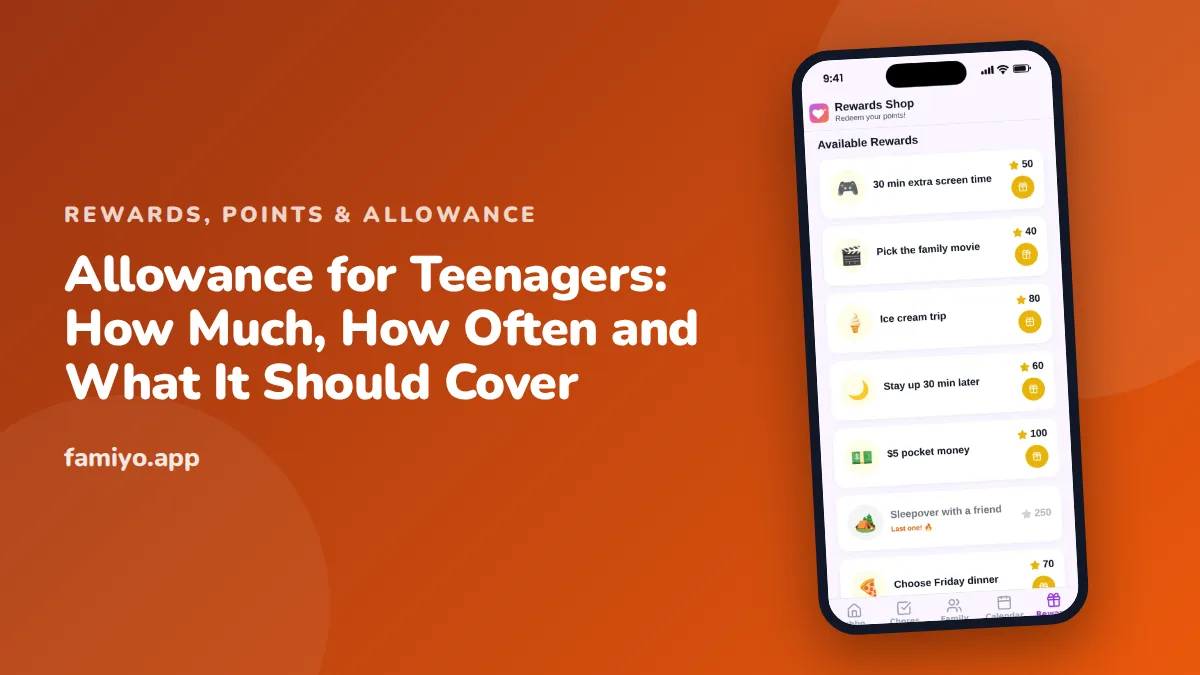
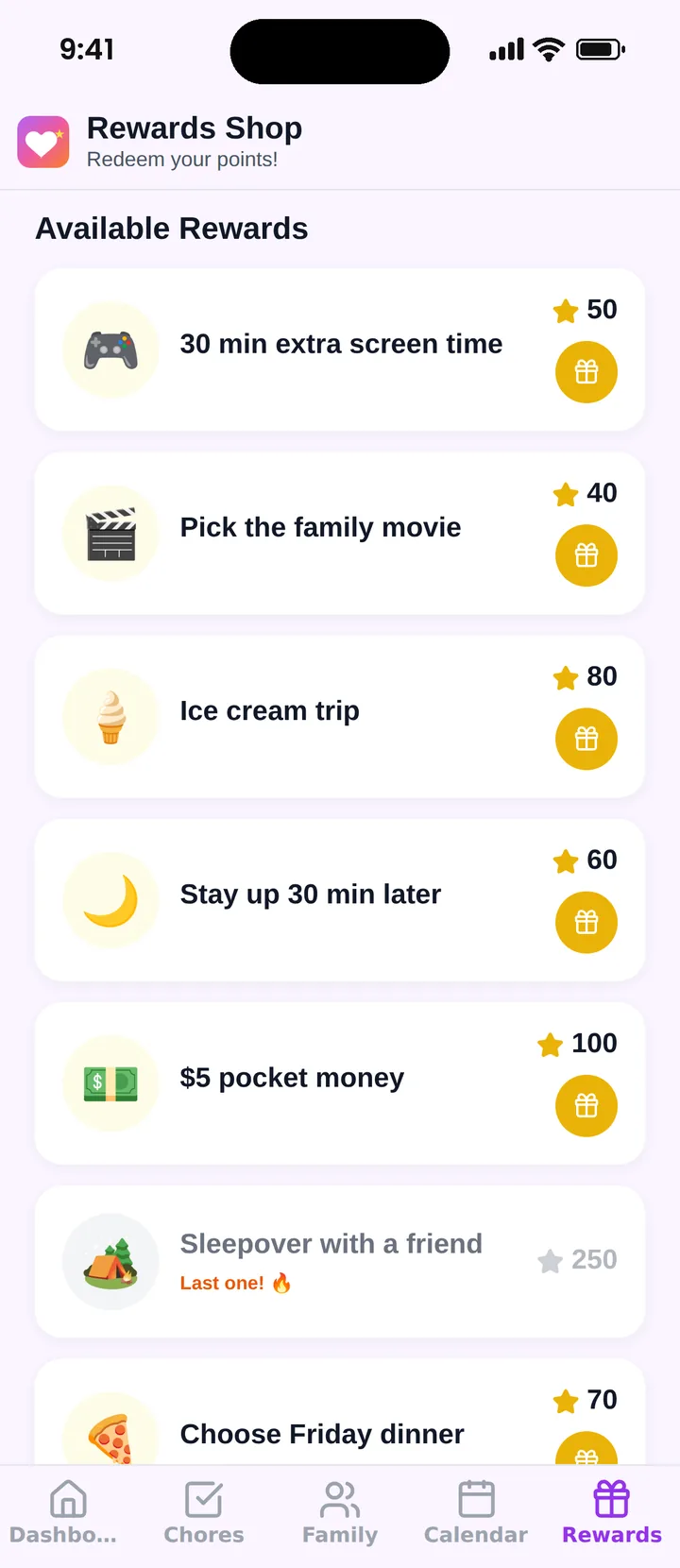
Famiyo is a free family app for iPhone and Android that combines a shared family calendar, chores with points and a rewards shop; kids join with a code, no email needed. It doesn't move money, so the base allowance stays with your bank transfer. Where it helps is the earned part. Your teen joins on their own phone with a 6-character code, extra jobs show up as chores worth points, and the rewards shop lists what those points buy. If you convert points to money at 100 points = $1, a "$5 cash" reward costs 500 points, and you hand over or transfer the money yourself. You get a notification whenever a reward is redeemed. Our list of the best allowance apps for kids compares other options.
Before the next payday, sit down with your teen for ten minutes and fill in the coverage table together. Agreeing on who pays for what solves more than picking the perfect amount.
Frequently asked questions
How much allowance should a 16-year-old get?
A common range is $15 to $25 a week, which works out to about $65 to $108 a month. The $1 per year of age rule puts a 16-year-old at $16 a week. Go toward the top of the range if the allowance also covers clothes, gas or a share of the phone bill, and lower if it's only fun money.
Should teenagers get a weekly or monthly allowance?
Weekly is easier for 13- and 14-year-olds, because a month is a long time to make money last. From around 15, paying every two weeks or monthly gives teens practice with something closer to a paycheck. Whatever you choose, pay on a fixed day, ideally with an automatic transfer.
Should a teenager's allowance depend on chores?
Keep everyday family chores, like cleaning their room or doing their own laundry, unpaid and expected. Many families pay the base allowance regardless and pay extra for bigger jobs beyond the normal list, at about $2 to $5 for a big one. That way the allowance teaches money skills and the extra jobs teach earning.
Should I stop giving allowance when my teen gets a job?
Not right away. A first job is often irregular, and cutting allowance the same week can make working feel pointless. A gentler approach is to keep the allowance but shift more costs onto the teen's earnings, such as gas or clothes, and reduce the allowance step by step over a few months.
Try Famiyo With Your Family
Chores with points, a rewards shop for kids and one shared family calendar. Set it up in a couple of minutes.



Free to download • No credit card required • Available on iOS & Android