Is a Reward System Good or Bad for Kids?
What the evidence says about reward systems for kids: when rewards help, when they backfire, a quick test for your own chart and how to design one that works.
By Famiyo Editorial Team6 min read
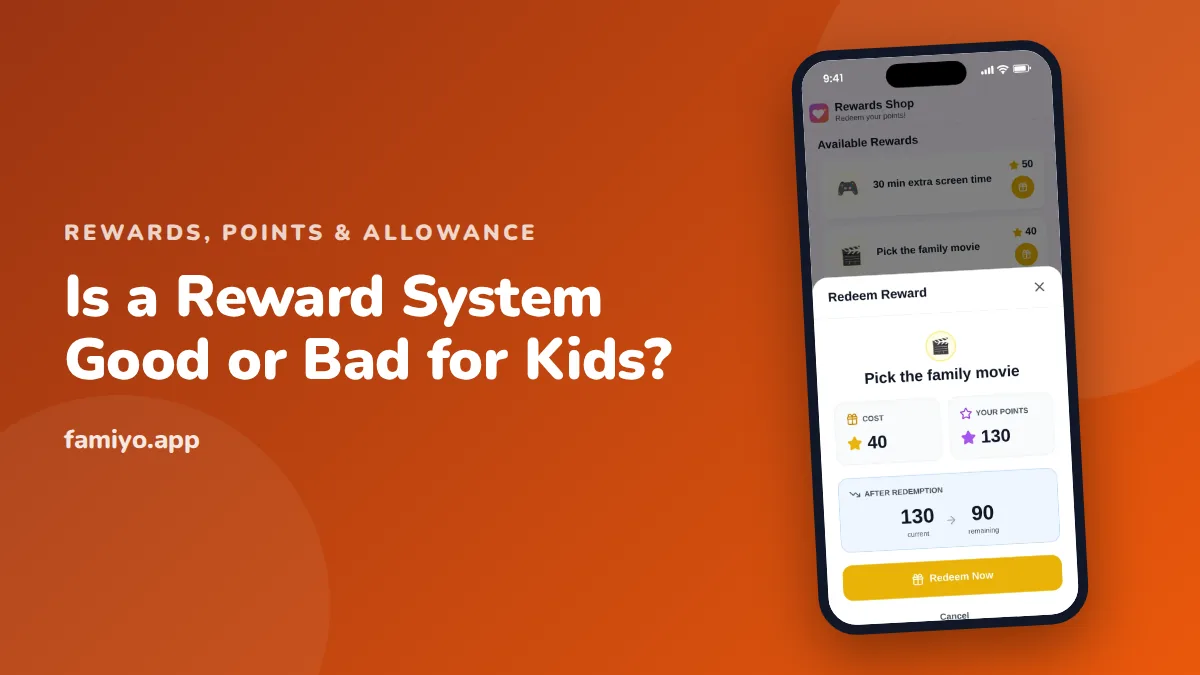
Few parenting tools split opinion like the reward chart. Some parents swear it ended the morning battles; others worry it teaches kids to ask "what do I get?" before lifting a finger. Both sides are describing something real. This page sorts out what the evidence actually supports, the situations where rewards help or hurt, and a short test you can run on your own system tonight.
What the evidence says about rewards
Two bodies of research seem to disagree, and most of the online argument comes from picking one and ignoring the other.
The first comes from behavioral psychology. Decades of work show that consistent positive reinforcement changes behavior, and it is the backbone of parent training programs. The American Academy of Pediatrics recommends parent training in behavior management as the first treatment for preschoolers with ADHD, and those programs use praise and small, planned rewards on purpose. The CDC's positive parenting guidance also encourages parents to notice and reward the behavior they want to see more of.
The second comes from motivation research. Studies on what psychologists call the overjustification effect found that when people receive an expected, tangible reward for an activity they already enjoy, they can become less interested in it once the reward stops. Self-determination theory, developed by Edward Deci and Richard Ryan, explains why: rewards that feel controlling chip away at a person's sense of choice, and choice is part of what makes an activity feel like your own.
These findings fit together better than they look. They mostly apply to different tasks. Rewards cause the most trouble when a child already likes the activity, the reward is expected and material, and it depends on doing the task. They cause very little trouble for tasks nobody finds interesting, like emptying the bathroom trash. And praise that gives information ("you remembered your lunchbox without a reminder") works differently from a prize. If you want the full picture on the motivation side, our guide to intrinsic motivation in kids covers the three needs behind it.
So the honest answer to "good or bad?" is: it depends on what you reward and how.
When a reward system helps, and when it doesn't
| Situation | Do rewards help? | Why |
|---|---|---|
| Building a new routine, like a morning checklist | Yes | The reward gets the habit started and can fade once it runs on its own |
| Dull chores, like unloading the dishwasher | Yes | There is no existing interest to undermine |
| A child who finds waiting or focus hard | Often, with small and frequent rewards | Immediate feedback is easier to connect to the behavior; check with your pediatrician if you have concerns |
| Activities the child already loves, like drawing or reading for fun | Usually not | This is where the overjustification effect shows up |
| Kindness, sharing, honesty | Praise, not prizes | Paying for honesty suggests it's a transaction |
| Practicing a skill, like piano | Early on, then fade | Reward time spent at first; as skill grows, the skill itself becomes the reward |
| Teenagers | Sometimes, if they help design it | Choice matters more at this age than the reward itself |
The pattern is simple enough to remember: reward the boring and the new, protect the things your child already loves.
How reward systems go wrong
Most systems that "stopped working" didn't fail because rewards are bad. They failed in one of a few predictable ways.
Rewarding what was already free. A child who loved helping you bake gets 10 points for it, and now baking is a job. Leave the things they volunteer for off the chart.
Price inflation. The movie pick cost 100 points in September. By November your child wants a toy for the same week of chores. Rising prices teach kids to negotiate rather than to do the task. Set prices once and change them rarely.
Mixing rewards and punishment. Taking away stars or points for misbehavior turns the reward chart into a threat chart. The child stops seeing it as something they're building and starts seeing it as something you can take. Handle misbehavior separately.
Goals that are too far away. If the first reward takes six weeks, a 6-year-old will give up in four days. A small reward should be reachable every 2 to 3 days and a big one every 3 to 4 weeks.
A price on everything. If every helpful act earns something, kids learn that helping is optional unless paid. Many families keep a few basics, like clearing their own plate, off the chart entirely.
Rewards replacing attention. A sticker is no substitute for a parent noticing. Rewards work best on top of warm attention, not instead of it.
A quick test for your own reward system
Answer these about the system you have now. Be honest; nobody is grading you.
- Does your child ask "what do I get?" for things they used to do without asking?
- Have you raised reward prices or added bigger rewards more than once in the last month?
- Have you used the chart as a threat ("I'll take your points") in the past week?
- Has your child stopped looking at the chart or caring about the points?
- Are any of the rewarded behaviors things your child already enjoyed?
- After 2 to 3 weeks of consistent use, has the target behavior actually changed?
If you answered yes to two or more of questions 1 to 5, or no to question 6, the system needs adjusting, not abandoning. Each yes points straight to one of the problems above.
How to design a reward system that stays on the good side
- Pick two to four specific behaviors, mostly dull or new ones: "dishes in the dishwasher after dinner," not "be helpful."
- Make the first reward reachable within 2 to 3 days, so the link between effort and payoff is obvious.
- Price rewards on a clear scale. A small one like 15 extra minutes of screen time or choosing dessert at 30 to 50 points, a medium one like picking the family movie at 100, a big one like a day out at 300 to 500. Our chore point system shows how to value each chore so this balances.
- Lean on experiences and privileges rather than things: staying up 30 minutes later, time alone with a parent, choosing Saturday's breakfast.
- Pair every reward with specific praise about what the child did. The praise carries the message; the reward marks the moment.
- Never subtract earned points. Deal with misbehavior on its own terms.
- Let kids help choose the rewards. That small bit of control is exactly what self-determination theory says protects motivation.
- Plan the fade. When a behavior has happened without reminders for a few weeks, take it off the chart and replace it with a new goal.
Saving up for a bigger reward also gives kids practice in waiting, which is a skill of its own. Our article on delayed gratification for kids explains how to stretch that wait as children grow.
Why it depends on the child
Age changes the design. Preschoolers need a reward they can see within a day or two and a chart with pictures. School-age kids can work toward weekly goals and enjoy counting points. Teens respond to choice and fairness far more than to prizes, so a reward system that they helped write will outlast one handed to them.
Temperament matters too. Some children find visible comparisons with siblings stressful, especially perfectionistic kids, so give each child their own chart rather than a shared leaderboard. Children with ADHD often do better with smaller, more frequent rewards and very short gaps between the behavior and the payoff. If behavior is a real worry, talk to your child's pediatrician or therapist, who can help tailor a plan to your child.
Running a reward system in Famiyo
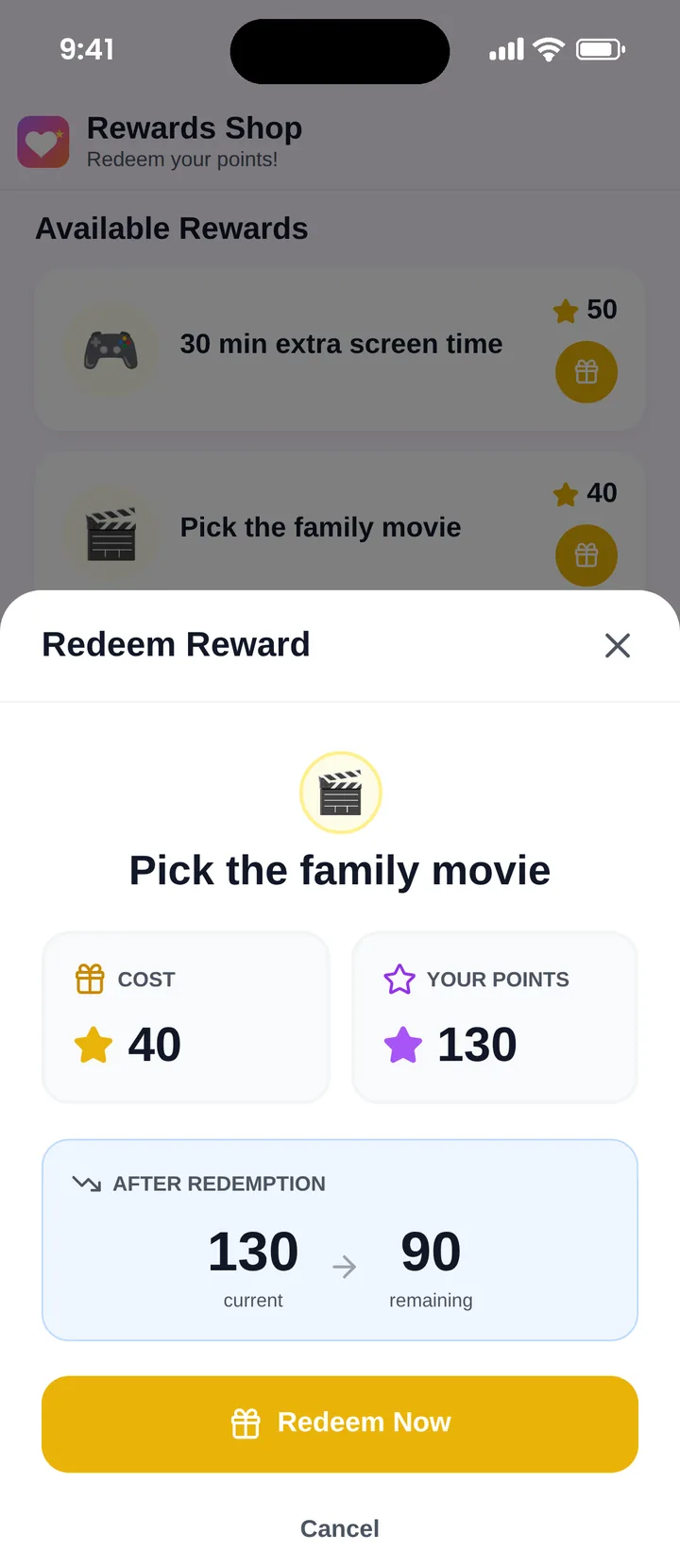
Famiyo is a free family app for iPhone and Android that combines a shared family calendar, chores with points and a rewards shop; kids join with a code, no email needed. Its rewards shop is built around the design rules above. You create each reward with a fixed price in points, decide how many are available and when, so "stay up 30 minutes later" can be limited to weekends and prices don't creep. Kids redeem from their own phone and see how many points they will have left, which turns the waiting into a decision they make. You get a notification when a reward is redeemed. For other ways to run a chart, see our list of the best reward chart apps for kids.
If you already have a chart, run the six-question test this week and fix the one problem that shows up most.
Frequently asked questions
Do reward charts damage intrinsic motivation?
They can, but mostly in one situation: when a child gets an expected, tangible reward for something they already enjoy doing. For dull tasks like unloading the dishwasher there is little interest to undermine. Keep rewards for chores and new routines, and leave hobbies the child loves off the chart.
At what age do reward systems stop working?
There is no cutoff age, but the design has to change. Preschoolers need small rewards within a day or two, school-age kids can work toward weekly goals, and teenagers respond best when they help choose the rewards and the rules. A system that feels imposed loses teens quickly.
Is it bribery to reward kids for chores?
Not when the deal is set in advance. A bribe is offered in the moment to stop a behavior, like candy to end a meltdown at the store. A reward system names the behavior and the reward ahead of time, so the child is choosing to earn something, not being paid to stop.
How long should we use a reward system?
Give a new system 2 to 3 weeks of consistent use before judging it. Once a behavior happens without reminders for a few weeks, take it off the chart and replace it with a new goal, or let rewards come less often. Most systems should change every couple of months.
Try Famiyo With Your Family
Chores with points, a rewards shop for kids and one shared family calendar. Set it up in a couple of minutes.



Free to download • No credit card required • Available on iOS & Android