Chore Allowance: How to Set Up a Fair System
How to link allowance and chores fairly: pick a model, split unpaid family jobs from paid extras, set a payday and handle missed chores without fights.
By Famiyo Editorial Team6 min read
Your 9-year-old is standing at the dishwasher asking, "If I empty it, do I get a dollar?" That question is the moment most families realize they need an actual chore allowance system instead of improvising one deal at a time. This page walks through the three models, a sample chart with real amounts, the rules that stop payday fights, and how to handle the money when your kid has never touched a paper bill.
Three ways to connect chores and allowance
Every chore allowance system is a version of one of these. The differences matter more than the dollar amounts.
| Model | How it works | Works well when | Watch out for |
|---|---|---|---|
| Allowance only | A fixed weekly amount, no link to chores. Chores are expected because you live here. | You mainly want to teach budgeting and saving | Kids may not see any link between effort and money |
| Pay per chore | Every chore has a price. No work, no money. | You have a teen who wants to earn and you have plenty of paid work | Kids skip chores in weeks they don't need cash, and "what do I get?" follows every request |
| Base plus paid extras | A fixed base allowance, unpaid family chores, and a menu of extra jobs with prices | Most families with kids 6 and up | You need a clear line between family chores and paid extras |
The hybrid model in the last row is the one we'd start with. The base allowance gives your child a steady amount to practice with, the unpaid chores make it clear that everyone helps run the house, and the paid extras answer the dishwasher question with a fair yes.
For the base amount itself, a common rule of thumb is $1 per week for each year of age, so a 10-year-old gets about $10. Treat that as a starting point, not a standard. Our guide to how much allowance kids get by age covers the typical ranges and what the money should cover at each stage.
Which chores get paid and which don't
This is where most systems fall apart, so decide it before you announce anything. A simple test works for nearly every job: if the chore cleans up the child's own stuff or keeps the household running day to day, it's a family chore and it's unpaid. If it's a job you'd otherwise do yourself on a weekend or pay someone else to do, it can be a paid extra.
Unpaid family chores usually include making their bed, clearing their own plate, putting laundry in the hamper, tidying their room, feeding a pet and packing their school bag.
Paid extras are bigger, less frequent and a little less fun. Washing the car, raking a section of the yard, wiping down the kitchen cabinet fronts, scrubbing the patio furniture or clearing out a closet shelf all qualify. Use the common rates of $0.25 to $1 for a small extra job and $2 to $5 for a big one, and write the price next to each job before anyone starts. Teens can take on larger paid work; chores for teenagers to earn money has fair rates for those jobs.
One more rule: paid extras are only open once the family chores for the day are done. Otherwise a kid will happily wash the car for $3 while their room still looks like a crime scene.
A sample chore allowance chart for an 8-year-old
Here's what a complete chart looks like for an 8-year-old on the hybrid model. The base is $8 a week, split into spend, save and give at 50%, 40% and 10%.
| Part of the system | What's on it | Money |
|---|---|---|
| Base allowance | Paid every Sunday, no strings | $8 ($4 spend, $3.20 save, $0.80 give) |
| Daily family chores (unpaid) | Make bed, feed the cat, clear own plate, put clothes in the hamper | $0 |
| Weekly family chore (unpaid) | Load the dishwasher after Saturday dinner | $0 |
| Small paid extra | Sort the recycling into the right bins | $0.50 |
| Small paid extra | Wipe the kitchen chairs and table legs | $1 |
| Big paid extra | Vacuum the car seats and floor mats | $2 |
| Big paid extra | Pull weeds from one garden bed with a parent | $3 |
| Weekly cap on extras | Keeps it from becoming a part-time job | $5 |
The cap is optional, but it helps. Without it, a motivated kid can turn Saturday into a bidding war, and you end up paying $14 for jobs nobody really needed done.
If dollar amounts feel too blunt for a younger child, points work the same way. At 100 points to $1, a $2 job becomes 200 points, and the conversion happens on payday. Our chore point system explains how many points to give each size of task.
The rules that prevent payday fights
Kids are excellent lawyers. Write the rules down while everyone is calm, read them together once, and stick them next to the chart.
- The base allowance is paid every week, even in a messy week. It's not docked for family chores.
- Family chores happen before screens, friends or paid extras. That's the consequence, not the money.
- A paid extra counts when it's finished to the standard you showed them. If it's half done, it gets redone before it's paid.
- Payday is fixed. Pick one day and time, like Sunday after dinner, and don't move it.
- No advances. If they want something that costs more than they have, they save for it.
- A child can turn down paid extras in a week. They can't turn down family chores.
- The base amount goes up once a year, on their birthday, not after a good argument.
Rule 5 is the hard one for parents. Saying no to an advance on a Tuesday feels mean, but waiting three weeks for something they really want teaches more than any lecture about saving. Delayed gratification for kids explains why that wait is worth protecting.
Cash, cards or a ledger: payday when nobody carries cash
Plenty of parents rarely carry bills anymore, which makes a weekly $8 surprisingly awkward. You have three practical options.
Cash in jars still works best for kids under about 8. They need to see and hold money to understand it. Three jars labeled spend, save and give make the split visible, and counting the save jar every few weeks is a small thrill.
A ledger, sometimes called the bank of mom and dad, suits kids from about 8 to 12. You hold the money and keep a running balance, on paper or in a spreadsheet. When they want to buy something, you pay and subtract it. The risk is that the balance feels like pretend money, so check it together on payday and let them make real purchases from it.
A kids' bank account or debit card makes sense for many teens, especially once they shop online. You transfer the allowance on payday and they manage it from there. The skills they practiced with jars and ledgers carry straight over.
Whichever you choose, keep the tracking of chores separate from where the money lives. The chart decides how much they earned. The jar, ledger or account is just where it lands.
Running a chore allowance with Famiyo
Famiyo is a free family app for iPhone and Android that combines a shared family calendar, chores with points and a rewards shop; kids join with a code, no email needed. For a chore allowance, the paid extras become chores with points: vacuuming the car worth 200 points, sorting recycling worth 50. Your child checks them off on their own phone, or you approve them first, and you get a notification when a job is done.
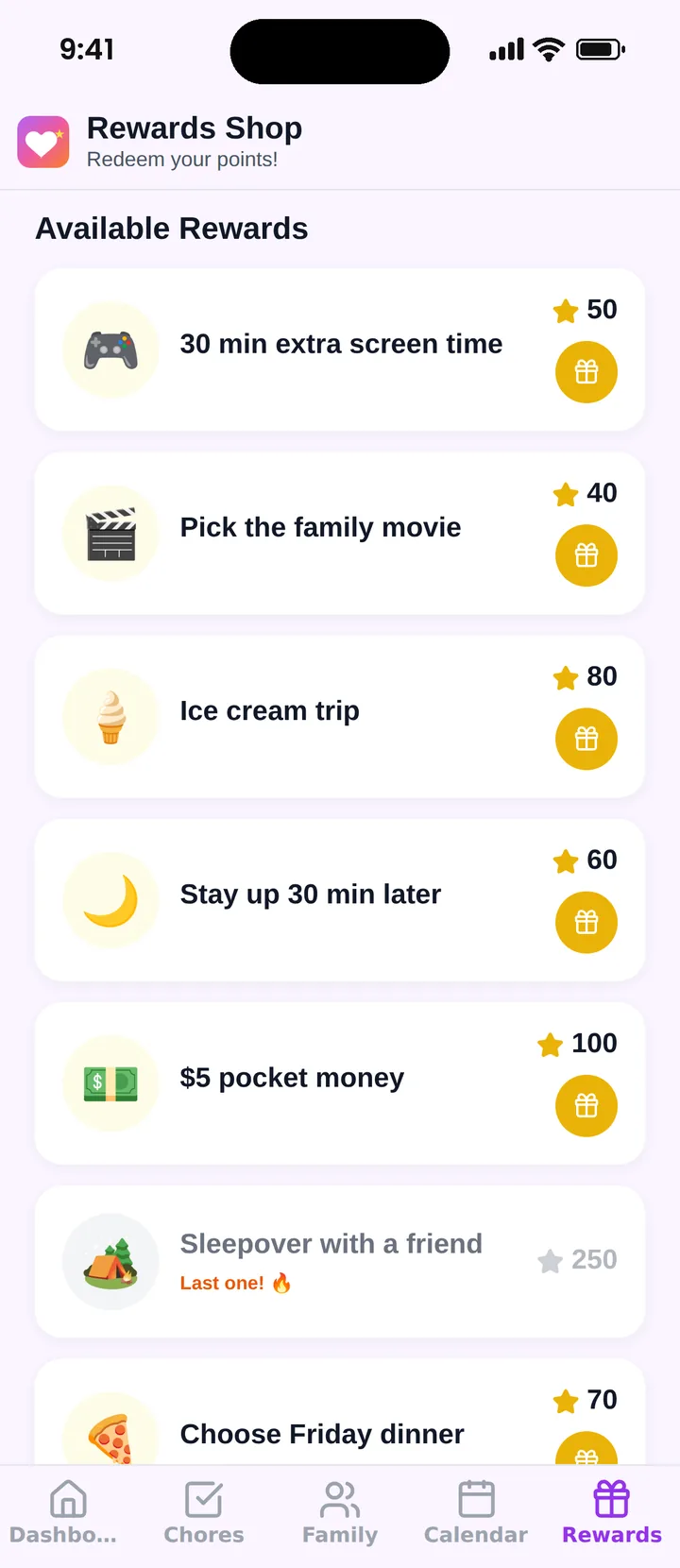
In the rewards shop you add a reward like "$5 pocket money" priced at 500 points, alongside non-money rewards. When your child redeems it, they see how many points they have left, and you hand over the cash or make the transfer yourself, since the app doesn't move real money. For other options, see our list of the best allowance apps for kids.
Start this Sunday: write the base amount, four family chores and three priced extras on one page, and run it unchanged for three weeks before you adjust anything.
Frequently asked questions
Should allowance be tied to chores?
Partly. Many families pay a base allowance so kids can practice managing money, keep everyday family chores unpaid, and pay extra for bigger jobs. Tying every dollar to chores turns each request into a negotiation, and a child who doesn't need money that week can simply opt out of helping.
How much chore allowance should an 8-year-old get?
A common rule of thumb is $1 per week for each year of age, so about $8 a week for an 8-year-old. Typical ranges for ages 8 to 10 run from $7 to $10. Paid extras at $0.25 to $1 for small jobs and $2 to $5 for big ones let them earn more.
Should I take allowance away when chores aren't done?
Try not to dock the base allowance for everyday family chores, because it mixes money lessons with discipline. Instead, family chores come before screens or plans, and a paid extra that isn't finished simply isn't paid. Rules written down in advance prevent most payday arguments.
What goes on a chore allowance chart?
Four things: the weekly base amount, the unpaid family jobs, the paid extras with their prices, and the payday. Kids mark paid jobs as they finish them and you add up the week on payday. If you use points instead of dollars, 100 points equal $1.
Try Famiyo With Your Family
Chores with points, a rewards shop for kids and one shared family calendar. Set it up in a couple of minutes.



Free to download • No credit card required • Available on iOS & Android