Delayed Gratification for Kids: Why It Matters and How to Build It
What delayed gratification is, what the marshmallow test really showed, realistic waits by age, everyday examples for kids and how to practice it at home.
By Famiyo Editorial Team6 min read
Your 6-year-old spends their points the moment they have enough for the smallest reward, every single time. Your 12-year-old blows birthday money in one afternoon and then asks to borrow from you. Both are about delayed gratification, and both are normal places to start. This guide explains what the skill is, what the research actually says, how long kids can realistically wait at each age, and how to practice it at home without turning life into a test.
What delayed gratification means for a child
Delayed gratification is choosing a bigger or better reward later over a smaller one right now. Two cookies after dinner instead of one now. A $20 toy next month instead of three cheap ones this week.
It looks like one skill but it's really several working together. The child has to want the later reward more, hold the goal in mind, put up with the uncomfortable feeling of waiting, find something else to think about, and trust that the later reward will actually show up. Each of those parts develops at its own pace, and each can be supported.
The brain areas most involved in planning and self-control keep developing through childhood and the teen years. So when a 4-year-old can't last five minutes, that's mostly age talking.
What the marshmallow test did and didn't show
The famous experiments were run by psychologist Walter Mischel and colleagues at Stanford. Preschoolers were offered one treat now, or two if they could wait alone in a room until the researcher came back. Follow-up work linked longer waiting in preschool to better outcomes years later, and the story spread everywhere.
Two later findings changed how researchers read it. First, larger replications with more varied groups of children found the link between preschool waiting and later outcomes was much weaker once family background and early skills were taken into account. Second, researchers at the University of Rochester showed that children waited much less when the adult had broken a small promise just before the test. For those kids, eating the treat now was a reasonable bet, because adults hadn't proven trustworthy.
Mischel's own work also showed something useful: children who distracted themselves (covering their eyes, singing, playing with their feet) or who turned the treat into something less tempting in their imagination waited longer. Those are strategies, and strategies can be taught.
So the practical reading is this. Waiting is partly temperament, partly age, partly environment and partly learned technique. Parents have real influence over the last three.
Why it matters in everyday family life
You'll see delayed gratification, or the lack of it, all over a normal week. Homework before games. Saving allowance instead of spending it at the first store. Practicing piano for a recital that's a month away. Waiting for a turn in a board game without grabbing.
Kids who get some practice with these small waits tend to find bigger ones easier, because they've learned that the wait is survivable and the reward does come. That's the realistic goal here: a child who still wants things now, but can choose to wait when the later option is better.
How long can kids wait? Realistic expectations by age
These are rough guides, and children vary a lot. The reward examples use a simple points scale where small rewards cost 30 to 50 points, medium ones 100 and big ones 300 to 500.
| Age | Realistic wait | Everyday example | What helps |
|---|---|---|---|
| 2-3 | Seconds to a minute or two | Waiting for a turn on the slide | Count out loud, give them something to hold |
| 4-5 | A few minutes, or until a routine step is done | Dessert after dinner, tablet after the timer | Visual timer, "first dinner, then dessert" |
| 6-7 | A day or two | Saving points for a small reward every 2 to 3 days | A chart or jar they can see filling up |
| 8-10 | About a week or two | Saving 100 points to pick the family movie | Show the balance, plan the date together |
| 11-13 | 3 to 4 weeks | Saving for a day out or a toy around $20 | Let them choose the goal and track it |
| 14+ | Several months | Saving allowance or earnings for a phone upgrade or concert ticket | A budget and a savings target |
If your child is far from their age row, start at the row where they can succeed and move up from there. Success at a short wait is what makes the next, longer wait possible.
Delayed gratification examples for kids
Here are everyday ways kids practice the skill, roughly from youngest to oldest:
- Waiting until you finish your sentence before talking.
- Leaving the cookie on the counter until after lunch.
- Planting seeds and waiting weeks for something to eat.
- Building a big LEGO set over several evenings instead of rushing it.
- Doing homework before switching on a game.
- Saving points for a medium reward instead of redeeming the cheapest one.
- Putting birthday money in savings and buying one bigger thing later.
- Practicing a sport or instrument for a game or recital weeks away.
- Saving allowance for a month to buy something they chose themselves.
How to teach delayed gratification at home
- Keep your small promises. The Rochester finding is the most useful one for parents. If you say "after dinner," make it after dinner. Children who can trust the wait are far more willing to try it.
- Start short and stretch. A wait your child can win is worth more than an ambitious one they fail. Add time slowly.
- Make the wait visible. A jar of marbles, a sticker chart or a points balance shows progress during the boring middle part.
- Teach waiting tricks. "Put it where you can't see it." "Let's sing while the timer runs." "Tell yourself: I'm waiting for the big one."
- Offer real choices and let the consequences land. "You can spend 30 points now on extra screen time, or keep saving for the movie pick on Friday." If they spend, don't rescue them on Friday.
- Name it when they do it. "You waited three days and now you get to choose the movie. That was hard, and you did it."
- Show them your own waiting. "I'd love new shoes, but I'm putting that money toward our trip."
What to avoid: turning waiting into a test they can fail in front of siblings, or setting a goal so far away that it feels impossible. Both teach a child that waiting doesn't pay.
Rewards, points and allowance as practice
A reward system is one of the easiest places to practice, because every redemption is a small decision between now and later. Price rewards so that a small one is reachable every 2 to 3 days and a big one every 3 to 4 weeks. Too many cheap rewards and there's nothing to save for. Only expensive ones and your child gives up. Our guide to kids reward charts covers how to set one up.
Money works the same way for older kids. Allowance gives them real choices with real trade-offs, and our article on how much allowance by age has starting amounts. For teens, a bigger allowance that covers more of their own spending turns saving into a monthly habit, which we cover in allowance for teenagers.
When a child really struggles to wait
Some kids find waiting much harder than their peers do, including many children with ADHD. For them, shorten the waits, make rewards smaller and more frequent, and make progress very easy to see. That's an adjustment, not lowering the bar. If impulsive behavior causes real problems at school, with friends or with safety, talk to your child's pediatrician.
Practicing the wait in Famiyo
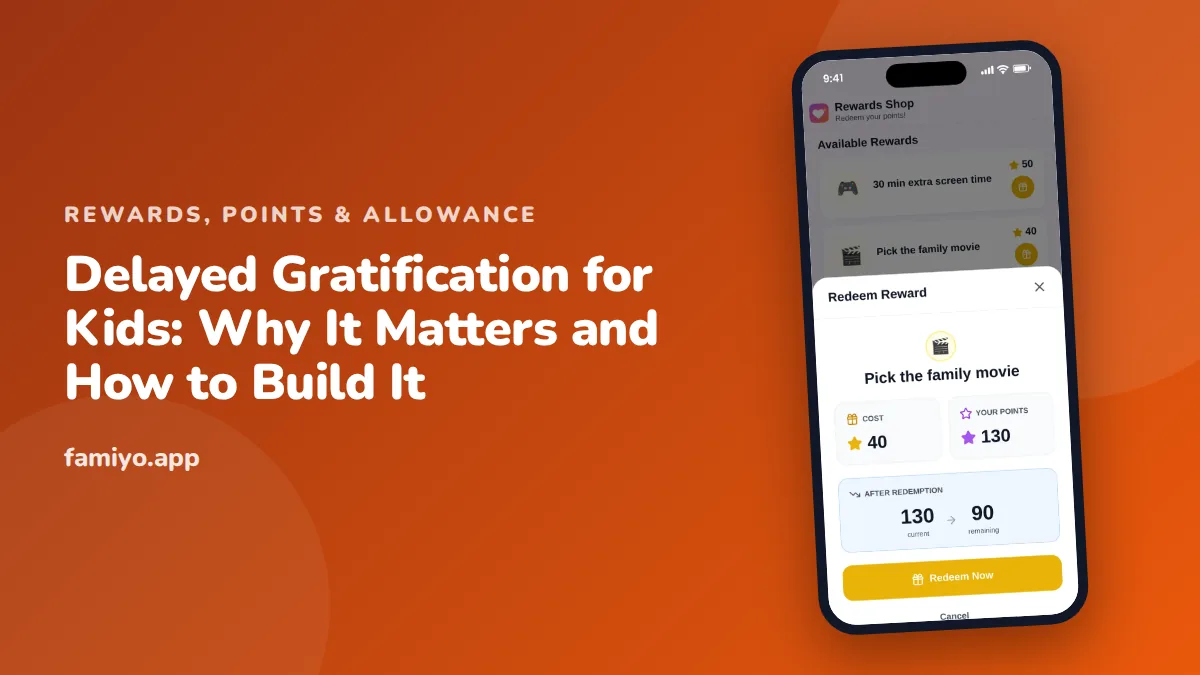
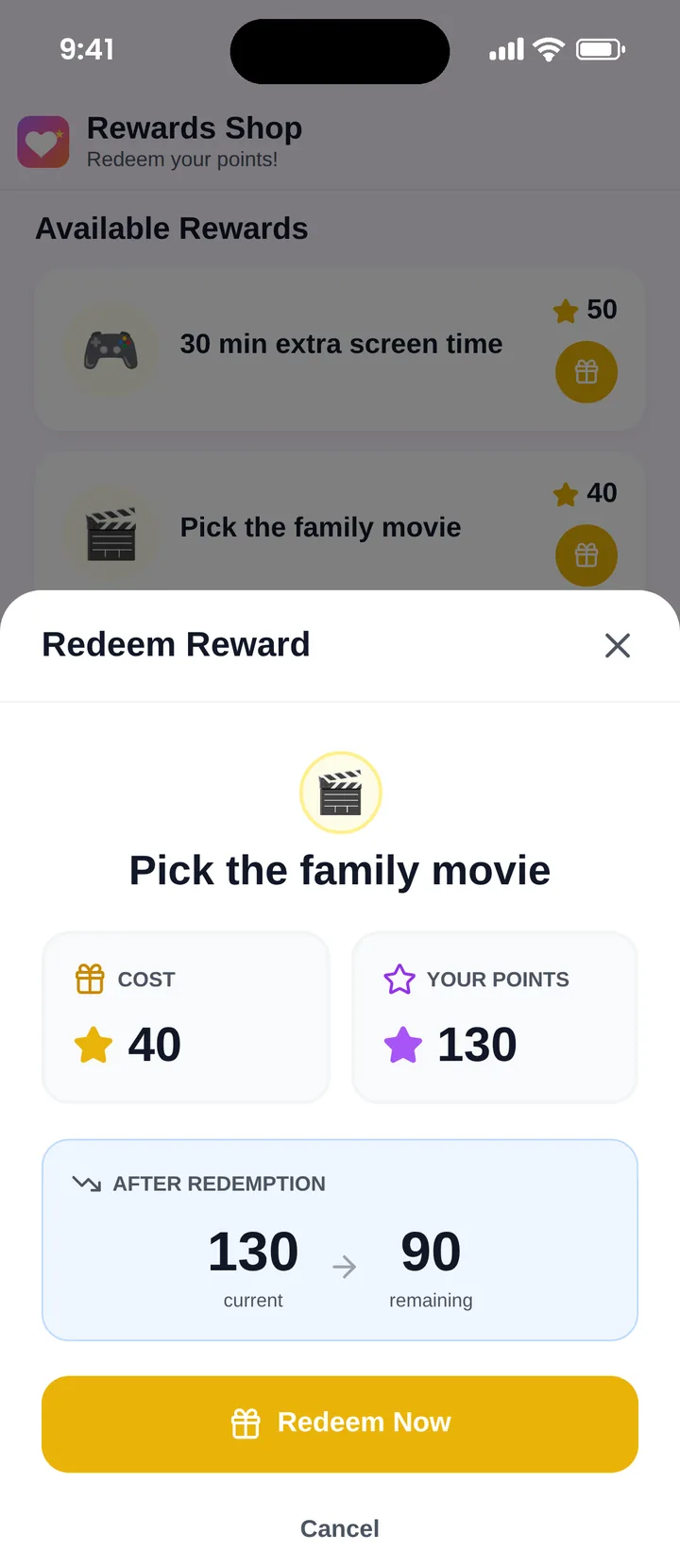
Famiyo is a free family app for iPhone and Android that combines a shared family calendar, chores with points and a rewards shop; kids join with a code, no email needed. Kids earn points for chores, and each reward in the rewards shop has a price in points, a number available and dates when it can be redeemed. That makes saving concrete: a family movie pick that's only available on Friday, or a day out with only one in stock this month. When your child goes to redeem from their own phone, they see the cost and how many points they'll have left, which is the exact moment to choose now or later. Our list of the best reward chart apps for kids compares other options.
This week, add one reward that's worth waiting for, priced a little beyond what your child usually spends, and see whether they save for it.
Frequently asked questions
At what age do kids learn delayed gratification?
It develops gradually. Toddlers can wait seconds, most preschoolers can wait a few minutes with help, school-age kids can save toward something over days or a couple of weeks, and teens can plan over months. The brain systems behind self-control keep maturing well into the teen years, so expect steady growth, not a switch.
Is the marshmallow test still considered valid?
The original Stanford studies were real and influential, but later and larger replications found that the link between waiting as a preschooler and later success was much weaker once family background was taken into account. Other research showed children wait less when adults have been unreliable. Waiting is a skill shaped by the environment, not a fixed trait.
What are good examples of delayed gratification for kids?
Saving birthday money for a bigger toy, doing homework before screen time, saving points for a medium reward instead of the cheapest one, growing vegetables from seed, building a big model over several days and practicing for a performance that's weeks away. Each one trades something small now for something better later.
How can I help a child who can't wait for anything?
Start with waits they can win, such as one minute with a visual timer, and stretch slowly. Make progress visible, keep the reward out of sight and give them something to do while they wait. If impulsive behavior causes real trouble at school or with safety, talk to your child's pediatrician.
Try Famiyo With Your Family
Chores with points, a rewards shop for kids and one shared family calendar. Set it up in a couple of minutes.



Free to download • No credit card required • Available on iOS & Android