Paid Chores for 10-Year-Olds: Jobs to Earn Money and What to Pay
Paid chores for 10-year-olds: which jobs to pay for, which to keep free, and a fair rate for each, from $0.25 for small tasks to $5 for big ones.
By Famiyo Editorial Team5 min read
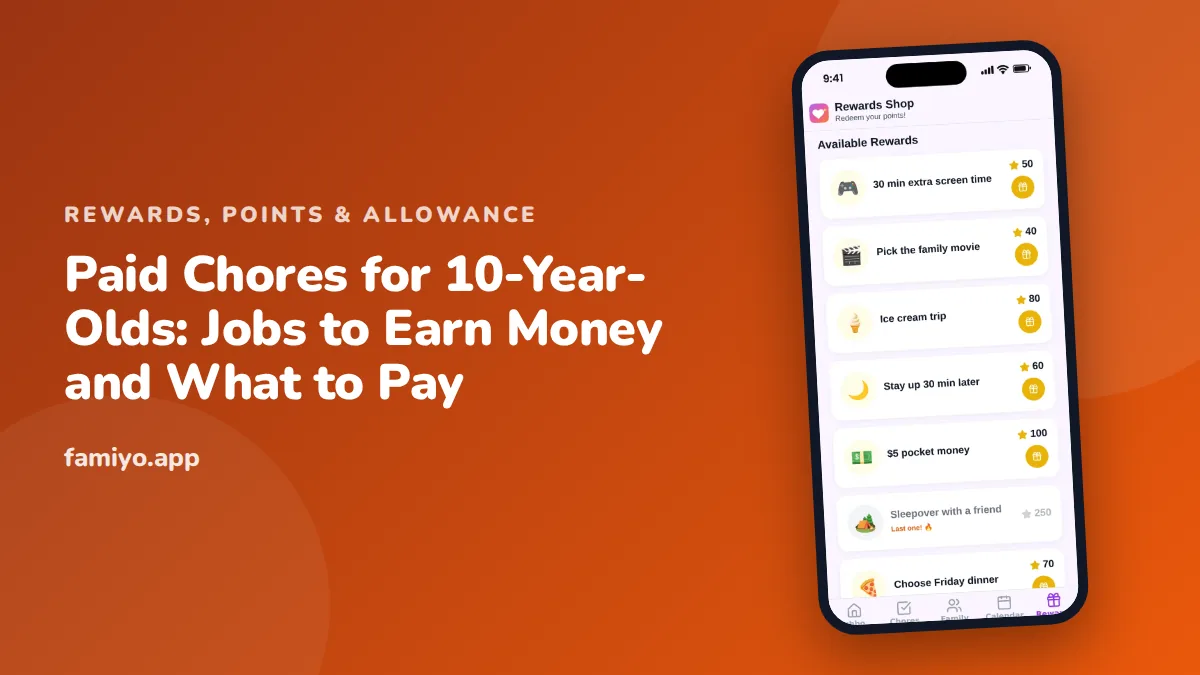
Ten is a good age to start earning. Your child is old enough to do real jobs for 30 minutes at a time, understands that a dollar buys something specific, and usually has a growing list of things they want. This guide lists the jobs worth paying for, what each should pay, how to run payday, and how to keep the system from turning every request into a negotiation.
Pay for extras, not for the basics
The simplest rule that holds up: some chores are the cost of belonging to the family, and others are optional work you'd otherwise do yourself or hire out. Pay only for the second kind.
Unpaid chores for a 10-year-old are the daily and weekly baseline. They match what children this age can manage, about 30 minutes a day, from the standard age guidance.
| Unpaid (family chores) | Paid (extra jobs) |
|---|---|
| Make the bed | Wash the car |
| Clear and rinse their own dishes | Clean the bathroom sink and toilet |
| Tidy their room | Change all the bed sheets in the house |
| Put laundry in the hamper | Vacuum the whole downstairs |
| Feed the family pet | Cook a simple family meal with you nearby |
| Pack the school bag | Rake leaves or pull weeds in a section of the yard |
If you pay for everything, your child learns that nothing is done without a price. If you pay for nothing, a 10-year-old who wants money has no route to it. The split is what keeps both lessons alive. Our article on how much to pay kids for chores goes deeper on the pay scale itself.
Paid jobs for a 10-year-old and what to pay
Prices below use the common range of $0.25 to $1 for a small extra job and $2 to $5 for a big one. Treat them as starting points and adjust for your area and your child's effort.
| Job | Time | Pay | Notes |
|---|---|---|---|
| Sort the recycling | 5 minutes | $0.25 to $0.50 | Fits the daily rhythm |
| Take out all the trash cans | 10 minutes | $0.50 | Weekly |
| Empty the dishwasher and wipe the counter | 10 minutes | $0.50 to $1 | Counts as extra if it's not already their job |
| Fold a full load of family laundry | 15 minutes | $1 | Put it away in each room |
| Change the sheets on all beds | 20 minutes | $1 to $2 | Needs a quick show of how |
| Vacuum the whole downstairs | 25 minutes | $2 | Check corners and under chairs |
| Clean the bathroom sink and toilet | 30 minutes | $2 to $3 | Gloves, and walk through the steps first |
| Wash the car inside and out | 30 to 40 minutes | $3 to $5 | Agree on "done" before starting |
| Clean out the fridge shelves | 30 minutes | $2 to $3 | Toss with an adult |
| Rake or weed one section of the yard | 30 minutes | $2 to $4 | Show the section's edges |
Quality counts. Agree on what "done" looks like before the job starts, and walk through it together afterward. Pay in full for done, nothing for half done, and give the chance to fix it before payday.
A sample week of earnings
Say your 10-year-old does their unpaid chores as usual and picks three extras. It might look like this.
- Wednesday: vacuums the downstairs, $2.
- Saturday: washes the car, $3.
- Sunday: sorts the recycling and takes out the cans, $1.
That's $6 in a week from extras. If they also get a weekly allowance in the typical $7 to $10 range, the paid jobs are the way to reach bigger goals sooner. A child who wants a $24 game can see it's four weeks of extras, and that's real information.
If you suggest a split like 50% spend, 40% save and 10% give, $6 becomes $3 to spend, $2.40 to save and $0.60 to give. Our guide to kids saving money covers how to keep the savings part from getting spent. You may also want to look at paid chores for 11-year-olds to see how the jobs and pay grow in a year.
Making money visible when it's mostly digital
A lot of what a 10-year-old will handle as money is already numbers on a screen. That can make saving feel abstract. A few ways to keep it real:
- Pay at least part in cash, so they can hold it and count it.
- Keep a running balance in a shared note or on paper with the date, the job and the amount, and let your child do the adding.
- If you use a kids' bank account, show the balance on payday and talk about what they'd like to do with it.
- Set one goal with a number, such as a $24 game, and track progress toward it together.
Whatever you choose, pay on the same day every week. Inconsistent payment is the quickest way to make a 10-year-old stop trusting the system.
Jobs outside your own house
Many 10-year-olds are ready for a first taste of work for someone else, as long as an adult stays in the loop. Watering a neighbor's plants while they're away, bringing in their mail, or helping a grandparent rake leaves are all reasonable. Agree on the pay with the neighbor first, keep it to a few minutes a day and stay nearby for anything involving tools or the street. Ten is too young to work alone for strangers, but it's a good age to learn what it feels like to be reliable for someone who's counting on you.
How to set it up without constant negotiating
- Write the unpaid list and the paid list, and post both where your child can see them.
- Let your child pick which paid jobs they want, so the choice is theirs.
- Agree on "done" for each job in a sentence. "The whole floor, under the table too."
- Settle the rule on timing: "Tell me before you start, so I know it's a paid job."
- Pay on payday. Don't pay for jobs you didn't know about or that weren't finished.
A line you can use when your child asks for money for something on the unpaid list: "That one's part of living here, and it comes with no payment. The car wash is a paid job if you want it."
If your 10-year-old resists chores in general, our article on earning screen time with chores offers a different currency. Some children care more about that than cash.
Paying with points in Famiyo
Famiyo is a free family app for iPhone and Android that combines a shared family calendar, chores with points and a rewards shop; kids join with a code, no email needed. For paid chores, give each extra job a number of points and let your child exchange the points in the rewards shop, where you add rewards at the prices you set. If you use the common conversion of 100 points to $1, a $2 job is 200 points.
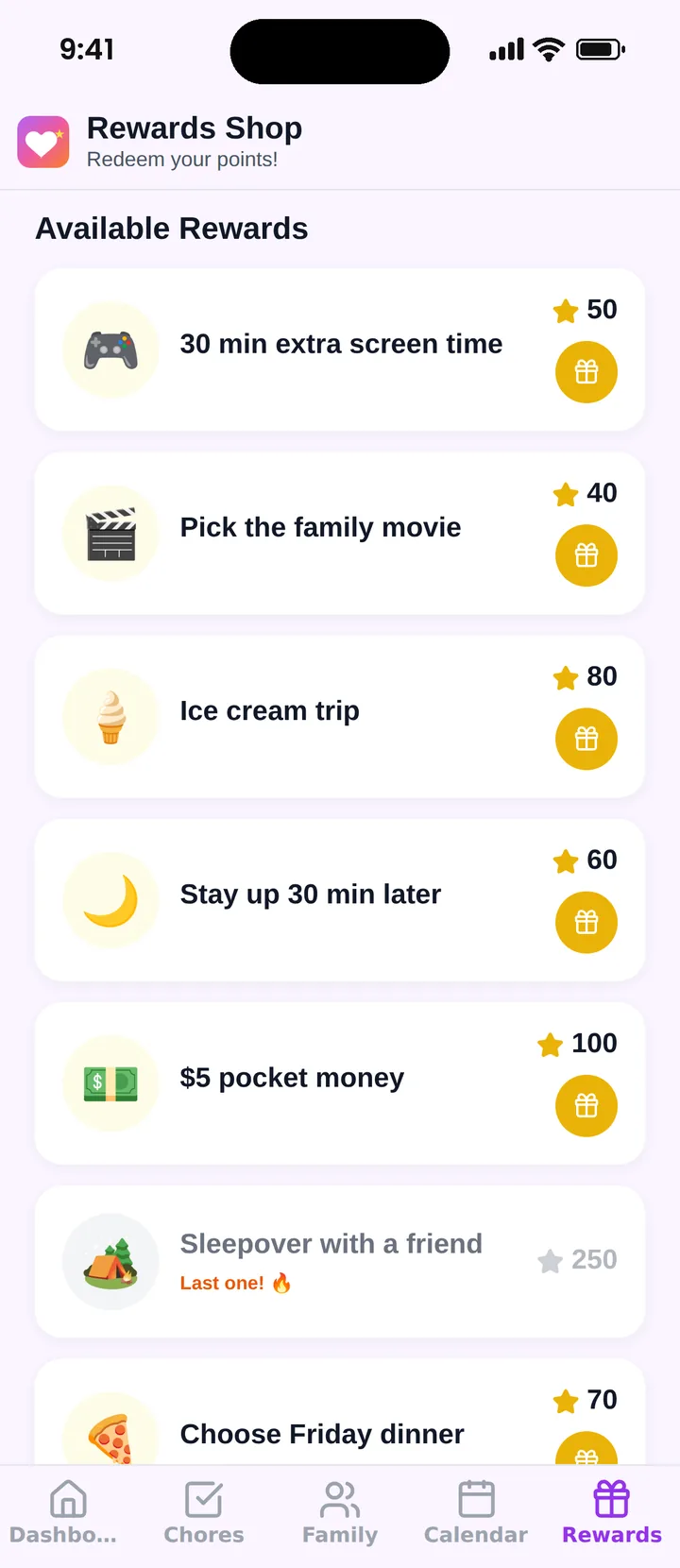
Pocket money can be one of those rewards, but the money itself changes hands outside the app. Parents are notified when a reward is redeemed, which is your cue to pay. You'll find more options in our list of the best allowance apps for kids.
Where to start
Choose two paid jobs from the table this weekend, agree on "done" with your child, and pay on Sunday. After a couple of weeks you'll see which jobs they take on willingly and can adjust the list and the prices.
Frequently asked questions
How much should a 10-year-old earn for chores?
For paid extras, $0.25 to $1 for small jobs and $2 to $5 for big ones is a common range. Many 10-year-olds end up earning a few dollars a week on top of any allowance. Typical allowance for ages 8 to 10 runs $7 to $10 a week.
Which chores should stay unpaid at 10?
Anything a family member does just by living in the house: making the bed, clearing their place, tidying their room, feeding the family pet, putting laundry in the hamper. Paid chores are the extras that go beyond that baseline, such as washing the car or deep-cleaning a bathroom.
Should I pay in cash or digital money?
Either works if it's visible. Cash in a jar makes the amount feel real, while a shared note or a bank's kids account teaches a digital habit. What matters is paying on the same day each week and letting your child see the total grow.
What if my 10-year-old says they don't need money?
That's fine, but the chores still happen. Unpaid chores are part of the family deal, and paid extras are optional. If money doesn't motivate them, offer a different reward they care about, such as a day out or extra time with a friend.
Try Famiyo With Your Family
Chores with points, a rewards shop for kids and one shared family calendar. Set it up in a couple of minutes.



Free to download • No credit card required • Available on iOS & Android